Starbucks goals for sustainability will require significant consumer buy-in

Advertisement

Advertise with us

Starbucks has an ambitious plan to reduce its environmental footprint, albeit one it acknowledges will require considerable buy-in from its customers.

Read this article for free:


or

Already have an account? Log in here »

To continue reading, please subscribe:

Subscribe and receive a limited-edition Free Press branded hat or tote.

Digital Subscription

One year of digital access for only $205*

  • Enjoy unlimited reading on winnipegfreepress.com
  • Read the E-Edition, our digital replica newspaper
  • Access News Break, our award-winning app
  • Play interactive puzzles

*First annual payment billed as $205.00 + GST for one year. This annual subscription will automatically renew at $233.00 + GST every 52 weeks (10% off the regular annual price of $259.35). Offer available to new and qualified returning subscribers only. Cancel any time.

To continue reading, please subscribe:

Add Free Press access to your Brandon Sun subscription for only an additional

$1 for the first 4 weeks*

  • Enjoy unlimited reading on winnipegfreepress.com
  • Read the E-Edition, our digital replica newspaper
  • Access News Break, our award-winning app
  • Play interactive puzzles
Start now

*Your next Brandon Sun subscription payment will increase by $1.00 and you will be charged $17.95 plus GST for four weeks. After four weeks, your payment will increase to $24.95 plus GST every four weeks.

Hey there, time traveller!
This article was published 22/01/2020 (2443 days ago), so information in it may no longer be current.

Starbucks has an ambitious plan to reduce its environmental footprint, albeit one it acknowledges will require considerable buy-in from its customers.

The Seattle-based coffee chain committed to three preliminary targets for 2030, including cutting by half its carbon emissions from direct operations and its supply chain, the waste it sends to landfills and water used in direct operations and coffee production.

Corporate environmental commitments such as these often require consumers to change their behaviours, experts say, which is possible with the right incentives, but need to steer clear of the appearance of self-interest.
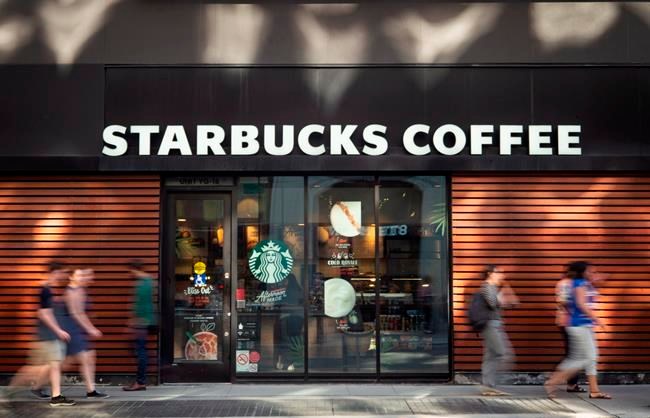
The ambitious goal for Starbucks to become a resource-positive company relies heavily on convincing consumers to change their behaviours and start toting reusable containers, drinking milk alternatives and ordering more plant-based menu items. Pedestrians walk past a downtown Toronto Starbucks Coffee location Thursday, May 31, 2018. THE CANADIAN PRESS/Graeme Roy

“We are committed to making our materials compostable and recyclable, but we know that ultimately, we need to enable consumers everywhere to move to reusable cups and utensils,” said Rebecca Zimmer, director of global responsibility at Starbucks, in an email.

Starbucks is the latest large company to announce lofty environmental goals. Several airlines recently turned to carbon offsets, which invest in projects to compensate for their emissions output, and Maple Leaf Foods claimed in November that it is now carbon neutral.

An assessment on Starbucks’s operations found that it emitted 16 million tonnes of greenhouse gases, withdrew one billion cubic metres of water and emitted 868 kilotonnes of waste across its full value chain in 2018.

Its mitigation strategies include expanding its plant-based options to migrate toward a more environmentally friendly menu and shifting from single-use to reusable packaging.

One potential option is to sway people away from cow’s milk toward plant-based alternatives such as nut and oat milks, said Zimmer, in an interview. Dairy is responsible for 21 per cent of the company’s global carbon footprint, according to a company report, edging out coffee and waste for the top spot.

Oat milk, in particular, seems to have a better environmental footprint, she said. Starbucks offers oat milk at some U.S. locations as a test, but has not yet made it available at any of its roughly 1,600 Canadian stores.

The company also aspires to have the majority of its customers arrive with mugs and cutlery in hand rather than rely on takeaway cups and disposable utensils, she said.

Just how the company will achieve those goals remains unknown and Starbucks will spend the year conducting market research and trials to determine specific plans.

It’s not easy to change ingrained behaviour, said Katherine White, a professor at the University of British Columbia’s Sauder School of Business.

“The big problem is usually that people just forget,” when it comes to bringing a coffee tumbler from home, she said, but with the right motivation it’s possible to teach people to form new habits.

One strategy is to offer rewards or punishments. Many grocery stores, for example, charge a fee for plastic bags. Starbucks, meanwhile, discounts drinks by 10 cents if customers bring their own cup.

The size of these incentives or fees matters, said White, adding five and 10 cents does little to change consumer behaviour.

A punishment could prompt backlash, she said, but Starbucks could offer a more substantial reward, such as an entry into a draw for free coffee for a month.

It’s not unreasonable to ask consumers to bring in mugs or consider oat milk, but it’s more serious if Starbucks commits to changing the economics of that proposition “in a really substantial way for consumers,” said Sarah Kaplan, a professor at the University of Toronto’s Rotman School of Management.

“If they made it so it was really substantially meaningful that would actually drive consumer behaviour,” she said.

Starbucks could charge consumers more for cow’s milk rather than an upcharge for dairy alternatives, she said.

“You want it to not … look just completely self-interested,” she added, noting Starbucks will likely be selling lots of reusable mugs in store.

While Starbucks has yet to determine just how it will get consumers on board with its vision, Zimmer thinks its future vision is possible.

“If I think broadly into the future, I do believe that as a society we’re going to be making choices that are better for the planet, and so I do see pretty significant shifts: the way we live, the way we consume and the way we basically lead our daily lives.”

This report by The Canadian Press was first published Jan. 22, 2020.
Report Error Submit a Tip

More Stories

Billions of dollars spent on health, but scattershot financial reporting leaves decision-makers, Manitobans in the dark, auditor general says

Nicole Buffie 3 minute read Preview

Billions of dollars spent on health, but scattershot financial reporting leaves decision-makers, Manitobans in the dark, auditor general says

Nicole Buffie 3 minute read 5:20 PM CDT

Manitoba’s auditor general says significant gaps in health-sector financial reporting make it difficult to understand how billions of dollars in public funds are spent.

Auditor General Tyson Shtykalo is calling for clearer, more transparent reporting in his latest report, titled Observations on Health Sector Financial Reporting and Accountability in Manitoba.

“Manitoba spends nearly $10 billion annually on health care, but current financial reporting does not provide a clear picture of how that money is spent, what services cost, or the financial pressures facing the system,” Shtykalo said in a news release.

While some financial information is available, the reports do not provide a “complete, consistent, or easily understood” picture of how health-care funds are spent, the report said.

Read
5:20 PM CDT

Is another goalie on Jets’ wish list?

Ken Wiebe 7 minute read Preview

Is another goalie on Jets’ wish list?

Ken Wiebe 7 minute read Sunday, Sep. 27, 2026

Kevin Cheveldayoff and company are down to the short strokes.

With the opening-day roster due on Monday afternoon, the Winnipeg Jets took steps on the weekend to get down to the final number.

As it stood on Sunday, the Jets were down to 24 healthy players in training camp after centre Danny Zhilkin and defenceman Henry Thrun were placed on waivers.

With a maximum of 23 spots available, the only things left to determine are whether the Jets are interested in claiming a more experienced goalie to serve as the backup to Stuart Skinner and if centre Brayden Yager will break camp with the big club.

Read
Sunday, Sep. 27, 2026

Klein vows to freeze water, sewer rate for next two years

Joyanne Pursaga 5 minute read Preview

Klein vows to freeze water, sewer rate for next two years

Joyanne Pursaga 5 minute read 6:09 PM CDT

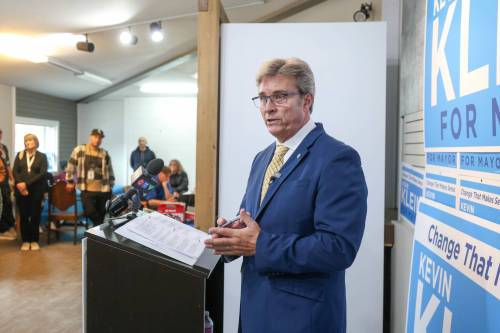
Mayoral candidate Kevin Klein is promising to cancel a water and sewer rate hike proposed for next year and freeze the fee for two years.

Klein said Winnipeggers are simply paying far too much for the utility.

“I think we have to freeze them right now because we’ve seen (a substantial increase) in the last four years. We are facing some of the most difficult financial times for families right now,” he said.

He would also ask the provincial Public Utilities Board to set Winnipeg’s future water and sewer rates, a power currently held by city council.

Read
6:09 PM CDT

Acquisition of former residential school grounds will help educate future generations: premier

Connor McDowell and Morgan Modjeski 6 minute read Preview

Acquisition of former residential school grounds will help educate future generations: premier

Connor McDowell and Morgan Modjeski 6 minute read 8:31 PM CDT

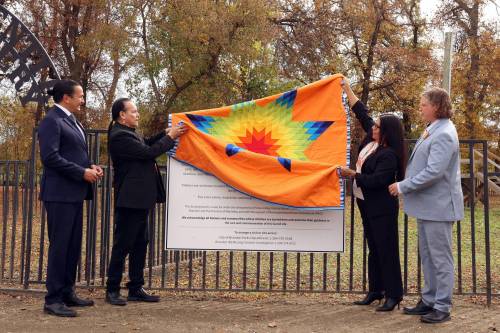
Premier Wab Kinew says a former Brandon-area campground acquired by the province will help educate future generations about the horrors of residential schools.

“We live in an era where people are trying to deny what happened in residential schools,” Kinew said during a Tuesday afternoon visit to Turtle Crossing Campground, near the former Brandon Indian Residential School. “It’s an important part of our national history, and keeping that truth alive.”

Kinew officially announced the province’s plan Tuesday, in partnership with the City of Brandon, to acquire and protect the site where the bodies of more than 50 Indigenous children are located.

The premier said the property has “huge national significance” for education about residential school history because it is one of the “most documented” in the country. He carried photographs, and some 20th century newspaper clippings from the Brandon Sun around the site Tuesday.

Read
8:31 PM CDT

Province to acquire campground near former residential school

Morgan Modjeski 3 minute read Preview

Province to acquire campground near former residential school

Morgan Modjeski 3 minute read 6:00 AM CDT

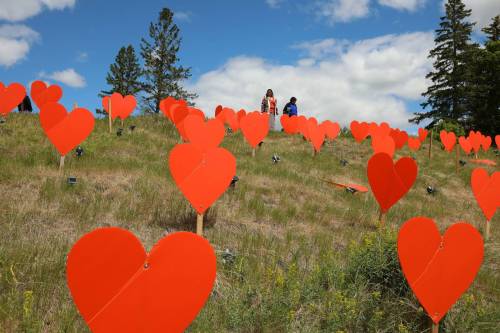
A burial site for dozens of children who died while attending the Brandon Indian Residential School will be acquired by the province, the Free Press has learned.

Premier Wab Kinew will announce the province’s plan to protect Turtle Crossing Campground at a news conference in Brandon Wednesday to mark National Day for Truth and Reconciliation. The move is in partnership with the City of Brandon.

The graves of at least 56 children are located at the campground, the Sioux Valley Dakota Nation has said, pointing to a geophysical study conducted by an archaeology firm in 2018.

There have been longstanding concerns from Indigenous leaders and community members that people were camping on the resting place of children victimized by colonialism.

Read
6:00 AM CDT

Kinew adds cabinet portfolio to focus on first responders

Carol Sanders and Nicole Buffie 5 minute read Preview

Kinew adds cabinet portfolio to focus on first responders

Carol Sanders and Nicole Buffie 5 minute read Updated: Yesterday at 6:40 PM CDT

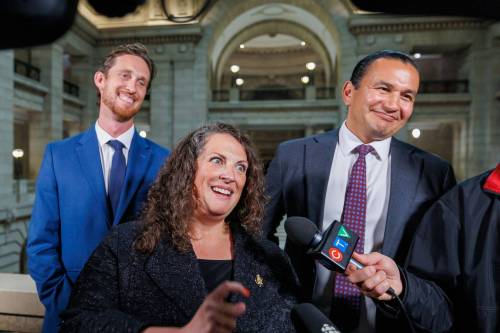
Premier Wab Kinew shuffled his cabinet Monday and created a new ministerial position that will oversee first responders in the province.

Kinew appointed David Pankratz, the MLA for Waverley, as minister responsible for first responder initiatives.

Tuxedo MLA Carla Compton was appointed minister responsible for accessibility, taking over the role from Families Minister Nahanni Fontaine.

The new ministers were sworn in at a ceremony at the legislature Monday afternoon.

Read
Updated: Yesterday at 6:40 PM CDT