Beef ranchers to bear the brunt of Alberta processing plant closure due to COVID-19

Advertisement

Advertise with us

The temporary closure of an Alberta meat processing facility due to a COVID-19 outbreak isn't expected to result in beef shortages, but the reduction in capacitywill mean that ranchers will bear the brunt as their costs rise and prices for their product fall.

Read this article for free:


or

Already have an account? Log in here »

To continue reading, please subscribe:

Subscribe and receive a limited-edition Free Press branded hat or tote.

Digital Subscription

One year of digital access for only $205*

  • Enjoy unlimited reading on winnipegfreepress.com
  • Read the E-Edition, our digital replica newspaper
  • Access News Break, our award-winning app
  • Play interactive puzzles

*First annual payment billed as $205.00 + GST for one year. This annual subscription will automatically renew at $233.00 + GST every 52 weeks (10% off the regular annual price of $259.35). Offer available to new and qualified returning subscribers only. Cancel any time.

To continue reading, please subscribe:

Add Free Press access to your Brandon Sun subscription for only an additional

$1 for the first 4 weeks*

  • Enjoy unlimited reading on winnipegfreepress.com
  • Read the E-Edition, our digital replica newspaper
  • Access News Break, our award-winning app
  • Play interactive puzzles
Start now

*Your next Brandon Sun subscription payment will increase by $1.00 and you will be charged $17.95 plus GST for four weeks. After four weeks, your payment will increase to $24.95 plus GST every four weeks.

Hey there, time traveller!
This article was published 21/04/2020 (2306 days ago), so information in it may no longer be current.

The temporary closure of an Alberta meat processing facility due to a COVID-19 outbreak isn’t expected to result in beef shortages, but the reduction in capacitywill mean that ranchers will bear the brunt as their costs rise and prices for their product fall.

Cargill Inc.’s High River, Alta., plant temporarily shuttered operations Monday after a worker died from the coronavirus and hundreds of other employees tested positive.

Meanwhile, a second plant — JBS plant in Brooks, Alta. — recorded 67 cases as of Monday. It has reduced operations, according to the Canadian Cattlemen’s Association, which represents the 60,000 beef farms and feedlots in the country.

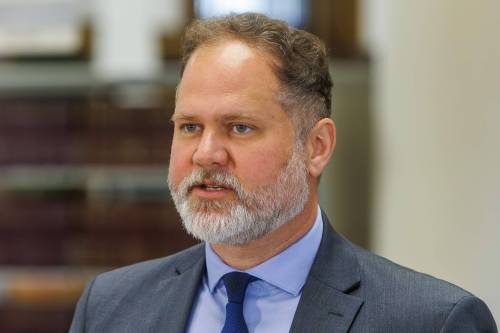
Prime Minister Justin Trudeau addresses Canadians on the COVID-19 pandemic from Rideau Cottage in Ottawa on Tuesday, April 21, 2020. Trudeau says the country shouldn't expect beef shortages despite a large processing facility temporarily closing after a COVID-19 outbreak, but prices may go up. THE CANADIAN PRESS/Sean Kilpatrick

The company says it is trying to ensure the facility remains open, though a union representing federal meat inspectors says it’s a matter of time before it is forced to temporarily halt production.

These two facilities make up 70 per cent of Canada’s beef processing capabilities, according to the CCA.

Alone, the Cargill plant processes some 4,500 head of cattle daily or more than one-third of the country’s total beef-processing capacity.

With the Cargill closure and JBS’s reduction, Canada has likely seen a reduction of nearly 40 per cent in its processing capacity, said Mike von Massow, an associate professor in the food, agricultural and resource economics department at The University of Guelph.

However, shoppers aren’t likely to see empty freezers in the grocery store meat section any time soon.

“In the short run, I don’t think we as consumers will see any tangible difference,” he said.

The prime minister echoed that message Tuesday, reassuring Canadians they would continue to find beef products on grocery shelves.

“We are not at this point anticipating shortages of beef, but prices might go up,” said Prime Minister Justin Trudeau during his daily update on the coronavirus pandemic.

“We will of course be monitoring that very, very carefully.”

Beef producers and associations have said they will prioritize ensuring Canadian supply before exports, he said.

Canada exports about 45 per cent of its beef and cattle production annually, according to the national association, and ships to 56 countries, with the U.S. receiving 74 per cent of beef exports.

The closure is expected to be brief.

It’s likely the Cargill plant will be closed for about two weeks — the duration of the virus’s incubation period, said von Massow. That’s roughly how long the temporary closure of a pork processing plant in Quebec lasted.

Olymel announced March 29 it would temporarily close its hog slaughter and cutting plant in Yamachiche, Que., for 14 days after nine plant employees tested positive for COVID-19. The closure gave employees the time to self-isolate at the recommendation of the public health department. The plant resumed operations on April 14.

A two-week closure allows staff to self-isolate to prevent further spread, deep clean a facility and implement any other measures to help physical distancing after reopening, said von Massow.

During a closure, inventories can be diverted and processing capacity can be increased at other facilities to avoid a shortage, he said. It would take months-long closures, as well as multiple plants shuttering to create a possible shortage.

Ranchers, though, are likely to suffer even from these short-term closures, he said.

If they have to send their cattle further for processing, transportation costs rise and that will come out of the price they’re paid for their product. If they decide to hang on to their animals longer, they’ll face increased overhead costs, like feed, said von Massow.

In the past week, ranchers have seen a nearly 30 per cent drop in price, said Dennis Laycraft, executive vice president at CCA.

The group’s economic scenarios project the industry could lose more than $500 million in revenue by the end of June. It is calling for immediate government action.

That includes improving the availability of cash advances, said Laycraft.

“It’s not easy to deal with lenders when the value of your product is falling sharply and no one’s really sure what it’ll be worth in that environment.”

The group also wants price insurance program premiums brought back down to normal levels, he said.

“For young and newer producers that have more debt, that’s a pretty important thing.”

This report by The Canadian Press was first published April 21, 2020.

Report Error Submit a Tip

More Stories

Three security guards charged with assault after Sea Bears star injured outside nightclub

Nicole Buffie 3 minute read Preview

Three security guards charged with assault after Sea Bears star injured outside nightclub

Nicole Buffie 3 minute read Updated: Yesterday at 12:50 PM CDT

Three security guards are facing assault charges, accused of injuring a Winnipeg Sea Bears player at a nightclub earlier this month.

Read
Updated: Yesterday at 12:50 PM CDT

A message to Mark: Don’t. Back. Down.

Judy Waytiuk 5 minute read Preview

A message to Mark: Don’t. Back. Down.

Judy Waytiuk 5 minute read 2:00 AM CDT

When is a leak really a trial balloon? While Mark Carney currently enjoys huge favourability in Canada, there are nine federal byelections pending. If he stumbles on his pledge of “Elbows up’ against the U.S., votes could go against the Liberals; millions of Canadians have utterly lost patience with Trump’s madness — and with Carney appearing to pander to it.

Read
2:00 AM CDT

Opaskwayak restorative justice court to give offenders opportunity to ‘heal’

Erik Pindera 5 minute read Preview

Opaskwayak restorative justice court to give offenders opportunity to ‘heal’

Erik Pindera 5 minute read Yesterday at 6:00 AM CDT

The Manitoba government, provincial court and Opaskwayak Cree Nation are signing a memorandum of understanding today to establish a community-led court focused on Indigenous restorative justice principles.

Justice Minister Matt Wiebe is in the northern First Nation, which neighbours The Pas, to attend this week’s Opaskwayak Indigenous Days summer festival, ahead of the signing of the nation-to-nation agreement after a pipe ceremony today.

“This is really a pivotal marker on the path to reconciliation for our justice system and an incredible opportunity to begin the process of reconciling the two systems of justice, that being the traditional Indigenous justice system with our colonial system,” Wiebe told the Free Press on Wednesday.

“I’m just excited to be here to have the opportunity to formally mark the collaboration, but really to listen and to hear from community about the best ways, the best path forward.”

Read
Yesterday at 6:00 AM CDT

PCs say Hutterite colonies singled out by Bill 21

Alex Lambert 4 minute read Preview

PCs say Hutterite colonies singled out by Bill 21

Alex Lambert 4 minute read 2:01 AM CDT

SOURIS — Members of Hutterite colonies in the province took aim at the NDP government’s proposed changes to drinking water legislation during a public meeting Thursday in Souris.

The meeting was hosted by Progressive Conservative MLA Colleen Robbins (Spruce Woods) to hear from rural residents about their concerns over Bill 21, which the government says will improve oversight on wells and other water systems in the province.

“There’s not enough clarity, but I feel that the overreach that this bill will bring is not clearly defined, and it could have a lot of negative consequences,” attendee Gilbert Hofer, a member of Green Acres colony near Wawanesa, said after the meeting, which drew about 20 people.

The legislation would allow public health officers to designate the type of water source based on its intended use, water quality and use duration rather than solely the number of connections it has.

Read
2:01 AM CDT

Nola chef earns national award

Eva Wasney 2 minute read Preview

Nola chef earns national award

Eva Wasney 2 minute read 2:01 AM CDT

Celebrated Winnipeg chef Emily Butcher has another feather to add to her toque. The executive chef and owner of Nola and Bar Accanto in St. Boniface has received the Culinary Award of Excellence from Restaurants Canada, a national foodservice advocacy organization.

Read
2:01 AM CDT

Europe anxious as ever about immigration

Kyle Volpi Hiebert 5 minute read 2:00 AM CDT

It was only a matter of time before immigration would again panic Europe. The issue has roiled the continent’s politics ever since its 2015 migrant crisis, when 1.3 million unauthorized migrants crossed its borders that summer. They exposed a broken immigration system in the process, triggering a populist backlash that hasn’t dimmed.

All those same tensions were reignited in late July, when 72,000 migrants converged on the Spanish exclave of Ceuta in just 24 hours. The city — a holdover from Spain’s colonial era — is Europe’s only land border with Africa, nestled next to Morocco. It was almost instantly overrun.

Dozens of people died in the chaos, while the reasons for the sudden influx remain unknown. However, virtually all the arrivals were sent back to Morocco almost immediately; some spent a few days in makeshift holding centres. None were recorded as finding their way to mainland Europe.

Still, the episode inflamed divisions in a region caught in existential limbo. Ultranationalist political parties are ascendant — yet low birth rates and stagnant productivity mean Europe’s future largely hinges on accepting more newcomers.