

These Toronto restaurants offer a taste into the Caribbean’s deep history of plant-based cooking
Advertisement
Read this article for free:
or
Already have an account? Log in here »
To continue reading, please subscribe:

Digital Subscription
One year of digital access for only $205*
- Enjoy unlimited reading on winnipegfreepress.com
- Read the E-Edition, our digital replica newspaper
- Access News Break, our award-winning app
- Play interactive puzzles
*First annual payment billed as $205.00 + GST for one year. This annual subscription will automatically renew at $233.00 + GST every 52 weeks (10% off the regular annual price of $259.35). Offer available to new and qualified returning subscribers only. Cancel any time.
To continue reading, please subscribe:
Add Free Press access to your Brandon Sun subscription for only an additional
$1 for the first 4 weeks*
- Enjoy unlimited reading on winnipegfreepress.com
- Read the E-Edition, our digital replica newspaper
- Access News Break, our award-winning app
- Play interactive puzzles
*Your next Brandon Sun subscription payment will increase by $1.00 and you will be charged $17.95 plus GST for four weeks. After four weeks, your payment will increase to $24.95 plus GST every four weeks.
Read unlimited articles for free today:
or
Already have an account? Log in here »
Hey there, time traveller!
This article was published 21/04/2022 (1638 days ago), so information in it may no longer be current.
In a game of word association, if someone says “Caribbean food,” the immediate response will probably be “jerk chicken.”
But there is a history of plant-based cuisine in the islands and it’s one where Caribbean vegetarian and vegan restaurants in Toronto can thrive.
One of the early takeout restaurants to fill the plant-based Caribbean void was Ital Vital in Scarborough.
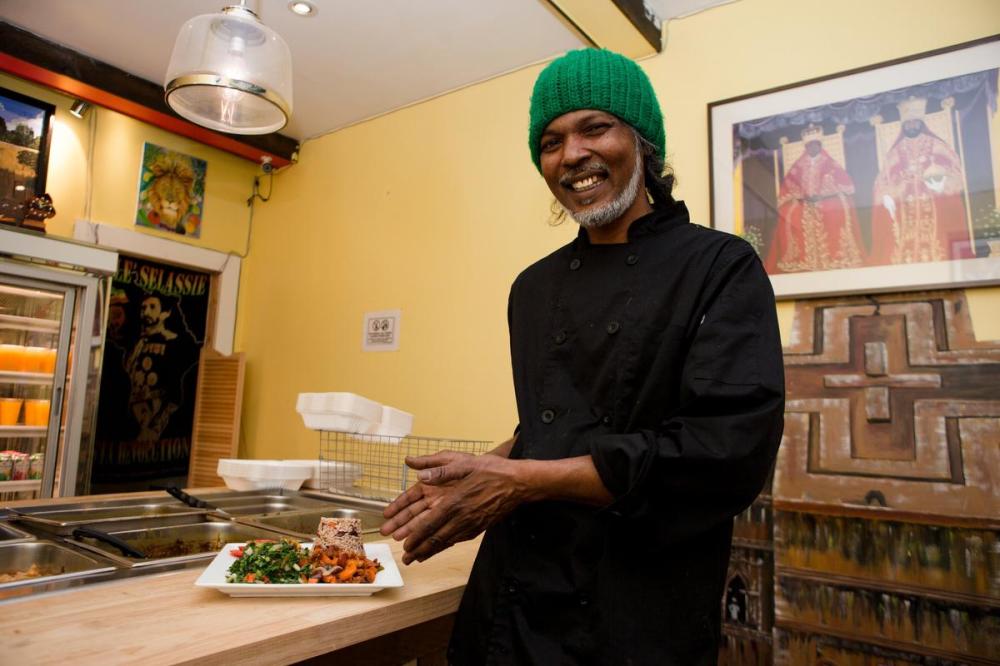
Since it opened at 741 Pharmacy Ave. in 2011 — on Bob Marley’s birthday — owner Arnold Freeman has served up an array of ital food — the traditional Rastafari way of eating that emphasizes living on natural food with no meat.
Freeman said he’s heard time and time again from customers that other times they’ve had vegan food, the flavours have been underwhelming. But, he says with pride, at his restaurant it’s a different story.
“Once they try the food, I always see them back,” he told the Star.
The starting point for his menu was Caribbean influences. Freeman was born in Guyana, which though part of South America, shares a culture and political affiliation with the Caribbean. Caribbean cuisine is a mix of African, Chinese and Indian influences. And when the self-taught chef was expanding his menu, he added more offerings from all of these, as well as North American cooking, which is less embedded in Caribbean cuisine — think stir-fried zucchini and cabbage.
One of his star dishes is a product of this fusion — barbecue spareribs. It’s a saucy stew of smoky house made barbecue sauce made with roasted garlic that drapes bell peppers and non-GMO soy protein with such a firm and familiar bite that people call up and ask “you sure there was no meat in that?”
Traditionally ital cooking doesn’t use additives like salt. But since he’s cooking for the mass public, Freeman loosens the parameters a bit, adding a touch of salt, herbs and spices. The key to stoke flavour in his dishes is letting his stews simmer low and slow.
The kitchen hosts a bounty of fresh produce and the flavours in his dishes reap the benefits. Freeman goes through 80 coconuts a week to make coconut milk from scratch for rice and peas and other dishes — canned just doesn’t taste the same, he said.
Tons of the stews he prepares are Caribbean staples: callaloo — a coarsely chopped and stir-fried leafy green; channa — curried chickpeas; ital stew — made with kidney beans and coconut milk.
Ital Vital is just one of the plant-based Caribbean spots in Toronto — there’s also Irie Veggie in Little Jamaica, V’s Caribbean Restaurant at Weston Road and Eglinton Avenue West and One Love Vegetarian on Bathurst Street in the Annex, to name a few. But if we named them all, there would still be less than 10. Talking with Freeman, he named his and five other restaurants, and a search by the Star turned up two others. According to Freeman, the scene is small and for the most part, everyone in it knows each other.
Many Caribbean restaurants in the GTA are meat-based, despite the history of Rastafari and ital cooking in Jamaica in particular. And at the same time, when people hunt for vegan restaurants, Caribbean spots are often forgotten on top 10 lists.
But there’s plenty of reason for that story to shift.
Nutritious, grown food is natural to a Caribbean climate and cuisine, said Jacqueline Dwyer, co-founder of Toronto Black Farmers, which she started with Noel Livingston to bring about autonomy and access to quality, clean produce for Black Torontonians.
“I’d always have an abundance of food at home,” said Dwyer, who is originally from Jamaica. “I would eat three or four different types of vegetables as a snack … I would eat fruits in abundance … When I came here it was a culture shock, because everything was seasonal.”
In “Provisions: The Roots of Caribbean Cooking” sisters Michelle and Suzanne Rousseau trace the origins of Caribbean cuisine in passages of their cookbook. And the recipes pay tribute exclusively to the vegetarian innovations women of the islands learned to cook.
Provisions — an all-encompassing term for root vegetables like yam, dasheen, sweet potato, cassava and chayote known as “chocho” — are so named because they are what enslaved Africans grew in the provision grounds colonizers allotted for them to farm their own foods. The roots and tubers served as their primary source of sustenance and the base for creative meals.
Take cassava, a root vegetable native to the region. Indigenous communities taught enslaved Africans ways to prepare it, according to the “Provisions” cookbook. For instance, when it is grated and dried cassava resembles flour. That was used to make bammy, a Jamaican flat bread still made presently.
Jamaica’s national dish ackee and saltfish is made using ackee, a soft, fleshy, yellow fruit that was brought from West Africa and salted cod, which was sometimes shared by enslavers. It is supplemented with “food” — the ground provisions.
These and more innovations came to be the diet of choice in the islands and to this day are the most common traditional dishes. Many are made with a more abundant portion of the historical proteins used — salt fish, salted beef and oxtail to name a few. But it’s the produce — cassava, breadfruit, ackee and more — that really were the starting point, since meat was not guaranteed.
So, it’s not a far jump to eat a plant-based diet and still enjoy Caribbean food. With chefs like Freeman at Ital Vital and others around the city who make plant-based versions of Caribbean meals that usually revolve around meat, it’s possible to do so without giving up familiar dishes.
On Thursdays, Ital Vital serves vegan pepperpot, a Guyanese dish often eaten around the holidays. It’s a dark, thick stew that owes its colour to cassareep — a thick brown syrup made from cassava. The dish is cooked down with seasonings like cinnamon and clove and Freeman adds pieces of cassava, carrots and vegan protein, rather than the usual cuts of pork or beef.
Down in Leslieville, at 1183 Queen St. E., Kevin Allwood, owner of KASPACE, offers up a peppery saltfish made from organic palm hearts. He also serves a savoury take on ackee coupled with salted tofu.
“I found that by using dried, salted, nigari tofu, we end up with an incredible flavour profile,” Allwood told the Star.
KASPACE is part café, part curated store and part restaurant, if you spot the folded menus by the cash register. Available daily are small quantities of organic vegan and vegetarian food inspired by Allwood’s Rastafarian upbringing.

There’s an array of brunch options — some including egg and others that are vegan — such as scrambled eggs or tofu, sandwiches, potato hash, or ackee if you’re going for traditional Caribbean.
Most lunch and dinner mains are paired with coconutty rice and peas made with organic basmati rice. Then there’s a West Indian chickpea and potato roti, but sometimes he makes the roti skin French-style, using a crepe machine and a thinner batter. The final product almost tastes like a stretched out fried dumpling.
For both Freeman and Allwood, with the creative inventions, the main goal is to serve food that is healthy, digestible and nutritious.
Freeman said he has customers say to him, “‘Hey man, since (I’ve been) eating this food, I feel good,’” and for him, that’s the best reward.
Angelyn Francis is a Toronto-based reporter for the Star covering equity and inequality. Reach her via email: afrancis@thestar.ca



