Canadians should get info on how much alcohol is in a standard drink: Bennett

Advertisement

Advertise with us

OTTAWA - Canadians deserve to know how much alcohol is in a standard-sized drink regardless of where they buy it, Mental Health and Addictions Minister Carolyn Bennett said this week.

Read this article for free:


or

Already have an account? Log in here »

To continue reading, please subscribe:

Subscribe and receive a limited-edition Free Press branded hat or tote.

Digital Subscription

One year of digital access for only $205*

  • Enjoy unlimited reading on winnipegfreepress.com
  • Read the E-Edition, our digital replica newspaper
  • Access News Break, our award-winning app
  • Play interactive puzzles

*First annual payment billed as $205.00 + GST for one year. This annual subscription will automatically renew at $233.00 + GST every 52 weeks (10% off the regular annual price of $259.35). Offer available to new and qualified returning subscribers only. Cancel any time.

To continue reading, please subscribe:

Add Free Press access to your Brandon Sun subscription for only an additional

$1 for the first 4 weeks*

  • Enjoy unlimited reading on winnipegfreepress.com
  • Read the E-Edition, our digital replica newspaper
  • Access News Break, our award-winning app
  • Play interactive puzzles
Start now

*Your next Brandon Sun subscription payment will increase by $1.00 and you will be charged $17.95 plus GST for four weeks. After four weeks, your payment will increase to $24.95 plus GST every four weeks.

Hey there, time traveller!
This article was published 15/02/2023 (1313 days ago), so information in it may no longer be current.

OTTAWA – Canadians deserve to know how much alcohol is in a standard-sized drink regardless of where they buy it, Mental Health and Addictions Minister Carolyn Bennett said this week.

But Bennett is not committing to a federal regulation that would force companies to add new labels to their products.

In January, the Canadian Centre on Substance Use and Addiction issued new advice about how much alcohol is safe to consume, following 2.5 years of research funded by Health Canada.
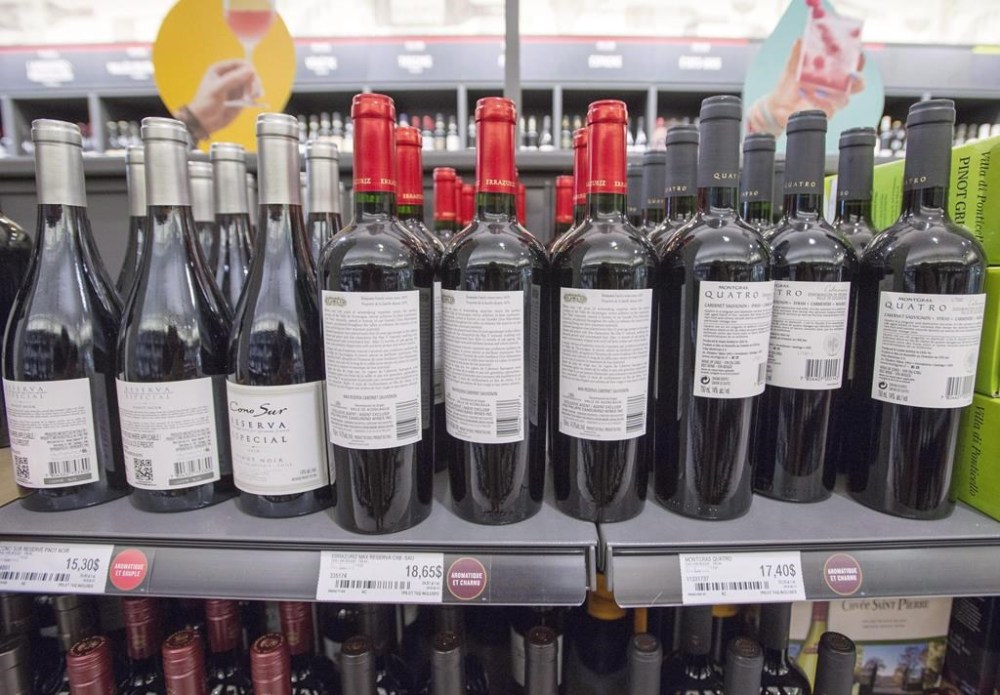
Bottles of wine at the SAQ in Montreal on Wednesday, July 11, 2018. THE CANADIAN PRESS/Ryan Remiorz

The centre said limiting yourself to no more than two standard drinks a week will help you avoid alcohol-related health consequences. It recommended adding labels to alcohol bottles and cans explaining the health risks and with information about what a standard drink is.

Asked Tuesday about whether Canada would enforce such labels, Bennett said there would be some value to making sure Canadians understand exactly what one standard-sized drink actually is, particularly when consuming alcohol at home.

A standard drink contains 17.05 ml of pure alcohol. But it could be complicated to figure that out without a label.

A “standard” beer, cooler or cider would be a 341-ml can or bottle that contains five per cent alcohol. But many beers are sold in other sizes and alcohol contents. A bottle of Italian Peroni Nastro Azzurro sold at Ontario’s LCBO stores is 330 ml and 5.2 per cent alcohol. Several craft beers are in cans of 473 ml and 6.5 per cent alcohol.

A standard glass of wine would be 142 ml with 12 per cent alcohol, but many wines also vary in their alcohol content, including some at 11 per cent, 12.5 per cent or 13.5 per cent.

A standard cocktail with spirits like vodka, gin or scotch would contain 43 ml of spirits with a 40 per cent alcohol content, but some can contain almost twice that.

While many spirits are 40 per cent, some are much higher. A bottle of Polish Spirytus Gdanski vodka, for example, is 76 per cent alcohol, while some spiced rum can be more than 80 per cent.

Bennett said if you order a triple drink at a bar, you know you’re going to be getting a drink with three times the standard amount of alcohol.

“When you buy it at the store, you may not know how much is really in that,” she said.

However, following a meeting Tuesday with the Beer Association of Canada, Bennett said she was hopeful the industry might tackle the labelling issue on its own.

“I met with the beer association today and I think we know we’ve got to do better on all of that.”

She said companies moved to remove the chemical BPA from plastic water bottles after an outcry over the health effects more than a decade ago.

The new guidelines say individuals who drink three to six drinks per week are at an increased risk of developing several forms of cancer, including breast cancer and colon cancer. At seven or more drinks a week, the chance of stroke or heart disease increases, the new guidance states.

It is a stark difference from the last guidelines, published in 2011, which suggested that 15 drinks per week for men and 10 per week for women would be considered low-risk.

Bennett also said that she is excited about the growth in various non-alcoholic and low-alcoholic products in the last several years. But she said that is more true of beer and wine than it is for spirits.

“People are able to have much more choice than they used to have in non-alcoholic, low-alcohol beer and, and the proxies and the wines,” says Bennett.

This report by The Canadian Press was first published Feb. 15, 2023.

Report Error Submit a Tip

More Stories

A life’s story: activist, educator, organizer knew the true meaning of community

Janine LeGal 7 minute read Preview

A life’s story: activist, educator, organizer knew the true meaning of community

Janine LeGal 7 minute read 3:00 AM CDT

Somewhere between a love for sharing stories and a love of community connections, Michael (Mike) Maunder lived his life. Giving voice to people and neighbourhoods was a passion for the natural-born community organizer.

An author, teacher and principal, Maunder lived in a one-bedroom apartment in West Broadway and devoted himself to community development, education and neighbourhood renewal.

He maintained a connection with Augustine United Church, whose commitment to social justice he appreciated, volunteered at the Sandy-Saulteaux Spiritual Centre, and found comfort in a Buddhist prayer community.

Maunder died on July 15 at the age of 80.

Read
3:00 AM CDT

United Way, other charities fight for dollars as donor base shrinks

Scott Billeck 7 minute read Preview

United Way, other charities fight for dollars as donor base shrinks

Scott Billeck 7 minute read Yesterday at 2:00 AM CDT

Winnipeg’s charitable sector is being squeezed from both sides: demand for help is growing while the pool of donors to meet that need is shrinking.

The imbalance is increasingly being carried by a relatively small group of deep-pocketed donors. Last year, 600 people — about three per cent of United Way Winnipeg’s individual donors — accounted for roughly $8 million, or 55 per cent of individual donations.

The fundraising pitch isn’t getting any easier.

Homelessness and public drug use have become increasingly visible, household budgets remain strained and the problems charities are trying to address can seem so entrenched that donors may reasonably wonder what difference another contribution can make.

Read
Yesterday at 2:00 AM CDT

Family account spiced with magic realism, geopolitical intrigue and a ghost story

Reviewed by Zilla Jones 4 minute read Preview

Family account spiced with magic realism, geopolitical intrigue and a ghost story

Reviewed by Zilla Jones 4 minute read 2:01 AM CDT

Tom Lin’s second novel Babylon, South Dakota moves beyond a historical account of an immigrant family’s struggle, delightfully blending and bending genres.

Lin is a Chinese-born novelist whose family emigrated to the U.S. when he was four years old. His debut novel, The Thousand Crimes of Ming Tsu, won the 2022 Andrew Carnegie Medal for Excellence in Fiction, making him the youngest ever recipient of that award. He earned a PhD in English from the University of California Davis and is currently an assistant professor of English and creative writing at the University of Iowa.

Babylon, South Dakota takes place in an unspecified time period that can be understood to be during the Mao era — likely the 1950s or ’60s. A young Chinese couple, the Hsuis, immigrate to the rural community that gives the book its title. They take the names Saul and Mei and settle on a 160-acre homestead left to them by a distant relative.

Saul’s dream is to breed and sell chrysanthemums from seeds he brought from China, while Mei wants to raise livestock. They speak no English, know nothing of life in the United States, are unprepared for the harshness of winter and the isolation of the farm and bring nothing with them except some gold, which Mei hides around the house for emergencies. Their only link to the outside world is a discarded and marginally functioning TV set, which Saul rescues and rigs up.

Read
2:01 AM CDT

Cabernet Sauvignon star of wine festival

Ben Sigurdson 5 minute read Preview

Cabernet Sauvignon star of wine festival

Ben Sigurdson 5 minute read 3:00 AM CDT

The Winnipeg Wine Festival will celebrate the king of red wine grapes next weekend — the theme of this year’s festival, which takes place Sept. 25 and 26 at the RBC Convention Centre, is Cabernet Sauvignon.

Cab Sauv, as it’s also known, is the world’s most widely planted wine grape of any colour, first coming to prominence in the 1800s in France’s Bordeaux region, where the grape is still popular. Rather than single-variety wines, Bordeaux reds tend to be blends, with those coming from the left bank of the Gironde estuary being Cabernet-dominant, while right-bank wines are Merlot-dominant, with Cabernet Sauvignon playing a supporting role. Cabernet and Merlot work well together and many other countries have followed suit in blending the two.

A team at University of California Davis put Cabernet Sauvignon through a DNA test in 1996 and discovered its parent grapes are Cabernet Franc and Sauvignon Blanc — it’s likely that at some point the two varieties, planted next to each other in some vineyard, crossed and mutated and became the grape we know today. (Someone growing grapes in the 19th century must have had an inkling of what was up, as the grape has been called Cabernet Sauvignon since long before the DNA test.)

Flavour-wise, most Cabernet Sauvignon wines are big and bold, with a core of deep dark berry flavours, some graphite and spice notes and relatively bright acidity. It’s a grape that is well-suited to barrel aging, with most examples seeing at least some time in wood.

Read
3:00 AM CDT

Puzzles Palace

1 minute read Monday, Jul. 27, 2026

To solve our puzzles, please subscribe with this special offer: |

Hellebuyck standoff caused by… Nathan MacKinnon?

Mike McIntyre 6 minute read Preview

Hellebuyck standoff caused by… Nathan MacKinnon?

Mike McIntyre 6 minute read Yesterday at 6:34 PM CDT

Looking for someone to blame in the Connor Hellebuyck fiasco and cast as public enemy No. 1? How about long-time Winnipeg Jets nemesis Nathan MacKinnon?

Allow us to explain as we fire up the time machine and head back to February in Italy.

Oh, what could have been if MacKinnon had been able to score on what appeared to be an open net late in the third period of the men’s gold medal game with Hellebuyck down and seemingly out of position.

Instead, the star forward fired wide, keeping the score deadlocked at 1-1 as the clock ticked down on regulation.

Read
Yesterday at 6:34 PM CDT