Tariffs, government spending, gas prices — what’s driving inflation right now?
Advertisement
Read this article for free:
or
Already have an account? Log in here »
To continue reading, please subscribe:

Digital Subscription
One year of digital access for only $205*
- Enjoy unlimited reading on winnipegfreepress.com
- Read the E-Edition, our digital replica newspaper
- Access News Break, our award-winning app
- Play interactive puzzles
*First annual payment billed as $205.00 + GST for one year. This annual subscription will automatically renew at $233.00 + GST every 52 weeks (10% off the regular annual price of $259.35). Offer available to new and qualified returning subscribers only. Cancel any time.
To continue reading, please subscribe:
Add Free Press access to your Brandon Sun subscription for only an additional
$1 for the first 4 weeks*
- Enjoy unlimited reading on winnipegfreepress.com
- Read the E-Edition, our digital replica newspaper
- Access News Break, our award-winning app
- Play interactive puzzles
*Your next Brandon Sun subscription payment will increase by $1.00 and you will be charged $17.95 plus GST for four weeks. After four weeks, your payment will increase to $24.95 plus GST every four weeks.
Read unlimited articles for free today:
or
Already have an account? Log in here »
Hey there, time traveller!
This article was published 25/09/2025 (370 days ago), so information in it may no longer be current.
OTTAWA – MPs returned to the House of Commons earlier this month to confront an old problem — inflation — which is now being driven by new forces.
Many consumers are still reeling from the decades-high inflation levels seen in the post-pandemic recovery period, when prices for housing, fuel and groceries all surged.
But the factors shaping inflation today are different from the ones in play when the lockdowns ended, and MPs and the Bank of Canada are now grappling with the impact of tariffs, taxes and government spending on the cost of living.
Here’s what you need to know about the state of inflation in Canada.
Where does inflation stand today?
Statistics Canada says the annual rate of inflation came in at 1.9 per cent in August, up from 1.7 per cent in July.
The Bank of Canada is responsible for maintaining price stability in Canada and sets a target of two per cent for annual inflation.
“I mean, 1.9 per cent is actually pretty good,” said Mostafa Askari, chief economist at the Institute of Fiscal Studies and Democracy and the University of Ottawa.
Askari said a brief month-to-month increase in inflation isn’t much to worry about on its own.
He said policy-makers should watch trends over six months or longer before reacting to movement in price figures.
What’s driving inflation?
Randall Bartlett, deputy chief economist at Desjardins, said the big factor easing inflation right now is the termination of the consumer carbon price.
Because the carbon levy was in place for consumers in 2024, the Liberals’ move to end the policy in April has meant lower prices at the gas pumps in recent months, skewing data in the year-over-year comparisons.
Shelter inflation is also diminishing as the pace of population growth slows, easing competition for apartments and reducing rent prices in many cities.
Canadians shopping for a new mortgage today are also seeing rates closer to four per cent on a five-year fixed loan. Rates were well over five per cent this time last year.
One area where consumers are still feeling the pinch is food inflation, which StatCan pegged at 3.4 per cent in August. That rate is still well below the double-digit yearly gains seen during the height of the inflationary period of a few years ago.
Askari said consumers are feeling the cumulative impact of years of inflation pushing prices higher, particularly at the grocery store.
Prices tend to rise quickly on the way up but are “sticky” on the way down, if they ease at all, he said.
Are counter tariffs pushing prices higher?
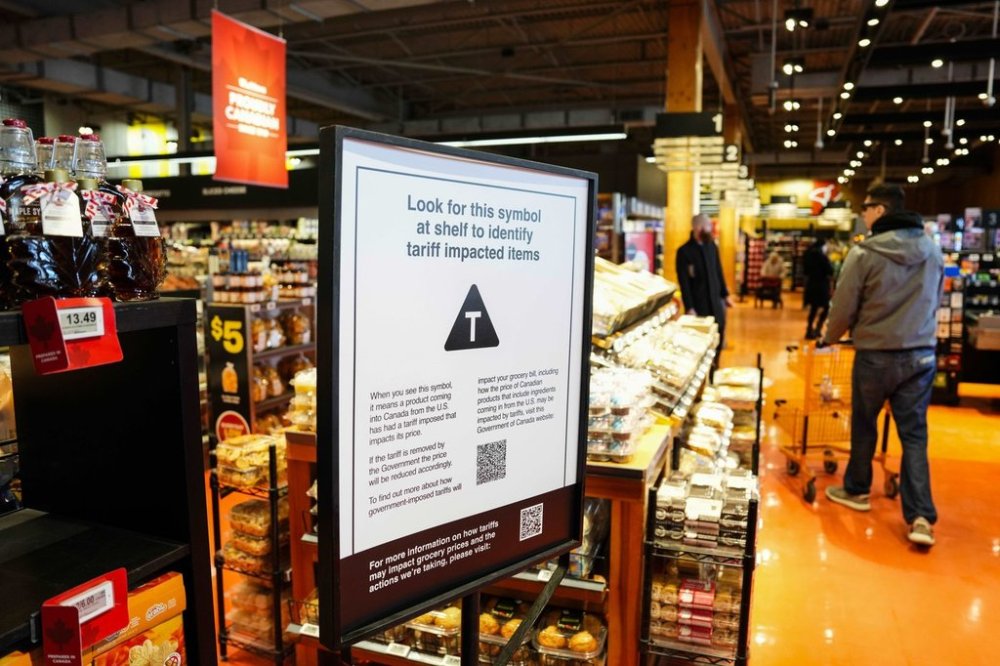
Another force affecting grocery inflation is Canada’s retaliatory tariffs against the United States.
Some counter tariffs — which are paid by Canadian firms importing U.S. goods — were imposed on inputs for manufactured products and are baked into the final cost of a good or absorbed into a company’s margins.
Those costs show up more readily in perishable goods bought at the grocery store, like Florida orange juice. But fresh food prices are also vulnerable to shifts in weather and growing conditions around the world.
Askari said this makes it difficult to say with absolute certainty how much price hikes are tied to tariff impacts.
Canada dropped most of its retaliatory tariffs on the United States at the start of the month.
Combined with the elimination of the consumer carbon price, Bartlett expects the end of counter tariffs will leave headline inflation a full percentage point lower in 2026 than it would have been with those two policies in place.
But he also expects previous impacts from counter tariffs will persist in the inflation readings for September and gradually fade through the rest of the year.
What about government spending?
Conservative Leader Pierre Poilievre has accused the federal government of running deficits that fuel inflation.
“Deficits drive up inflation, grocery prices, housing costs and interest rates,” he said in question period on Sept. 17.
Experts say the impact of federal spending on inflation is less clear than that.
Askari said that when government spending results in more money in the pockets of Canadians or businesses, it drives up spending demand in the economy. More demand, without an associated boost in supply, can drive up inflation.
When government spending is aimed at increasing supply, however — by expanding the stock of housing, for example — that can take pressure out of inflation, Askari said.
“In principle, deficit spending could put pressure on prices. Calling every government spending inflationary is not correct,” he said.
Canada’s economy contracted in the second quarter, and most economists expect a modest recovery to start in the third quarter.
Bartlett said this reflects an economy that’s operating below its potential — there’s slack in the economy, in other words — so a bit of fiscal stimulus could “shore up” the economy without triggering a sharp spike in inflation.
There are limits, however. Bartlett said the size of the deficit the federal Liberals have telegraphed is coming in the upcoming fall budget may, in fact, be higher than warranted, given the state of the economy.
Ottawa’s planned capital investments could be inflationary in the near-term if they lead to a surge in demand for construction labour and materials, Bartlett said.
But those same spending plans could take steam out of inflation in the future if they help to boost productivity in the economy in the medium or longer term, he added.
“The proof in the pudding is going to be in the tasting, in terms of how effective this infrastructure investment is,” Bartlett said.
Meanwhile, plans to reduce federal operating spending by as much as 15 per cent over three years would be disinflationary if they come to pass, he said.
What’s happening to interest rates?
The Bank of Canada has been watching inflation carefully this year, waiting to see how the U.S. tariff dispute will affect prices and the economy.
While the central bank signalled there’s still plenty of uncertainty on the trade front, monetary policy-makers cut the benchmark interest rate by a quarter point to 2.5 per cent last week.

Bank of Canada Governor Tiff Macklem said the balance of risks had shifted toward a weakening economy and away from rising prices.
“If they thought there would be a risk (of inflation), they would not have done that,” Askari said of the rate cut.
The Bank of Canada has not baked the federal government’s recent spending announcements into its forecasts.
Macklem said the central bank will do so once those spending plans are published in the federal budget, set for Nov. 4 — roughly a week after the Bank of Canada’s next interest rate announcement.
This report by The Canadian Press was first published Sept. 24, 2025.
Related Articles
Clock is ticking on Poilievre to reevaluate his approach

Advertisement Advertise With Us
Advertisement Advertise With Us