Metaphorical Washington ‘swamp’ overrun by actual vermin

Advertisement

Advertise with us

WASHINGTON - Andre Pittman and Gregory Cornes are on a mission to rid Washington of opportunistic vermin.

Read this article for free:

or

Already have an account? Log in here »

To continue reading, please subscribe:

Subscribe and receive a limited-edition Free Press branded hat or tote.

Digital Subscription

One year of digital access for only $205*

  • Enjoy unlimited reading on winnipegfreepress.com
  • Read the E-Edition, our digital replica newspaper
  • Access News Break, our award-winning app
  • Play interactive puzzles

*First annual payment billed as $205.00 + GST for one year. This annual subscription will automatically renew at $233.00 + GST every 52 weeks (10% off the regular annual price of $259.35). Offer available to new and qualified returning subscribers only. Cancel any time.

To continue reading, please subscribe:

Add Free Press access to your Brandon Sun subscription for only an additional

$1 for the first 4 weeks*

  • Enjoy unlimited reading on winnipegfreepress.com
  • Read the E-Edition, our digital replica newspaper
  • Access News Break, our award-winning app
  • Play interactive puzzles
Start now

*Your next Brandon Sun subscription payment will increase by $1.00 and you will be charged $17.95 plus GST for four weeks. After four weeks, your payment will increase to $24.95 plus GST every four weeks.

Hey there, time traveller!
This article was published 11/12/2018 (2792 days ago), so information in it may no longer be current.

WASHINGTON – Andre Pittman and Gregory Cornes are on a mission to rid Washington of opportunistic vermin.

But their target isn’t corrupt officials or shady political fixers; it’s Rattus Norvegicus, the common Norway Rat.

The nation’s capital is facing a spiraling rat infestation, fueled by mild winters and a human population boom. Washington’s government is struggling to keep pace, with the pest control department fielding a record number of calls.
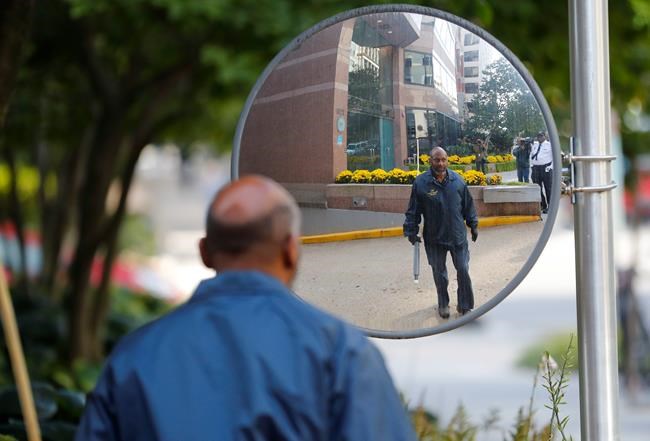
Pest Control Officer Gregory Cornes, from the D.C. Department of Health's Rodent Control Division, surveys the flower beds of an office building in Washington, for rat burrows before pumping poison into burrows, Wednesday, Oct. 17, 2019. Cornes will pump poison into the burrows and this powder will stick to the paws and fur, when the rats groom themselves, they unwittingly ingest it and die. (AP Photo/Pablo Martinez Monsivais) The nation’s capital is facing a spiraling rat infestation, fueled by mild winters and a human population boom. Washington’s government is struggling to keep pace

On one recent day, Pittman and Cornes, both veteran Health Department employees, are working within sight of the Capitol, shovelling dry ice pellets into suspected rat burrow entrances. On another, they’re summoned about six blocks north of the White House, at 16th Street and M, where residents have complained of an outbreak.

“Rats adapt to everything. They can be like geniuses,” Pittman said.

On the grounds of a church, Cornes and Pittman poke around, expertly spotting telltale holes and matted dirt trails that signal rat burrows. Cornes uses an instrument like an extra-long Super Soaker to inject poison into the hole, while Pittman watches to see if the white powder puffs up from other holes and then shovels dirt to block those exits.

At the office building next door, the crew receives a hearty welcome from the security guard.

“The rats would scurry over employees’ feet as they left the building after sunset,” says the guard, who asked that his name not be published so as not to embarrass his employer. “We finally moved all garbage cans away from the door because that’s where they would feed and party.”

Cornes assures him, “We’re winning.”

The numbers don’t exactly back up Cornes’ confidence. The pest control company Orkin ranks Washington as America’s fourth “Rattiest City,” based on the number of new service calls per year. That’s up one spot from the previous year and just behind Los Angeles and New York; Chicago has been ranked No. 1 for four consecutive years.

While Washington doesn’t boast New York’s famous subway monsters, anecdotal evidence is piling up that the rodents are on the march. In September, a viral video showed security camera footage of a rat pulling a fire alarm , forcing the evacuation of an apartment building.

Back on M Street, Cornes and Pittman discover a network of burrows in a large planter box in front of an office building. They inject poison, causing bushes to shake with fleeing rodents. A baby rat suddenly emerges from the ground and flees around the corner.

Gerard Brown, head of Washington’s rodent control department, says a string of gentle winters has enabled the rodents to breed constantly. The harsh winters don’t necessarily kill off the rats. Most Norway rats live only about eight months, and they stay warm by burrowing underground or chewing their way into basements. But an extended freeze would choke off their food supply, which limits the rodents’ prodigious breeding. A mature female rat can give birth to one litter per month, with an average of 10 babies per litter.

Washington is also in the midst of a gentrification-fueled economic and population boom. The district’s population just passed 700,000 — more than Vermont and Wyoming. Brown said the number of restaurants, bars and coffee shops has increased 25 per cent in two years.
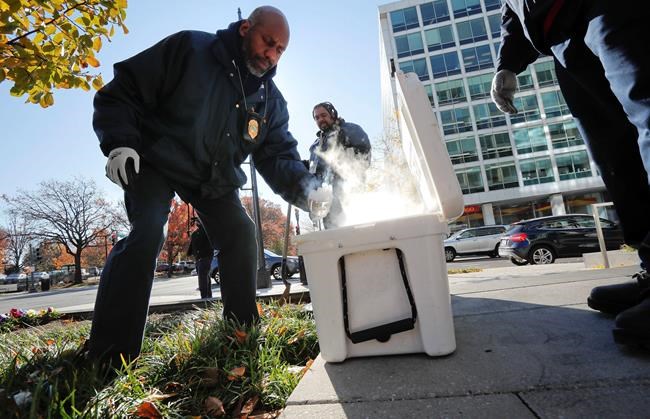
Pest Control Officers Gregory Cornes, left, uses a hand trowel to scoop-up dry ice before dropping it directly into rat burrows, as his co-worker Curtis Redman assist, near the Capitol building in Washington, Wednesday, Nov. 21, 2018. Both are from the Department of Health's Rodent Control Division. The nation’s capital is facing a spiraling rat infestation, fueled by mild winters and a human population boom. Washington’s government is struggling to keep pace (AP Photo/Pablo Martinez Monsivais)

“More people with more money means more restaurants, which means more garbage, which means more rat food,” Brown said.

In several ways, Washington is perfectly suited for the critters. It is filled with green space, from the National Mall to the many signature traffic circles; Dupont Circle is apparently a hot spot.

Rats also covet the waterfront, and part of Washington’s gentrification boom has focused on the Navy Yards or the new Wharf Marina — presenting the ultimate rodent attraction of a flourishing waterfront restaurant scene.

This isn’t even Washington’s first war on rats. Former Mayor Anthony Williams referenced rat problems in his inauguration speech in 1999. Back in 1967, a rat gnawing on power station wires knocked out electricity for about a third of Washington for nearly an hour.

This time, Mayor Muriel Bowser has allocated an extra $900,000 to boost rodent control efforts and increase staffing. The government is also offering financial assistance and incentives for restaurants to buy minitrash compactors that fit in urban alleyways and limit the rats’ access to food.

At the site near the White House, Pittman and Cornes find the real problem around the back of the office building: a collection of uncovered garbage and compost containers, plus a giant pile of discarded file cabinets — all surrounded by black pellets.

“See all these droppings? All this stuff has got to go,” Pittman tells the building manager.

He could write up a $500 health code violation ($1,000 for a repeat offender) but instead Pittman tells him: “I’ll give you two weeks to get this cleaned up. Then we’ll be back.”

As urban rodentologist Robert Corrigan puts it, “80 per cent of any rat control campaign is actually refuse management.”

Corrigan has consulted with Washington and other cities on rodent problems and runs free “rat academies” in Washington for both city workers and residents.
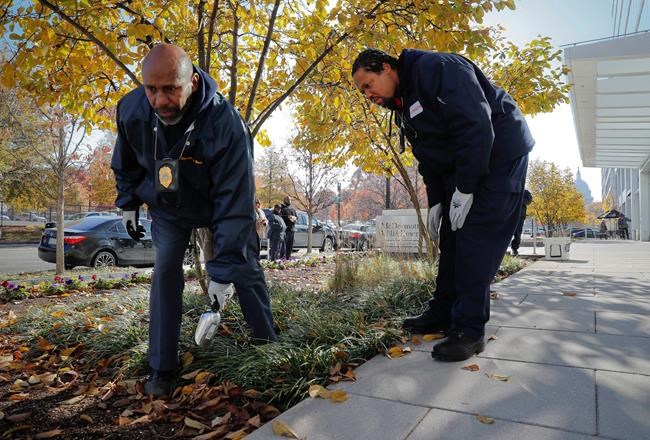
Pest Control Officers Gregory Cornes, left, and Andre Pitman, both from the D.C. Department of Health's Rodent Control Division, searching the flower beds for rat burrows near U.S. Capitol building in Washington, Wednesday, Nov. 21, 2018. The nation’s capital is facing a spiraling rat infestation, fueled by mild winters and a human population boom. Washington’s government is struggling to keep pace (AP Photo/Pablo Martinez Monsivais)

Corrigan recommends a radical solution that would be logistically difficult for most major cities: picking up most trash at night.

“The usual early morning pickup plays right into the hands of the rats, which are active all night long,” he said.

Multiple city officials said this would be almost impossible to implement due to staffing issues and late-night noise concerns.

Corrigan, not a fan of amateurs handling poisons, says the dry ice method, which suffocates the rodents in their burrows, is safe for homeowners to use. He also recommends that residents spray trash bins with a mix of water and 10 per cent bleach. Beyond that, the only real solution is the hardest part of the equation — controlling human behaviour.

“You’re only as good as your neighbour,” he said. “You can have 10 beautiful houses in a row and if number 11 is a slob, everybody suffers.”

___

Follow Khalil on Twitter at: www.Twitter.com/Ashrafkhalil

Report Error Submit a Tip

More Stories

Excited Goldeyes fans buzz over Manitoba Mosquitoes’ name change

Grace Penner 4 minute read Preview

Excited Goldeyes fans buzz over Manitoba Mosquitoes’ name change

Grace Penner 4 minute read Friday, Jul. 31, 2026

BITE club has entered the ball park for a single game, filling the stands with mosquitoes — just not in the way you may think.

The Fish are participating an alternate identity takeover, one that many other teams in the minor baseball leagues have been having some fun with. The Winnipeg Goldeyes re-branded to pay homage to the province’s beloved summer creatures, the Manitoba Mosquitoes.

The Fargo-Moorhead RedHawks had some fun with its alternative identity, doing a five-game name change to the Woodchippers, a fun reference to the 1996 film Fargo.

Other honourable mentions are the Chicago Dogs, who switched over to the Chicago Wieners, the Sioux Fall Canaries transformed into the Minnehaha Martians, Milwaukee Milkmen became the Franklin Benjamins, and the Lake Country Dockhounds swapped to the Wisconsin Dive Bars.

Read
Friday, Jul. 31, 2026

Today’s horoscope

Georgia Nicols 4 minute read Preview

Today’s horoscope

Georgia Nicols 4 minute read Yesterday at 2:00 AM CDT

MOON ALERT: Avoid shopping (except food and gas) and important decisions from 7 a.m. until 4 p.m. today. After that, the moon moves from Pisces into Aries.

ARIES (March 21-April 19)

The day is a mixed bag. There are still fun opportunities to play and enjoy socializing with others. However, you might be sandbagged by someone who is critical or negative. Be careful with whom you choose to associate, because they might irk you. Focus on home repairs.

TAURUS (April 20-May 20)

Read
Yesterday at 2:00 AM CDT

Hydro scrambling to restore power to remaining 4,500 customers after storm; some outages will continue into Saturday

Chris Kitching 5 minute read Preview

Hydro scrambling to restore power to remaining 4,500 customers after storm; some outages will continue into Saturday

Chris Kitching 5 minute read Friday, Jul. 31, 2026

Power outages could stretch into a third day for some Manitobans — mainly in and around Winnipeg — while crews continued to repair widespread damage caused by powerful thunderstorms.

About 4,500 Manitoba Hydro customers were still without electricity at 2:30 p.m. Friday, after more than 30,000 lost power while powerful winds brought down trees and power lines Wednesday night and early Thursday.

The Crown corporation said it is aiming to have all outages with greater numbers of customers restored by Friday night, but some customers may remain without power into Saturday.

“The challenge is just the sheer scale of this thing — hundreds of different outages spread across a large part of the city,” Hydro spokesman Peter Chura said. “Just getting to all of them in a timely fashion is very difficult.”

Read
Friday, Jul. 31, 2026

Culture minister’s pledge sends officials on hunt for money to fix Islamic centre after apparent hate crime

Carol Sanders 5 minute read Preview

Culture minister’s pledge sends officials on hunt for money to fix Islamic centre after apparent hate crime

Carol Sanders 5 minute read Friday, Jul. 31, 2026

Government officials were left scrambling Friday to explain why the province is paying for repairs at a mosque recently targeted in a potential hate crime after a $1 million security enhancement fund was fully allocated in June.

Read
Friday, Jul. 31, 2026

‘Good deal of synergy’ brewing in South Osborne

Gabrielle Piché 5 minute read Preview

‘Good deal of synergy’ brewing in South Osborne

Gabrielle Piché 5 minute read Friday, Jul. 31, 2026

Pub crawls could become the next South Osborne draw.

At least, that’s the hope of entrepreneurs in the area as three breweries build out locations in the Winnipeg neighbourhood.

Nonsuch Brewing Co. and Good Neighbour Brewing Co. have opened storefronts along the strip in the past three months. Dastardly Villain is creating a taproom and nanobrewery.

“I’m really excited to have these pubs and taprooms,” said Ben Shantz, board chair of the South Osborne Business Improvement Zone.

Read
Friday, Jul. 31, 2026

Nemat’s novel chronicles grandmother’s harrowing life in Russia and Iran

Reviewed by Gordon Arnold 4 minute read Preview

Nemat’s novel chronicles grandmother’s harrowing life in Russia and Iran

Reviewed by Gordon Arnold 4 minute read Saturday, Aug. 1, 2026

Mistress of the Persian Boarding House is the most enjoyable book I have read in the more than 15 years since I began reviewing books for the Free Press.

Author Marina Nemat’s prose, inspired by her paternal grandmother’s life, flows smoothly, like a babbling brook down a mountain.

Nemat is an Iranian-born Canadian writer and human rights activist known for her bestselling memoirs Prisoner of Tehran and After Tehran: A Life Reclaimed. Arrested at 16 for opposing Iran’s post-revolution regime, she endured torture and forced marriage in Evin Prison before emigrating to Canada in 1991.

Nemat’s grandmothers were both Russian, and she was brought up in a Russian Orthodox Christian family in Tehran. With their Iranian husbands, whom they had married before the Russian Revolution of 1917, both grandmothers fled from Russia to Iran as part of a massive wave of migration.

Read
Saturday, Aug. 1, 2026