Nature Conservancy recommends a better fate for your Christmas tree

Advertisement

Advertise with us

Canada's Christmas tree farms produce over three million pine, spruce and fir trees each year — and most of them are simply abandoned at the curb soon after Santa makes his annual visit.

Read this article for free:


or

Already have an account? Log in here »

To continue reading, please subscribe:

Subscribe and receive a limited-edition Free Press branded hat or tote.

Digital Subscription

One year of digital access for only $205*

  • Enjoy unlimited reading on winnipegfreepress.com
  • Read the E-Edition, our digital replica newspaper
  • Access News Break, our award-winning app
  • Play interactive puzzles

*First annual payment billed as $205.00 + GST for one year. This annual subscription will automatically renew at $233.00 + GST every 52 weeks (10% off the regular annual price of $259.35). Offer available to new and qualified returning subscribers only. Cancel any time.

To continue reading, please subscribe:

Add Free Press access to your Brandon Sun subscription for only an additional

$1 for the first 4 weeks*

  • Enjoy unlimited reading on winnipegfreepress.com
  • Read the E-Edition, our digital replica newspaper
  • Access News Break, our award-winning app
  • Play interactive puzzles
Start now

*Your next Brandon Sun subscription payment will increase by $1.00 and you will be charged $17.95 plus GST for four weeks. After four weeks, your payment will increase to $24.95 plus GST every four weeks.

Hey there, time traveller!
This article was published 26/12/2018 (2789 days ago), so information in it may no longer be current.

Canada’s Christmas tree farms produce over three million pine, spruce and fir trees each year — and most of them are simply abandoned at the curb soon after Santa makes his annual visit.

Now, the Nature Conservancy of Canada is suggesting that people should instead haul their tree to the backyard, to help nature and learn a bit about ecology.

“There are better things we can do with our live Christmas tree when we’re done with it,” said Dan Kraus, senior conservation biologist with the Nature Conservancy of Canada.
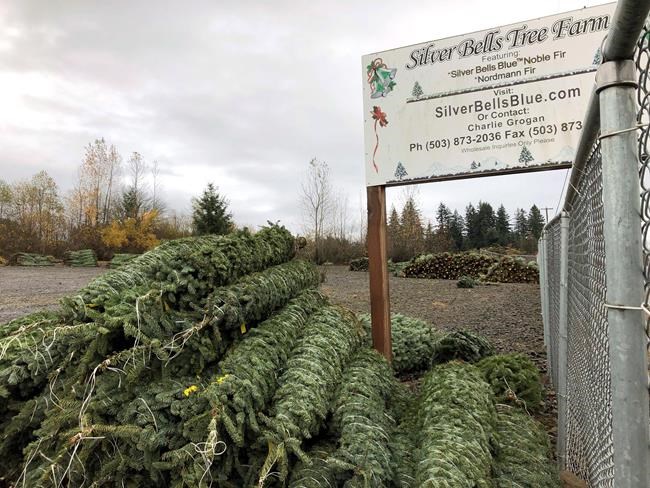
The Nature Conservancy of Canada urging people to use their old Christmas trees in their backyard as shelter for birds and other creatures and allowing them to decompose to feed the soil, rather than putting the old trees out to the curb. In this November 2018 photo, Christmas trees sit in a dirt lot at Silver Bells Tree Farm in Silverton, Ore., before being loaded onto a semi-truck headed for a Los Angeles tree lot. THE CANADIAN PRESS/AP Photo/Gillian Flaccus

Most municipalities have programs to chip and compost old Christmas trees, but Kraus said residents have an opportunity to make the most of their old tree.

“Put it out in the backyard and you’ll find that backyard birds start using it right away, especially if you have a birdfeeder. The birds will land in the tree before they go to the feeder. Some of them may even stay in it at night to get some shelter,” he said.

“You can decorate your old tree for birds and squirrels by doing things like hanging suet, or peanuts.”

He said that over winter, many of the needles will fall off, and by spring the tree will be ready to introduce to the soil.

Kraus suggests cutting off the branches in the spring and laying them on the ground around flowers.

“They’ll provide a little bit of shelter. They’ll help hold moisture in the soil, and then you can just put the tree trunk somewhere on the ground, even as a border for your garden area. That will start to provide some habitat right away for things like toads or various insects through the summer in your garden,” he said.

Kraus said the smaller you cut the branches, and the more they are in contact with the soil, the sooner they will begin to decompose.

“You are feeding the soil. By fall the smaller branches and twigs that have been in contact with the soil will have probably broken down quite a bit. They might not even be there anymore,” he said.

He said it could take a couple years for the trunk of the tree to completely decompose, but drilling holes in it will speed the process.

“That will encourage insects to burrow into the wood. It will provide habitat and make the trunk break down more quickly,” he said.

Kraus said, for those who don’t have a place on their property to recycle a tree, make sure your municipality composts them.

He said many places used to just put the trees in the landfill, which creates methane that’s not good for climate change.
Report Error Submit a Tip

More Stories

Foster mom pleads guilty to assault that left six-year-old-girl paralyzed

Dean Pritchard 4 minute read Preview

Foster mom pleads guilty to assault that left six-year-old-girl paralyzed

Dean Pritchard 4 minute read Updated: Yesterday at 6:27 PM CDT

A Winnipeg foster mother has admitted to violently assaulting her ill foster daughter and leaving her paralyzed after the girl resisted the woman’s efforts to provide her with medication, a court has heard.

Marilyn Keno, 26, pleaded guilty Friday to one count of aggravated assault.

Keno remains in custody and will be sentenced at a later date following the completion of a court-ordered pre-sentence report.

The maximum sentence for aggravated assault is 14 years in prison. Crown attorney Alanna Littman and defence lawyer Jeremy Kostiuk did not disclose what sentences they will be recommending.

Read
Updated: Yesterday at 6:27 PM CDT

PCs say Hutterite colonies singled out by Bill 21

Alex Lambert 4 minute read Preview

PCs say Hutterite colonies singled out by Bill 21

Alex Lambert 4 minute read Yesterday at 2:01 AM CDT

SOURIS — Members of Hutterite colonies in the province took aim at the NDP government’s proposed changes to drinking water legislation during a public meeting Thursday in Souris.

The meeting was hosted by Progressive Conservative MLA Colleen Robbins (Spruce Woods) to hear from rural residents about their concerns over Bill 21, which the government says will improve oversight on wells and other water systems in the province.

“There’s not enough clarity, but I feel that the overreach that this bill will bring is not clearly defined, and it could have a lot of negative consequences,” attendee Gilbert Hofer, a member of Green Acres colony near Wawanesa, said after the meeting, which drew about 20 people.

The legislation would allow public health officers to designate the type of water source based on its intended use, water quality and use duration rather than solely the number of connections it has.

Read
Yesterday at 2:01 AM CDT

Could renewed interest in strategically critical rare earth elements finally make sub-sector profitable?

Joel Schlesinger 6 minute read Preview

Could renewed interest in strategically critical rare earth elements finally make sub-sector profitable?

Joel Schlesinger 6 minute read 3:00 AM CDT

Rare earth elements are among the most critical of mined resources for modern economies.

They’re essential in manufacturing specialized magnets used in a host of technologies from wind turbines and electric vehicles to hard drives, smartphones, television screens, and fibre optics. Most notably, however, rare earth minerals are increasingly vital to the defence industry.

These 17 elements — closely related chemically and usually found all together in mineral deposits — have indeed been growing in geopolitical importance as the United States, Canada and other Western nations recognize their dependence on production from China.

It is the world’s largest producer and processor of rare earths, including the most in-demand elements neodymium and praseodymium used to manufacture very light and powerful magnets for an array of technologies, including the most advanced weapons of modern warfare.

Read
3:00 AM CDT

Trailblazing Western Scrap Metals heavy-equipment operator relishes role at massive crane’s control

David Sanderson 7 minute read Preview

Trailblazing Western Scrap Metals heavy-equipment operator relishes role at massive crane’s control

David Sanderson 7 minute read Yesterday at 10:15 AM CDT

Less than five per cent of heavy-equipment operators in the country are women but that number is trending upward, according to a study conducted by trade magazine Crane & Hoist Canada.

It was reported that in Ontario roughly eight per cent of jobs in the transport and heavy-equipment field are currently held by women. Furthermore, in 2024 almost 20 per cent of graduates at an Edmonton-based heavy-equipment operator training school were female, the article stated.

That brings us to Harmony Guspodarchuk, the first female crane operator in the 70-year history of Western Scrap Metals, a family-owned business at 18 Sutherland Ave.

Three years ago, Guspodarchuk literally stepped into the driver’s seat of a 27,500-kilogram, Liebherr C 924 Heavy Lift Litronic crane. The 29-year-old hasn’t looked back much since.

Read
Yesterday at 10:15 AM CDT

‘Disrespectful’: residents frustrated after Wyatt arrives hour late to committee meeting

Joyanne Pursaga 3 minute read Preview

‘Disrespectful’: residents frustrated after Wyatt arrives hour late to committee meeting

Joyanne Pursaga 3 minute read Updated: Yesterday at 1:00 PM CDT

Several Winnipeggers attending a city development hearing on Thursday expressed frustration that one councillor arrived about an hour late, delaying the matter from being heard.

Coun. Russ Wyatt, who continues to attend city hall while facing criminal charges, began participating in the 9:30 a.m. East Kildonan-Transcona community committee meeting at 10:35 a.m.

A resident who hoped to speak at the meeting about a development plan in south Transcona noted the tardiness led the committee to bump the topic down on its agenda, while dozens waited to speak on it.

Christina Pyra eventually opted to leave city hall instead of waiting for her turn to make a presentation, to avoid missing a work commitment.

Read
Updated: Yesterday at 1:00 PM CDT

Puzzles Palace

1 minute read Monday, Jul. 27, 2026

To solve our puzzles, please subscribe with this special offer: |