Experimental app might spot drug overdoses in time to help

Advertisement

Advertise with us

WASHINGTON - Too often people die of an opioid overdose because no one's around to notice they're in trouble. Now scientists are creating a smartphone app that beams sound waves to measure breathing — and summon help if it stops.

Read this article for free:

or

Already have an account? Log in here »

To continue reading, please subscribe:

Subscribe and receive a limited-edition Free Press branded hat or tote.

Digital Subscription

One year of digital access for only $205*

  • Enjoy unlimited reading on winnipegfreepress.com
  • Read the E-Edition, our digital replica newspaper
  • Access News Break, our award-winning app
  • Play interactive puzzles

*First annual payment billed as $205.00 + GST for one year. This annual subscription will automatically renew at $233.00 + GST every 52 weeks (10% off the regular annual price of $259.35). Offer available to new and qualified returning subscribers only. Cancel any time.

To continue reading, please subscribe:

Add Free Press access to your Brandon Sun subscription for only an additional

$1 for the first 4 weeks*

  • Enjoy unlimited reading on winnipegfreepress.com
  • Read the E-Edition, our digital replica newspaper
  • Access News Break, our award-winning app
  • Play interactive puzzles
Start now

*Your next Brandon Sun subscription payment will increase by $1.00 and you will be charged $17.95 plus GST for four weeks. After four weeks, your payment will increase to $24.95 plus GST every four weeks.

Hey there, time traveller!
This article was published 09/01/2019 (2765 days ago), so information in it may no longer be current.

WASHINGTON – Too often people die of an opioid overdose because no one’s around to notice they’re in trouble. Now scientists are creating a smartphone app that beams sound waves to measure breathing — and summon help if it stops.

The app is still experimental. But in a novel test, the “Second Chance” app detected early signs of overdose in the critical minutes after people injected heroin or other illegal drugs, researchers reported Wednesday.

One question is whether most drug users would pull out their phone and switch on an app before shooting up. The University of Washington research team contends it could offer a much-needed tool for people who haven’t yet found addiction treatment.
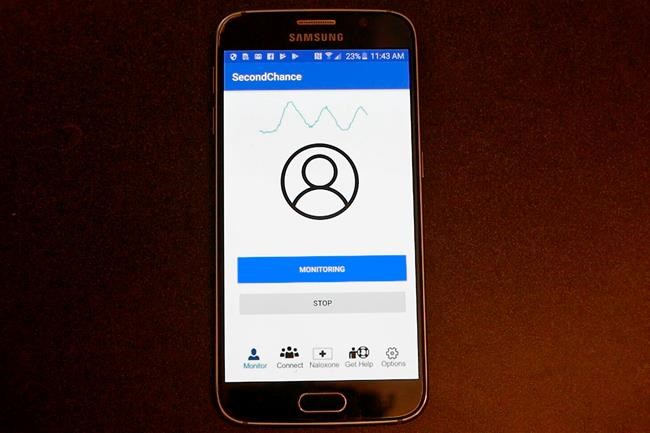
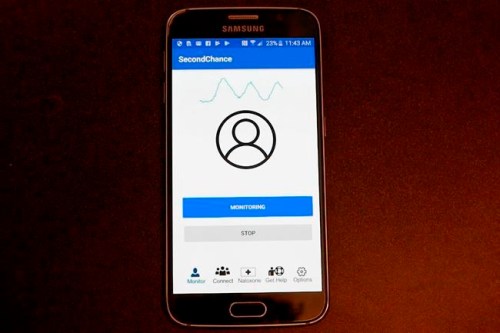
This image from video provided by the University of Washington in January 2019 shows a demonstration of the smartphone app developed by Rajalakshmi Nandakumar, Shyamnath Gollakota and Jacob E. Sunshine that uses sound waves to measure breathing. In first-step testing reported Wednesday, Jan. 9 the device detected early breathing problems in some people who’d just injected illegal drugs. (Mark Stone/University of Washington via AP)

“They’re not trying to kill themselves — they’re addicted to these drugs. They have an incentive to be safe,” said Shyamnath Gollakota, an engineering and computer science associate professor whose lab turns regular cellphones into temporary sonar devices.

But an emergency room physician who regularly cares for overdose patients wonders how many people really would try such a device.

“This is an innovative way to attack the problem,” said Dr. Zachary Dezman of the University of Maryland School of Medicine, who wasn’t involved in the research.

Still, “I don’t know if many folks who use substances are going to have the forethought to prepare,” he added.

More than 47,000 people in the U.S. died of opioid overdoses in 2017. The drugs suppress breathing but a medicine called naloxone often can save victims — if it reaches them in time. Usually, that means someone has to witness the collapse. Dr. Jacob Sunshine, a University of Washington anesthesiologist, notes that people have died with a relative in the next room unaware they were in trouble.

The research team settled on cellphones as potential overdose monitors because just about everyone owns one. They designed an app that measures how someone’s chest rises and falls to see if they’re slipping into the slow, shallow breaths of an overdose or stop breathing completely.

How? The software converts the phone’s built-in speaker and microphone to send out inaudible sound waves and record how they bounce back. Analyzing the signals shows specific breathing patterns.

It won’t work inside a pocket, and people would have to stay within 3 feet. The researchers are in the process of making the app capable of dialing for help if a possible overdose is detected.

They put the experimental gadget to the test at North America’s first supervised injection site in Vancouver, British Columbia, where people are allowed to bring in illegal drugs and inject themselves under medical supervision in case of overdose. Study participants agreed to have doctoral student Rajalakshmi Nandakumar place the app-running cellphone nearby during their regularly monitored visit.

The software correctly identified breathing problems that could signal an overdose — seven or fewer breaths a minute, or pauses in breathing — 90 per cent of the time, the researchers found. Most were near-misses; two of the 94 study participants had to be resuscitated.

For a bigger test, the researchers next turned to people who don’t abuse drugs but were about to receive anesthesia for elective surgery. Rendering someone unconscious for an operation mimics how an overdose shuts down breathing.

Measuring 30 seconds of slowed or absent breathing as those patients went under, the app correctly predicted 19 of 20 simulated overdoses, the researchers reported. The one missed case was a patient breathing slightly faster than the app’s cutoff.

The findings were reported in the journal Science Translational Medicine. The researchers have patented the invention and plan to seek Food and Drug Administration approval.

___

The Associated Press Health & Science Department receives support from the Howard Hughes Medical Institute’s Department of Science Education. The AP is solely responsible for all content.

Report Error Submit a Tip

More Stories

Homegrown grub: Resto turns to the Leaf for freshest ingredients

AV Kitching 4 minute read Preview

Homegrown grub: Resto turns to the Leaf for freshest ingredients

AV Kitching 4 minute read Yesterday at 3:39 PM CDT

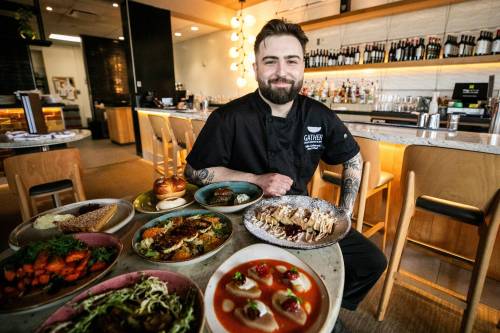
The term “eat local” has taken on a whole new meaning at Gather Craft Kitchen and Bar, where the journey from plot to plate is measured in footsteps rather than miles.

Head chef Mike Licharson has expanded the restaurant’s focus on local sourcing by incorporating fruit and vegetables grown in The Leaf’s biomes and outdoor kitchen garden into his menu.

Bananas from the tropical biomes star in his banana-bread French toast and accompanying banana compote. Leeks, braised slowly and paired with Manitoba-grown beluga lentils, and Swiss chard — which takes the place of grape leaves in Licharson’s play on classic meze dolmades, a nod to the chef’s Greek-Ukrainian-Irish heritage — are both grown in the outdoor kitchen garden.

The park’s produce complements the restaurant’s other locally sourced ingredients, Licharson says.

Read
Yesterday at 3:39 PM CDT

Use summer’s hard truth to mend your heart

Maureen Scurfield 4 minute read Monday, Aug. 3, 2026

Dear Miss Lonelyhearts: I refused to go stay at my girlfriend’s cabin in July, because her alcoholic ex-husband still owns the lot beside her. He’s building a big fancy cabin this summer and she’s more than OK with that, even though they’re divorced.

I seriously criticized him — calling him a drunk and a loser — and she actually dumped me before she went off to the lake for all of July!

When she finally came back home I went to see her. She told me I “just wasn’t enough of a lake person” for her.

Then the fight began! I said, “So are you back with him permanently?” and she said, “What do you think? You let me go!”

Central remains toughest division in league

Ken Wiebe 8 minute read Preview

Central remains toughest division in league

Ken Wiebe 8 minute read Yesterday at 6:35 PM CDT

With NHL training camps set to open in just over five weeks’ time, the Central Division still looks like one of the toughest places to earn a playoff spot in the league.

With three of the top seven teams in the NHL standings last season residing within it — including the Presidents’ Trophy winning Colorado Avalanche (121 points) — it’s clear that the most likely path back to the Stanley Cup playoffs for the Winnipeg Jets is by earning one of the two wild-card berths available in the Western Conference.

And since a couple of teams in the Pacific Division are on the rise, including the Anaheim Ducks and San Jose Sharks (who missed the playoffs by four points in Macklin Celebrini’s second NHL season), it’s likely going to take north of 90 or 92 points to punch a post-season ticket.

With that in mind, let’s take a look at some of the moves that were made in the Central, realizing there are a few questions left unanswered for the Jets and the seven other clubs:

Read
Yesterday at 6:35 PM CDT

City seeking proposals to lease, manage, program St. Boniface heritage buildings

Joyanne Pursaga 5 minute read Preview

City seeking proposals to lease, manage, program St. Boniface heritage buildings

Joyanne Pursaga 5 minute read Yesterday at 5:46 PM CDT

The future of three key St. Boniface heritage buildings should soon become clearer, following years of debate over what to do with them.

The city is seeking proposals to lease, program and manage the Carré Civique de Saint-Boniface (St. Boniface Civic Square), which includes the former St. Boniface city hall (219 Provencher Blvd.), former St. Boniface fire hall (212 Dumoulin St.) and the former St. Boniface health unit building (233 Provencher Blvd.)

The city would continue to own the buildings.

“Promotion of francophone art, language, culture and history are all things that I’d like to see continue and thrive and prosper (through this lease),” said St. Boniface Coun. Matt Allard.

Read
Yesterday at 5:46 PM CDT

What’s open, what’s closed, what’s up in Winnipeg on Terry Fox Day

Free Press staff 4 minute read Preview

What’s open, what’s closed, what’s up in Winnipeg on Terry Fox Day

Free Press staff 4 minute read Friday, Jul. 31, 2026

The first Monday in August marks Terry Fox Day in Manitoba, honouring the legendary Canadian who was born in Winnipeg in 1958. 

Read
Friday, Jul. 31, 2026

Experimental app might spot drug overdoses in time to help

Lauran Neergaard, The Associated Press 4 minute read Preview

Experimental app might spot drug overdoses in time to help

Lauran Neergaard, The Associated Press 4 minute read Wednesday, Jan. 9, 2019

WASHINGTON - Too often people die of an opioid overdose because no one's around to notice they're in trouble. Now scientists are creating a smartphone app that beams sound waves to measure breathing — and summon help if it stops.

The app is still experimental. But in a novel test, the "Second Chance" app detected early signs of overdose in the critical minutes after people injected heroin or other illegal drugs, researchers reported Wednesday.

One question is whether most drug users would pull out their phone and switch on an app before shooting up. The University of Washington research team contends it could offer a much-needed tool for people who haven't yet found addiction treatment.

"They're not trying to kill themselves — they're addicted to these drugs. They have an incentive to be safe," said Shyamnath Gollakota, an engineering and computer science associate professor whose lab turns regular cellphones into temporary sonar devices.

Read
Wednesday, Jan. 9, 2019