WEATHER ALERT

Chronic pain given as top reason for using medical marijuana

Advertisement

Advertise with us

Chronic pain is the most common reason people give when they enrol in state-approved medical marijuana programs.

Read this article for free:

or

Already have an account? Log in here »

To continue reading, please subscribe:

Subscribe and receive a limited-edition Free Press branded hat or tote.

Digital Subscription

One year of digital access for only $205*

  • Enjoy unlimited reading on winnipegfreepress.com
  • Read the E-Edition, our digital replica newspaper
  • Access News Break, our award-winning app
  • Play interactive puzzles

*First annual payment billed as $205.00 + GST for one year. This annual subscription will automatically renew at $233.00 + GST every 52 weeks (10% off the regular annual price of $259.35). Offer available to new and qualified returning subscribers only. Cancel any time.

To continue reading, please subscribe:

Add Free Press access to your Brandon Sun subscription for only an additional

$1 for the first 4 weeks*

  • Enjoy unlimited reading on winnipegfreepress.com
  • Read the E-Edition, our digital replica newspaper
  • Access News Break, our award-winning app
  • Play interactive puzzles
Start now

*Your next Brandon Sun subscription payment will increase by $1.00 and you will be charged $17.95 plus GST for four weeks. After four weeks, your payment will increase to $24.95 plus GST every four weeks.

Hey there, time traveller!
This article was published 04/02/2019 (2731 days ago), so information in it may no longer be current.

Chronic pain is the most common reason people give when they enrol in state-approved medical marijuana programs.

That’s followed by stiffness from multiple sclerosis and chemotherapy-related nausea, according to an analysis of 15 states published Monday in the journal Health Affairs.

The study didn’t measure whether marijuana actually helped anyone with their problems, but the patients’ reasons match up with what’s known about the science of marijuana and its chemical components.
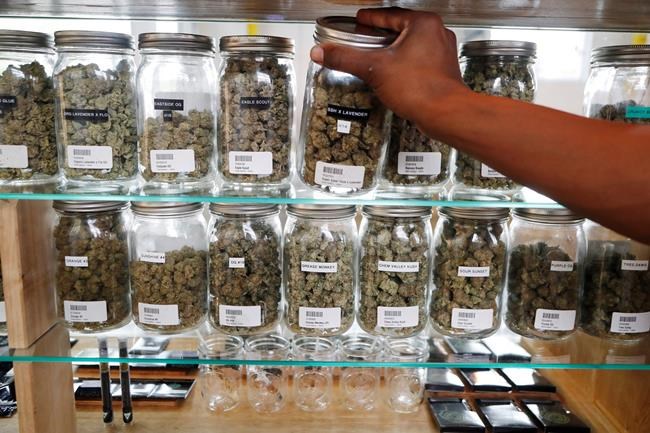
FILE - In this Oct. 2, 2018, file photo, a clerk reaches for a container of marijuana buds for a customer at Utopia Gardens, a medical marijuana dispensary in Detroit. Chronic pain is the most commonly cited reason people give when they enroll in state medical cannabis programs. A study published Monday, Feb. 4, 2019, in the journal Health Affairs looks at available data from states that allow marijuana for medical use. (AP Photo/Carlos Osorio, File)

“The majority of patients for whom we have data are using cannabis for reasons where the science is the strongest,” said lead author Kevin Boehnke of University of Michigan in Ann Arbor.

California became the first state to allow medical use of marijuana in 1996. More than 30 states now allow marijuana for dozens of health problems. Lists of allowable conditions vary by state, but in general, a doctor must certify a patient has an approved diagnosis.

While the U.S. government has approved medicines based on compounds found in the plant, it considers marijuana illegal and imposes limits on research. That’s led to states allowing some diseases and symptoms where rigorous science is lacking. Most of the evidence comes from studying pharmaceuticals based on marijuana ingredients, not from studies of smoked marijuana or edible forms.

Dementia and glaucoma, for example, are conditions where marijuana hasn’t proved valuable, but some states include them. Many states allow Parkinson’s disease or post-traumatic stress disorder where evidence is limited.

The analysis is based on 2016 data from the 15 states that reported the reasons given for using marijuana. Researchers compared the symptoms and conditions with a comprehensive review of the scientific evidence: a 2017 report from the National Academies of Sciences, Engineering and Medicine.

About 85 per cent of patients’ reasons were supported by substantial or conclusive evidence in the National Academies report.

The study shows people are learning about the evidence for cannabis and its chemical components, said Ziva Cooper of University of California Los Angeles’ Cannabis Research Initiative. Cooper served on the National Academies report committee, but wasn’t involved in the new study.

About two-thirds of the about 730,000 reasons were related to chronic pain, the study found. Patients could report more than one pain condition, so the figure may overestimate patient numbers.

Patients include 37-year-old Brandian Smith of Pana, Illinois, who qualifies because she has fibromyalgia. On bad days, her muscles feel like they’re being squeezed in a vise. She said she has stopped taking opioid painkillers because marijuana works better for her. She spends about $300 a month at her marijuana dispensary.

“Cannabis is the first thing I’ve found that actually makes the pain go away and not leave me so high that I can’t enjoy my day,” Smith said.

The study also found:

—Alaska, Colorado, Nevada, and Oregon saw a decline in medical marijuana patients after legalization of recreational marijuana in those states.

—More than 800,000 patients were enrolled in medical marijuana programs in 2017 in 19 states. That doesn’t count California and Maine, which don’t require patients to register. Other estimates have put the number at more than 2 million .

___

Follow AP Medical Writer Carla K. Johnson on Twitter: @CarlaKJohnson

___

The Associated Press Health & Science Department receives support from the Howard Hughes Medical Institute’s Department of Science Education. The AP is solely responsible for all content.

Report Error Submit a Tip

More Stories

Manitoba Innovates seeks to pump up in-person networking as artificial intelligence-created resumés become norm

Gabrielle Piché 6 minute read Preview

Manitoba Innovates seeks to pump up in-person networking as artificial intelligence-created resumés become norm

Gabrielle Piché 6 minute read Yesterday at 7:57 PM CDT

The average job seeker has a resumé ghost writer: artificial intelligence.

Many Manitoba businesses are flooded by AI-generated resumés and, in turn, use AI to filter the tide. In response, Manitoba Innovates — a startup incubator — is launching an initiative to lead more in-person networking.

“We’re still looking for authenticity in people,” said Ron Cantiveros, manager of the incubator’s new career catalyst program.

“We’re looking for innovative ways to … attract talent, but also verify and qualify talent.”

Read
Yesterday at 7:57 PM CDT

A small step among troubling signs

Editorial 4 minute read Preview

A small step among troubling signs

Editorial 4 minute read Updated: Yesterday at 8:02 AM CDT

There’s no getting around the fact — to many people, downtown Winnipeg is unsafe. Period.

Read
Updated: Yesterday at 8:02 AM CDT

Daycare grapples with five-year-old’s outbursts, choking incidents

Maggie Macintosh 4 minute read Preview

Daycare grapples with five-year-old’s outbursts, choking incidents

Maggie Macintosh 4 minute read Friday, Jul. 24, 2026

A Windsor Park child-care facility is weighing a five-year-old’s right to care versus the safety of other children who have been choked.

Little People’s Place expelled a pre-schooler in the spring in response to his aggressive behaviour toward other children and staff.

The child’s family has appealed to the province for him to be reinstated.

The case is raising concerns about inclusion support resources and measures to protect everyone at the Cottonwood Road daycare.

Read
Friday, Jul. 24, 2026

Vacant Bay store on road to redevelopment, St. Vital Centre owner says

Gabrielle Piche 6 minute read Preview

Vacant Bay store on road to redevelopment, St. Vital Centre owner says

Gabrielle Piche 6 minute read Friday, Jul. 24, 2026

Entertainment attractions are coming to fill the former Hudson’s Bay space in St. Vital Centre.

Montreal-based real estate firm Leyad, the south Winnipeg mall’s owner, says it is finalizing an agreement for the vacant property. Further details should appear in the next couple months, said president Henry Zavriyev.

“We’re looking at what other types of experiences we can bring to the mall that aren’t just typical retail,” he said during a visit to Winnipeg this week.

“We want to create an experience where you can just come to the mall, hang out here for hours, no matter if you’re a kid, an adult, a retiree.”

Read
Friday, Jul. 24, 2026

‘Eight credible threats’ against Hydro employees: CEO

Chris Kitching 6 minute read Preview

‘Eight credible threats’ against Hydro employees: CEO

Chris Kitching 6 minute read Updated: Yesterday at 4:32 PM CDT

Manitoba Hydro president and CEO Allan Danroth took aim at critics and revealed he and staff members have been threatened while defending the Crown corporation’s plan for three new combustion turbines Monday.

Without identifying individuals, Danroth said “constant, uninformed criticism” of Hydro and misinformation has eroded public trust and contributed to hostilities and an unsafe workplace for employees.

“Manitoba Hydro is currently managing eight credible threats against our employees, five of them directed at me personally,” Danroth told a Public Utilities Board hearing in Winnipeg.

“More troubling is these threats are increasingly affecting our front-line workforce. In the last year, my employees have been threatened with weapons, including guns, while performing their duties, and in one recent incident a homeowner directed his dogs to attack one of our meter readers.”

Read
Updated: Yesterday at 4:32 PM CDT

Lawsuit targets pontoon boat operator, Sea-Doo driver, owner in fatal Whitemud River crash

Tyler Searle 4 minute read Preview

Lawsuit targets pontoon boat operator, Sea-Doo driver, owner in fatal Whitemud River crash

Tyler Searle 4 minute read Yesterday at 6:32 PM CDT

The father of a 39-year-old Portage la Prairie woman killed in a boat crash on the Whitemud River is suing the men who were operating the involved watercraft, claiming they were negligent when navigating the winding waterway.

Ashley Danielle Rodgers died Aug. 10, 2024, when the Sea-Doo on which she was a passenger rounded a curve in the river and collided with an oncoming pontoon boat. She suffered blunt injuries and died, leaving behind two children.

“She was a vulnerable passenger on the back of a Sea-Doo which had no protection,” said lawyer Martin Pollock.

“It’s a very interesting case because it addresses water safety, it addresses boating safety, it’s an absolute nightmare to parents and loved ones when people are out on waterways. Rules have to be respected, especially going around blind curves.”

Read
Yesterday at 6:32 PM CDT