Correction: Travel-Portugal-Black History Month-Lagos

Advertisement

Advertise with us

LAGOS, Portugal - In a story Feb. 6 about a museum exploring a Portuguese town's role in the African slave trade, The Associated Press misidentified the museum's Portuguese name. It is O Mercado de Escravos, not El Mercado de Escravos. Removes reference to conquistadors.

Read this article for free:


or

Already have an account? Log in here »

To continue reading, please subscribe:

Subscribe and receive a limited-edition Free Press branded hat or tote.

Digital Subscription

One year of digital access for only $205*

  • Enjoy unlimited reading on winnipegfreepress.com
  • Read the E-Edition, our digital replica newspaper
  • Access News Break, our award-winning app
  • Play interactive puzzles

*First annual payment billed as $205.00 + GST for one year. This annual subscription will automatically renew at $233.00 + GST every 52 weeks (10% off the regular annual price of $259.35). Offer available to new and qualified returning subscribers only. Cancel any time.

To continue reading, please subscribe:

Add Free Press access to your Brandon Sun subscription for only an additional

$1 for the first 4 weeks*

  • Enjoy unlimited reading on winnipegfreepress.com
  • Read the E-Edition, our digital replica newspaper
  • Access News Break, our award-winning app
  • Play interactive puzzles
Start now

*Your next Brandon Sun subscription payment will increase by $1.00 and you will be charged $17.95 plus GST for four weeks. After four weeks, your payment will increase to $24.95 plus GST every four weeks.

Hey there, time traveller!
This article was published 06/02/2019 (2749 days ago), so information in it may no longer be current.

LAGOS, Portugal – In a story Feb. 6 about a museum exploring a Portuguese town’s role in the African slave trade, The Associated Press misidentified the museum’s Portuguese name. It is O Mercado de Escravos, not El Mercado de Escravos. Removes reference to conquistadors.

A corrected version of the story is below:

Portuguese town opens window to its slave-trade history
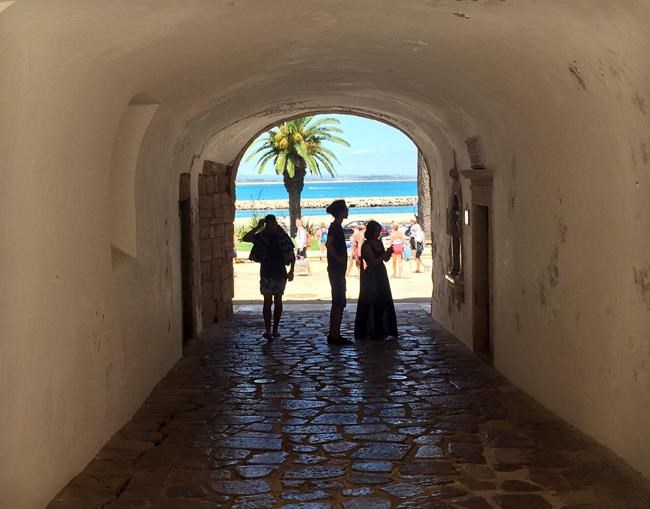
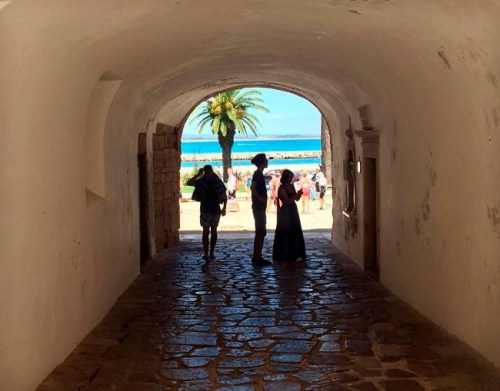
In this June, 27, 2018 photo, tourists walk through a tunnel at the medieval-area Castle of Lagos in Lagos, Portugal. Lagos, a striking Portuguese beach town of charming coastlines and slightly sandstone cliffs, is the birthplace of the African slave trade in Europe. A museum dedicated to slavery is helping this enclave in the heart of southern Portugal's Algarve region come to terms with its history. (AP Photo/Russell Contreras)

Lagos, a Portuguese beach town of charming coastlines and sandstone cliffs, is also the birthplace of the African slave trade in Europe

By RUSSELL CONTRERAS

Associated Press

To the casual visitor, Lagos is a striking beach town of charming coastlines and sightly sandstone cliffs. A medieval castle sits alongside boutique cafes and outdoor restaurants serving boiled and baked octopus. One can speed along the shore in a watercraft during the day and catch an intimate Fado show at night.

Lagos is also where the African slave trade took root in Europe.

And once you go looking for that, nothing erases its legacy — not the pristine waters, not the soft chords of a Portuguese guitarra.

Across Portugal, some cities and residents are trying to come to terms with the country’s role in a trade that ultimately enslaved an estimated 12.5 million Africans around the world. Activists and elected officials have debated placing memorial markers or establishing slavery museums.

In Lagos, the community has made its move.

In 1444, the first 200 captured black slaves from West Africa arrived in this enclave in the heart of southern Portugal’s Algarve region. They had been kidnapped in raids after Prince Henry the Navigator set up a trading post off the coast of present-day Mauritania. Different forms of slavery already existed, but a newly efficient and barbaric system soon arose.

Profits from the sale of those first enslaved Africans led to more Portuguese raids of West Africa. Over 10 years, an estimated 800 slaves came to Lagos through this pre-Middle Passage route. As a result, Lagos became Europe’s first African slave market, and it was enriching the Portuguese Crown.

Within a generation, the Portuguese African slave market moved to the capital, Lisbon, where the monarch established rules on arrivals, taxation and sales. Other European navigators developed their own routes, and their nations followed in the lucrative African slave trade.
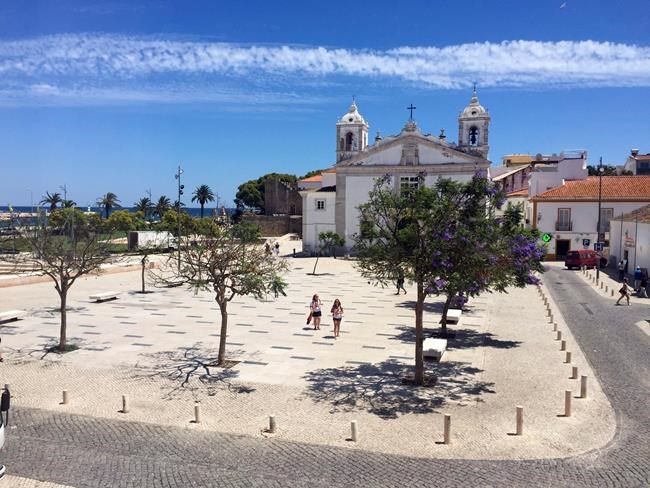
this June 27, 2018 photo, tourists walk through the Infante D. Henrique Square in Lagos, Portugal. Lagos, a striking Portuguese beach town of charming coastlines and slightly sandstone cliffs, is also the birthplace of the African slave trade in Europe. (AP Photo/Russell Contreras)

Walking around Lagos, it’s hard to reconcile how a place of such beauty was witness to such human horror. After all, eating a bifana — a Portuguese sandwich made of marinated pork cutlets — while listening to the calm waves lap at boulders is soothing to any soul trying to escape the political divisions back home.

And yet, to the credit of this small beach town, it’s not ignoring its past. It wants to you investigate it.

At the spot where the slave market began, a slavery museum has been erected. O Mercado de Escravos, or the Slave Market, sits in a building that once housed enslaved Africans. The museum tells the story of the first captured black slaves and the economic boom that followed. A striking sculpture of King Amador, who started a slave revolt on the island of Sao Tome in 1595, grabs your attention on the first floor. It stands next to a bench where some museum officials say slaves once waited to be sold.

Upstairs, the walls are painted with images of the slave route and of slavery. Exhibits include a book kept by a slave trader and chains that once held slaves.

Outside in the Praça do Infante D. Henrique square is the open space where slaves likely walked before experiencing their first sale. Castelo dos Governadores, a 13th century Moorish castle and fortress, is located around the corner. One can’t help but imagine slaves walking through these tunnels where tourists now take selfies and stroll freely after a snack.

Carlos Fortuna, an economics professor at the University of Coimbra in Coimbra, Portugal, said that El Mercado de Escravos is part of a trend in travel that some call “dark tourism,” where visitors seek out sites linked to misery and tragedy.

“Think Auschwitz,” Fortuna said. “You can visit the site of this notorious concentration camp and then get ice cream right after just outside.”

At El Mercado de Escravos, visitors can buy souvenir magnets and bookmarks.

So to take in the full impact of this town’s connection to human suffering, one must put away the wallet and the selfie stick. Meditate on what took place here and appreciate the acknowledgement of that history after 500 years. It’s a powerful feeling.

___

If You Go…
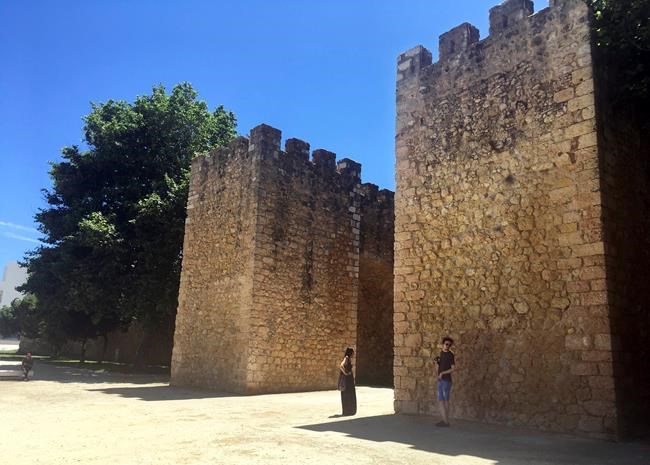
In this June 27, 2018, photo, tourists stand in front of the medieval-era Castle of Lagos in Lagos, Portugal. Lagos, a striking Portuguese beach town of charming coastlines and slightly sandstone cliffs, is the birthplace of the African slave trade in Europe. (AP Photo/Russell Contreras)

El Mercado de Escravos

Praça Infante Dom Henrique 1,

8600-525 Lagos, Portugal

Admission: € 4

Located in the Praça do Infante D. Henrique square, across from the Church of Santa Maria

https://www.visitalgarve.pt/es/450/mercado-de-esclavos.aspx

___

Associated Press journalist Russell Contreras is a member of the AP’s race and ethnicity team. Follow Contreras on Twitter at http://twitter.com/russcontreras

Report Error Submit a Tip

More Stories

Men’s recovery home dedicated to ‘homeless hero’ Faron Hall’s memory

Scott Billeck 14 minute read Preview

Men’s recovery home dedicated to ‘homeless hero’ Faron Hall’s memory

Scott Billeck 14 minute read Friday, Aug. 14, 2026

Faron Hall never got the chance to begin recovery. Once heralded as Winnipeg’s “homeless hero” after twice plunging into the Red River to save strangers from drowning, Hall told St. Boniface Street Links executive director Marion Willis shortly before his death in 2014 that he wanted help for his alcoholism.

Read
Friday, Aug. 14, 2026

Correction: Travel-Portugal-Black History Month-Lagos

The Associated Press 6 minute read Preview

Correction: Travel-Portugal-Black History Month-Lagos

The Associated Press 6 minute read Thursday, Feb. 7, 2019

LAGOS, Portugal - In a story Feb. 6 about a museum exploring a Portuguese town's role in the African slave trade, The Associated Press misidentified the museum's Portuguese name. It is O Mercado de Escravos, not El Mercado de Escravos. Removes reference to conquistadors.

A corrected version of the story is below:

Portuguese town opens window to its slave-trade history

Lagos, a Portuguese beach town of charming coastlines and sandstone cliffs, is also the birthplace of the African slave trade in Europe

Read
Thursday, Feb. 7, 2019

Trailblazing Western Scrap Metals heavy-equipment operator relishes role at massive crane’s control

David Sanderson 7 minute read Preview

Trailblazing Western Scrap Metals heavy-equipment operator relishes role at massive crane’s control

David Sanderson 7 minute read Friday, Aug. 14, 2026

Less than five per cent of heavy-equipment operators in the country are women but that number is trending upward, according to a study conducted by trade magazine Crane & Hoist Canada.

It was reported that in Ontario roughly eight per cent of jobs in the transport and heavy-equipment field are currently held by women. Furthermore, in 2024 almost 20 per cent of graduates at an Edmonton-based heavy-equipment operator training school were female, the article stated.

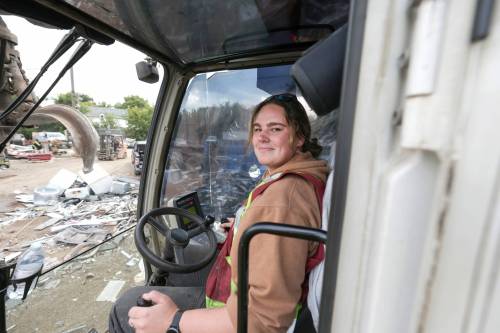
That brings us to Harmony Guspodarchuk, the first female crane operator in the 70-year history of Western Scrap Metals, a family-owned business at 18 Sutherland Ave.

Three years ago, Guspodarchuk literally stepped into the driver’s seat of a 27,500-kilogram, Liebherr C 924 Heavy Lift Litronic crane. The 29-year-old hasn’t looked back much since.

Read
Friday, Aug. 14, 2026

Puzzles Palace

1 minute read Monday, Jul. 27, 2026

To solve our puzzles, please subscribe with this special offer: |

Murphy helps Goldeyes battle back to beat Explorers

Mike McIntyre 6 minute read Preview

Murphy helps Goldeyes battle back to beat Explorers

Mike McIntyre 6 minute read 5:55 PM CDT

Max Murphy didn’t hesitate when asked to describe his season so far.

“It’s been terrible,” the veteran Winnipeg Goldeyes outfielder told the Free Press.

Murphy is admittedly critical of himself, the product of a high standard he’s set during a pro baseball career that began in 2014 and has included the past six years with the Fish, where he’s established new franchise records for home runs and RBIs.

So you can imagine the relief felt on Sunday when he looked a lot more like the Murphy of old in leading his team to a 6-2 comeback victory over the Sioux City Explorers to close out a six-game homestand at Blue Cross Park in front of a season-high crowd of 6,825.

Read
5:55 PM CDT

Poilievre’s lips moving, but Canadians aren’t interested in what he’s saying

Tom Brodbeck 5 minute read Preview

Poilievre’s lips moving, but Canadians aren’t interested in what he’s saying

Tom Brodbeck 5 minute read Thursday, Aug. 6, 2026

Pierre Poilievre’s biggest political challenge right now isn’t Prime Minister Mark Carney’s popularity.

It’s the fact that he still seems to be campaigning against a political landscape that no longer exists.

More than a year after the 2025 federal election, the Conservative leader is still relying on the same message, the same themes and the same attacks that defined his party’s campaign before voters went to the polls.

And Canadians appear to be tuning it out.

Read
Thursday, Aug. 6, 2026