Parent frustration mounting over snow days: ‘A nightmare this winter’
Advertisement
Read this article for free:
or
Already have an account? Log in here »
To continue reading, please subscribe:

Digital Subscription
One year of digital access for only $205*
- Enjoy unlimited reading on winnipegfreepress.com
- Read the E-Edition, our digital replica newspaper
- Access News Break, our award-winning app
- Play interactive puzzles
*First annual payment billed as $205.00 + GST for one year. This annual subscription will automatically renew at $233.00 + GST every 52 weeks (10% off the regular annual price of $259.35). Offer available to new and qualified returning subscribers only. Cancel any time.
To continue reading, please subscribe:
Add Free Press access to your Brandon Sun subscription for only an additional
$1 for the first 4 weeks*
- Enjoy unlimited reading on winnipegfreepress.com
- Read the E-Edition, our digital replica newspaper
- Access News Break, our award-winning app
- Play interactive puzzles
*Your next Brandon Sun subscription payment will increase by $1.00 and you will be charged $17.95 plus GST for four weeks. After four weeks, your payment will increase to $24.95 plus GST every four weeks.
Read unlimited articles for free today:
or
Already have an account? Log in here »
Hey there, time traveller!
This article was published 28/02/2019 (2732 days ago), so information in it may no longer be current.
It’s a decision that sparks joy for some, and chaos for others: The snow day.
Parents across the country have been forced to scramble in recent weeks as wintry conditions prompted schools to shut, with some regions recording an unusually high number of closures.
“The school closures have been a nightmare this winter,” says Magdalena Castelli, who has three children in southern Ontario’s Hamilton Wentworth District School Board, and another in daycare.
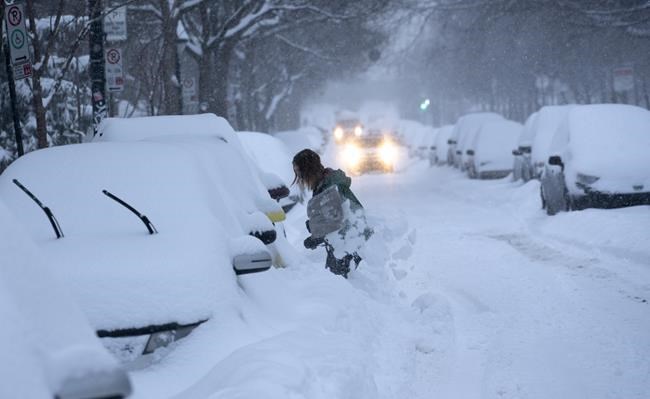
The disruption to daily routine unleashes a pre-dawn scramble in many households, a juggling act that sees some parents work from home, drop kids at a babysitter’s or trudge into the office with charges in tow.
“When they close a school they don’t see the big impact that has on people’s lives,” says Castelli.
While student safety is consistently cited as the driving force behind snow days, the wide variety of policies in different parts of the country demonstrate how subjective those decisions can be.
An examination of storm day procedures reveals a haphazard patchwork of varying approaches to inclement weather across Canada that appear to be based on a region’s common practice and culture as much as the forecast.
While schools in the Prairie provinces virtually never close for bad weather, schools on Canada’s East Coast regularly shut down during snow storms.
In B.C., Ontario and Quebec, schools tend to call snow days sparingly.
The snow day disparity cannot entirely be explained by weather, suggests Linda Libby, a meteorologist with Environment Canada.
“It’s different across the country,” she said. “I don’t use the term worse.”
While Atlantic Canada is on multiple storm tracks, and temperatures can often hover around the freezing mark, Libby said “it doesn’t mean our weather is any worse.”
Still, the number of snow days remains higher in the Maritimes, with some school boards consistently reporting double-digit school closures over a winter.
Halifax tends to have fewer snow days than more rural areas, averaging about 4.4 snow days a year over the last decade.
But that’s still more than double the number of school closures in similar-sized cities in Quebec and Ontario. For example, Quebec City averages 1.75 snow days a year, while the Hamilton area averages 1.6 days — though this year it’s had substantially more.
Meanwhile, the contrast between Atlantic Canada and the Prairies is even more dramatic.
When asked the number of snow days for the last 10 years, a spokeswoman for Edmonton Public Schools said: “Zero.”
A response from the Winnipeg School Division was similar.
“We have not had a ‘snow day’ in over 30 years,” spokesman Radean Carter said. “Our policy — and this applies for all school divisions in Winnipeg — is that schools remain open unless city buses are shut down.”
Schools in Saskatchewan also rarely close — if ever.
Regina Public Schools, for example, do not have snow days, explains spokesman Terry Lazarou.
“Our schools will remain open through most weather-related occurrences, including snow or -40 C temperatures,” he said.
Lazarou added that there have been multiple times in the past several years that school buses didn’t run because of extreme snowfall or ice accumulation.
“But schools did not close because of it,” he said. “We do not keep records of schools closing due to weather because it does not happen.”
A report on school storm days in Nova Scotia in 2009 acknowledged the role of culture in snow day decisions.
“Two closely connected practices have become a long-held tradition in the public school culture in Nova Scotia,” the report said. “Schools are closed to students when the buses are cancelled because of the weather and … teachers do not have to report to work on storm days when schools are closed to students.”
In Ontario, the Durham District School Board, which includes Whitby, Oshawa and surrounding communities, remains open even when buses are cancelled due to inclement weather.
“We still have a lot of students who are within walking distance — all the students in the immediate surrounding neighbourhood would walk to school,” said Christine Nancekivell, chief facilities officer for the Durham board.
“Even bus students, some parents would still drive them to school and drop them off. So there are still students that attend, and school is still open.”
Even within the same city, however, different schools boards can take different approaches.
The Hamilton Wentworth District School Board says if bus transportation is cancelled, schools are closed. Yet the Catholic school board in the same region does not have the same policy — it cancelled bus service this week but schools remained open.
The arbitrary nature of snow days across the country has lead some parents to speak out about the frustration of dealing with school cancellations, and the potential impact on instructional time.
New Brunswick’s education minister has spoken out about the loss of classroom time in the province.
Dominic Cardy has floated the idea of so-called blizzard bags — homework for students to do on a snow day.
Nova Scotia Teachers Union president Paul Wozney said teachers already provide students with learning activities with a take-home component.
He said preparing multiple baggies for kids to use on storm days is a “staggering amount of effort” given snow days don’t hurt learning.
Wozney pointed to a 2014 study by Harvard University researcher Joshua Goodman that found a strong relationship between student absences and achievement — but no impact from lost instructional time due to school closures.
Besides, Wozney said any stereotype that teachers are “at home drinking scotch in their jammies” couldn’t be further from the truth.
He said teachers use snow days to catch up on marking, communicate with parents, work on lesson preparation, develop individual program plans and for personal wellness.
“Teachers are burning out at epic rates, so some are going to self care,” he said.
Yet many parents are also under pressure, and snow days can add to the stress.
“Whatever the weather, we need to get to work,” says Castelli, the mother of four in the Hamilton region, noting that some parents must go to work to get paid and be able to feed their children.
Cardy says he’s heard concerns from parents about the scramble for last minute child care.
“This isn’t 1945. You don’t have a parent at home baking cookies for the kids while dad goes off to work,” Cardy said. “It’s a totally different society and we haven’t done a lot to recognize the changes.”
He said snow days could unfairly disadvantage low-income earners, who may have to take an unpaid day off work or pay for additional child care on an already stretched budget.
– With files from Cassandra Szklarski in Toronto.