UN: No screen time for babies; only 1 hour for kids under 5

Advertisement

Advertise with us

LONDON - The World Health Organization has issued its first-ever guidance for how much screen time children under 5 should get: not very much, and none at all for those under 1.

Read this article for free:


or

Already have an account? Log in here »

To continue reading, please subscribe:

Subscribe and receive a limited-edition Free Press branded hat or tote.

Digital Subscription

One year of digital access for only $205*

  • Enjoy unlimited reading on winnipegfreepress.com
  • Read the E-Edition, our digital replica newspaper
  • Access News Break, our award-winning app
  • Play interactive puzzles

*First annual payment billed as $205.00 + GST for one year. This annual subscription will automatically renew at $233.00 + GST every 52 weeks (10% off the regular annual price of $259.35). Offer available to new and qualified returning subscribers only. Cancel any time.

To continue reading, please subscribe:

Add Free Press access to your Brandon Sun subscription for only an additional

$1 for the first 4 weeks*

  • Enjoy unlimited reading on winnipegfreepress.com
  • Read the E-Edition, our digital replica newspaper
  • Access News Break, our award-winning app
  • Play interactive puzzles
Start now

*Your next Brandon Sun subscription payment will increase by $1.00 and you will be charged $17.95 plus GST for four weeks. After four weeks, your payment will increase to $24.95 plus GST every four weeks.

Hey there, time traveller!
This article was published 24/04/2019 (2671 days ago), so information in it may no longer be current.

LONDON – The World Health Organization has issued its first-ever guidance for how much screen time children under 5 should get: not very much, and none at all for those under 1.

The U.N. health agency said Wednesday that kids under 5 should not spend more than one hour watching screens every day — and that less is better.

The guidelines are somewhat similar to advice from the American Academy of Pediatrics. That group recommends children younger than 18 months should avoid screens other than video chats. It says parents of young children under two should choose “high-quality programming” with educational value and that can be watched with a parent to help kids understand what they’re seeing.
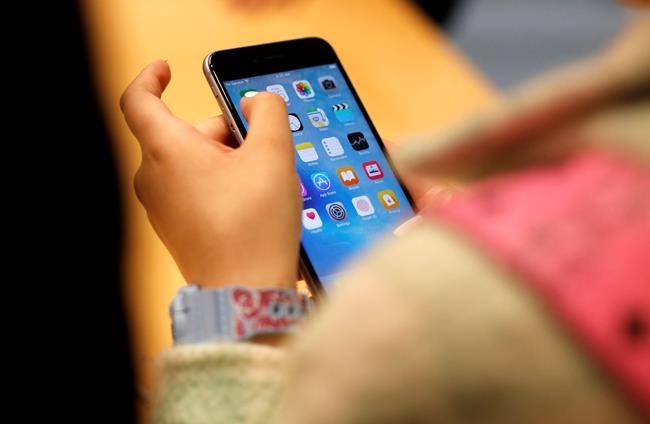
FILE - In this Sept. 25, 2015, file photo, a child holds an Apple iPhone 6S at an Apple store on Chicago's Magnificent Mile in Chicago. The World Health Organization Wednesday, April 24, 2019, issued its first-ever guidance for how much screen time children under 5 should get: not very much, and none at all for those under 1. (AP Photo/Kiichiro Sato, File)

Some groups said WHO’s screen time guidelines failed to consider the potential benefits of digital media.

WHO’s screen time advice “overly focuses on quantity of screen time and fails to consider the content and context of use,” said Andrew Przybylski, director of research at the Oxford Internet Institute at the University of Oxford. “Not all screen time is created equal.”

Britain’s Royal College of Paediatrics and Child Health said the data available were too weak to allow its experts to set any thresholds for the appropriate level of screen time.

“Our research has shown that currently there is not strong enough evidence to support the setting of screen time limits,” said Dr. Max Davie, the college’s Officer for Health Improvement. “The restricted screen time limits suggested by WHO do not seem proportionate to the potential harm,” he said.

WHO did not specifically detail the potential harm caused by too much screen time, but said the guidelines — which also included recommendations for physical activity and sleep — were needed to address the increasing amount of sedentary behaviour in the general population. It noted that physical inactivity is a leading risk factor for death and a contributor to the rise in obesity.

The agency said infants less than 1 year should spend at least half an hour every day on their stomachs and that older kids should get at least three hours of physical activity every day.


Report Error Submit a Tip

More Stories

Revered Broadway rail anchors Winnipeg’s resilient skateboarding scene

Benjamin Waldman 11 minute read Preview

Revered Broadway rail anchors Winnipeg’s resilient skateboarding scene

Benjamin Waldman 11 minute read Yesterday at 11:13 AM CDT

The Woodsworth Building at the corner of Broadway and Kennedy Street is an accidental, unofficial mecca of Winnipeg skateboarding.

Read
Yesterday at 11:13 AM CDT

WRHA directs three care homes to accommodate surge of hospital patients

Malak Abas 5 minute read Preview

WRHA directs three care homes to accommodate surge of hospital patients

Malak Abas 5 minute read Updated: Yesterday at 5:01 PM CDT

The Winnipeg Regional Health Authority has directed three long-term care centres to make space for hospital patients, citing “exceptionally high demand for care across the health-care system.”

Read
Updated: Yesterday at 5:01 PM CDT

Development turning long-vacant gas station in Selkirk into commercial hub

By Tiago Resko 2 minute read Preview

Development turning long-vacant gas station in Selkirk into commercial hub

By Tiago Resko 2 minute read Thursday, Aug. 13, 2026

A plot of land that has sat vacant in Selkirk for 30 years is being redeveloped to host new businesses in the heart of the city.

The former gas station site on Main Street — between Rosser and Pacific avenues — will be turned into a commercial hub that will be home to six local businesses, and will be a big stepping stone for economic growth in Selkirk, Mayor Larry Johannson said Thursday.

“For decades this site has been a reminder of what once was. Today, it represents what is possible when investors see the potential of our community and choose to be a part of its future,” he said in a news release announcing the project and Thursday’s groundbreaking.

“This development reflects confidence in Selkirk, our economy and the direction we are heading.”

Read
Thursday, Aug. 13, 2026

Could renewed interest in strategically critical rare earth elements finally make sub-sector profitable?

Joel Schlesinger 6 minute read Preview

Could renewed interest in strategically critical rare earth elements finally make sub-sector profitable?

Joel Schlesinger 6 minute read 3:00 AM CDT

Rare earth elements are among the most critical of mined resources for modern economies.

They’re essential in manufacturing specialized magnets used in a host of technologies from wind turbines and electric vehicles to hard drives, smartphones, television screens, and fibre optics. Most notably, however, rare earth minerals are increasingly vital to the defence industry.

These 17 elements — closely related chemically and usually found all together in mineral deposits — have indeed been growing in geopolitical importance as the United States, Canada and other Western nations recognize their dependence on production from China.

It is the world’s largest producer and processor of rare earths, including the most in-demand elements neodymium and praseodymium used to manufacture very light and powerful magnets for an array of technologies, including the most advanced weapons of modern warfare.

Read
3:00 AM CDT

August in the kitchen garden

Colleen Zacharias 7 minute read Preview

August in the kitchen garden

Colleen Zacharias 7 minute read 3:00 AM CDT

Lynne Hermiston is passionate about growing her own food. Her backyard food garden in south Winnipeg is an amazing example of the abundance and diversity of food that can be grown in a relatively small space. But it’s also a prime example of how a zest for learning innovative methods can make food gardening more fun.

Hermiston’s backyard is approximately 10 metres wide and 15 metres deep. The growing area consisting of raised beds and a couple of in-ground beds between her deck and back fence is about nine metres deep. There is not a single blade of turf grass in sight. The design for this attractive and productive space was created by Classic Landscaping four years ago. A series of raised wooden beds mulched with straw are neatly arranged on a light grey, slate-like surface. An inviting centre arbor acts as a focal point and supports climbing plants. The square-shaped raised-bed area receives eight to nine hours of sun daily. It is flanked on one side by a long, linear-shaped bed, planted with flowering perennials that attract and support pollinators.

The food plants Hermiston is growing this summer include tomatoes, cucumbers, squash, beets, chickpeas, beans, onions, sweet potatoes, horseradish, garlic, peppers, carrots, pumpkin and cauliflower. She is growing Chinese Pink celery, an heirloom variety with bubblegum-pink stems, for the first time, as well as eggplant.

She also grows salad greens and herbs, which have made delicious additions to her summer recipes this year. Only a few harvests remain of the spinach she planted. But, compared to last year’s growing season, some food plants are taking their time, Hermiston says.

Read
3:00 AM CDT

HSC weapons scanners effective, needed at other hospitals: nurses union

Carol Sanders 5 minute read Preview

HSC weapons scanners effective, needed at other hospitals: nurses union

Carol Sanders 5 minute read 9:57 AM CDT

The AI weapons scanners at Health Sciences Centre have detected close to 2,000 items since they were installed at Manitoba’s largest hospital.

From March 6, 2025 to the beginning of this month, a total of 1,973 items had been flagged by the scanners and identified for further review, Shared Health said this week.

Knives, Swiss army knives and other multi-tools, drugs, alcohol, box cutters, syringes and other injection devices were detected, it said. The technology set up at entrances to the adult and children’s emergency rooms and the crisis response centre is designed to identify a wide range of objects that may require review under site safety protocols.

But Manitoba Nurses Union president Darlene Jackson said the technology isn’t available everywhere at HSC, and a sawed-off rifle was discovered in the adult ER earlier this month.

Read
9:57 AM CDT