US pregnancy deaths are up, especially among minorities

Advertisement

Advertise with us

Pregnancy-related deaths are rising in the United States and the main risk factor is being black, according to new reports that highlight racial disparities in care during and after childbirth.

Read this article for free:


or

Already have an account? Log in here »

To continue reading, please subscribe:

Subscribe and receive a limited-edition Free Press branded hat or tote.

Digital Subscription

One year of digital access for only $205*

  • Enjoy unlimited reading on winnipegfreepress.com
  • Read the E-Edition, our digital replica newspaper
  • Access News Break, our award-winning app
  • Play interactive puzzles

*First annual payment billed as $205.00 + GST for one year. This annual subscription will automatically renew at $233.00 + GST every 52 weeks (10% off the regular annual price of $259.35). Offer available to new and qualified returning subscribers only. Cancel any time.

To continue reading, please subscribe:

Add Free Press access to your Brandon Sun subscription for only an additional

$1 for the first 4 weeks*

  • Enjoy unlimited reading on winnipegfreepress.com
  • Read the E-Edition, our digital replica newspaper
  • Access News Break, our award-winning app
  • Play interactive puzzles
Start now

*Your next Brandon Sun subscription payment will increase by $1.00 and you will be charged $17.95 plus GST for four weeks. After four weeks, your payment will increase to $24.95 plus GST every four weeks.

Hey there, time traveller!
This article was published 07/05/2019 (2685 days ago), so information in it may no longer be current.

Pregnancy-related deaths are rising in the United States and the main risk factor is being black, according to new reports that highlight racial disparities in care during and after childbirth.

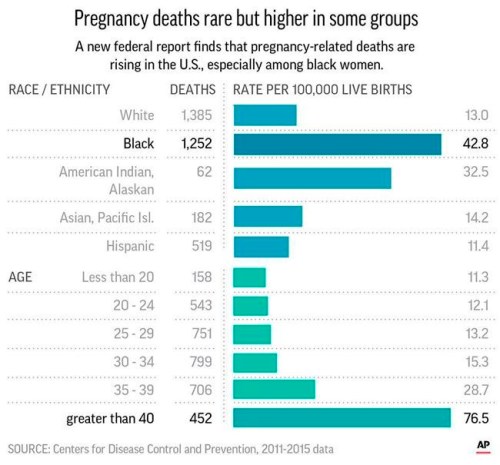
Black women, along with Native Americans and Alaska natives, are three times more likely to die before, during or after having a baby, and more than half of these deaths are preventable, Tuesday’s report from the Centers for Disease Control and Prevention concludes.

Although these deaths are rare — about 700 a year — they have been rising for decades.
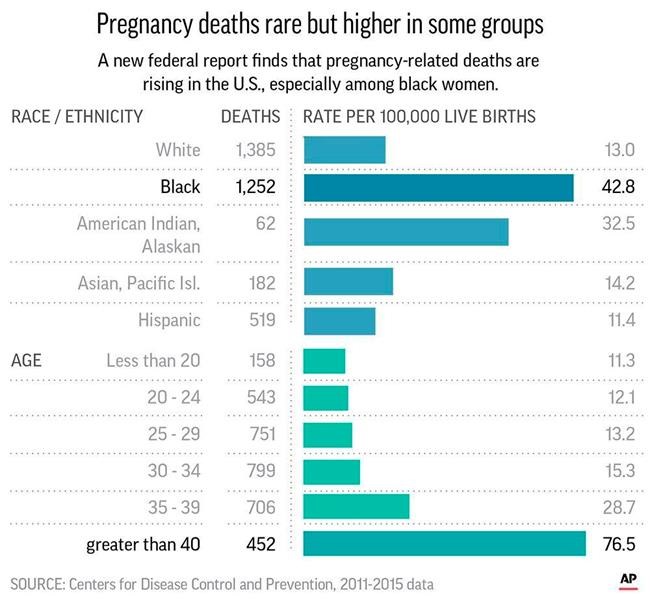
More U.S. women are dying from pregnancy-related causes.;

“An American mom today is 50% more likely to die in childbirth than her own mother was,” said Dr. Neel Shah, a Harvard Medical School obstetrician.

Separately, the American College of Obstetricians and Gynecologists released new guidelines saying being black is the greatest risk factor for these deaths. The guidelines say women should have a comprehensive heart-risk evaluation 12 weeks after delivery, but up to 40% of women don’t return for that visit and payment issues may be one reason.

Bleeding and infections used to cause most pregnancy-related deaths, but heart-related problems do now.

“Pregnancy is really a stress test” because of the extra blood the heart is moving for mom and child, said the head of the guidelines panel, Dr. James Martin. That can reveal previously unknown problems or lead to new ones.

The CDC report found that about one third of maternal deaths happened during pregnancy, a third were during or within a week of birth, and the rest were up to a year later.

Globally, maternal mortality fell about 44% between 1990 and 2015, according to the World Health Organization. But the U.S. is out of step: Moms die in about 17 out of every 100,000 U.S. births each year, up from 12 per 100,000 a quarter century ago.

Possible factors include the high C-section rates in the U.S. and soaring rates of obesity, which raises the risk of heart disease, diabetes and other complications.

Black women in the U.S. are about three times as likely to die from a pregnancy-related cause as others, partly because of racial bias they may experience in getting care and doctors not recognizing risk factors such as high blood pressure, said Dr. Lisa Hollier, the obstetrician group’s president.

Stacy Ann Walker may be an example. She was 29, healthy and excited to be expecting her first child eight years ago “when the unimaginable happened and left both of us fighting for our life.”

The Hartford, Connecticut, woman said her doctor brushed off her complaints of shortness of breath, exhaustion and swelling in her legs as normal aches and pains of pregnancy. Her baby developed life-threatening complications requiring an emergency cesarean section, and weighed less than 3 pounds at delivery.

But her ordeal wasn’t over. After the birth, she developed heart valve problems and heart failure, requiring surgery.
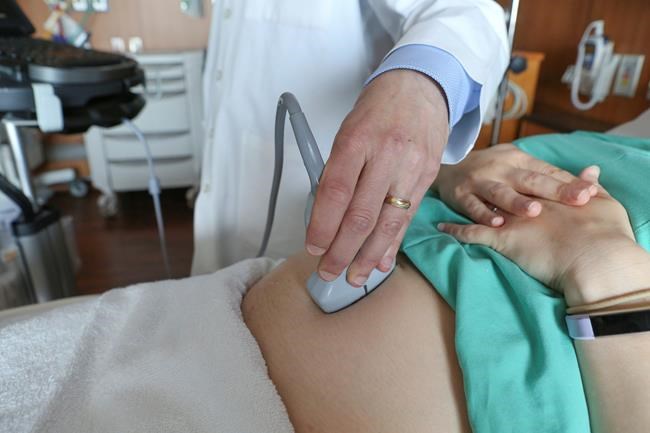
FILE - In this Aug. 7, 2018 file photo, a doctor performs an ultrasound scan on a pregnant woman at a hospital in Chicago. According to a report released by the Centers for Disease Control and Prevention on Tuesday, May 7, 2019, in about 17 out of every 100,000 U.S. births each year, the mother dies from pregnancy-related causes - around 700 deaths a year. But the rate has been slowly climbing for decades. The rate was around 12 per 100,000 a quarter century ago. (AP Photo/Teresa Crawford)

“Never did I think my life would be in danger,” said Walker, who is black. She spoke at a news conference the obstetricians group held on the guidelines.

The CDC looked at about 3,000 pregnancy-related deaths from 2011 through 2015, using death certificates. Researchers also looked at more intensive investigations of about 250 deaths done in 13 states.

The latter review determined that 60% of deaths were preventable. Often, three or four problems contributed to a death, ranging from doctors’ mistakes to the difficulty some women had getting housing and healthy food.

The report shows the need to educate doctors and patients about risks for new moms, and to expand Medicaid health coverage in all states so that postpartum care is available for all moms up to a year after giving birth, said Dr. Alison Stuebe of the University of North Carolina.

“We as a society do a terrible job of taking care of mothers after the baby comes out,” she said.

“It’s like the baby is the candy and the mama is the wrapper,” she added. “Once the baby is out of the wrapper, the wrapper is tossed aside.”

___

The Associated Press Health and Science Department receives support from the Howard Hughes Medical Institute’s Department of Science Education. The AP is solely responsible for all content.

Report Error Submit a Tip

More Stories

Retired sportscaster Scott Oake determined as fundraising for women's addictions treatment facility enters home stretch

Melissa Martin 5 minute read Preview

Retired sportscaster Scott Oake determined as fundraising for women's addictions treatment facility enters home stretch

Melissa Martin 5 minute read Thursday, Sep. 10, 2026

For now, the patch of land just east of the Victoria Hospital doesn’t look like much: just a field of rocks, mounded dirt, and concrete piles driven into the earth. Yet when Scott Oake looks over the site, he can already imagine how it will look in just over a year’s time, when the new Anne Oake Family Recovery Centre is expected to open.

It’s easier to picture this time around. In 2020, when the recently-retired CBC sportscaster and his late wife, Anne, were building their first labour of intermingled grief and love, the Bruce Oake Recovery Centre for men, it was hard for him to wrap his mind around how a raw construction site could transform into a welcoming addictions treatment facility.

When that centre opened in 2021, Oake found it looked “almost identical” to the architect’s renderings. So it’s easy to hope the Anne Oake Centre will be the same. It will be the first facility of its kind, its founders believe, not only in Canada but in North America: a place where 50 to 70 women can pursue sobriety while staying with their children.

“At Bruce Oake there’s a culture of love, and most of all a culture of hope,” Oake said, speaking at the site Thursday after a media conference to announce the final push of the centre’s fundraising campaign. “I can feel it every time I walk into that building. And I know it will be the same here.”

Read
Thursday, Sep. 10, 2026

A life's story: ‘Ivor the Driver’ found his calling in the ranching life

Aaron Epp 7 minute read Preview

A life's story: ‘Ivor the Driver’ found his calling in the ranching life

Aaron Epp 7 minute read 3:00 AM CDT

Ivor Asham’s family couldn’t have picked a better image to accompany his obituary. There he is, riding Flash, his beloved brown and white quarter horse, a black cowboy hat on his head and a drink in his hand.

Asham owned and operated Birds Hill Park Ranch for nearly 35 years, where he shared his lifelong passion for horses with thousands of visitors. He moved hay, harnessed horses and drove the wagons, introducing himself as “Ivor the Driver.”

Over the years, Asham built a reputation as the quintessential cowboy.

There’s a restaurant at the ranch filled with memorabilia that he collected over the years. Calgary Stampede posters, cowboy boot-shaped shot glasses, a child’s rocking horse, a wagon wheel and numerous photos of legendary actor John Wayne are just some of the items that line the walls.

Read
3:00 AM CDT

9 to 5:

Tory McNally 8 minute read Preview

9 to 5:

Tory McNally 8 minute read 2:00 AM CDT

I watched the 1980 comedy 9 to 5 for the first time this week.

I know: I’m an HR consultant. I’ve been doing this work for 13 years, I write about workplaces for a living, and somehow I had never actually watched the movie that gave us one of the most recognizable workplace songs of all time.

I knew the premise, of course. I knew American music icon Dolly Parton was in it. I knew there was a terrible boss and three women who eventually decided they had enough.

I expected a funny, somewhat dated movie about three women getting revenge on an awful boss. What I didn’t expect was to spend the next two hours thinking about how much has changed in the workplace since 1980 — and how much really hasn’t.

Read
2:00 AM CDT

Artist’s inspired work brings Red River Métis story back to Portage and Main

Conrad Sweatman 8 minute read Preview

Artist’s inspired work brings Red River Métis story back to Portage and Main

Conrad Sweatman 8 minute read Updated: Yesterday at 2:47 PM CDT

Jennine Krauchi calls them the “grandmothers.” “They speak to you very silently. You never hear a word, but they speak,” Krauchi says, referring to the antique pieces of Métis needlework she’s carefully studied for years. But there are few precedents for her latest art project: a 85-foot-wide by 32-foot-high chain curtain of Métis needlework that drapes over the historic Bank of Montreal’s neoclassical facade.

Read
Updated: Yesterday at 2:47 PM CDT

US pregnancy deaths are up, especially among minorities

Mike Stobbe And Marilynn Marchione, The Associated Press 4 minute read Preview

US pregnancy deaths are up, especially among minorities

Mike Stobbe And Marilynn Marchione, The Associated Press 4 minute read Tuesday, May. 7, 2019

Pregnancy-related deaths are rising in the United States and the main risk factor is being black, according to new reports that highlight racial disparities in care during and after childbirth.

Black women, along with Native Americans and Alaska natives, are three times more likely to die before, during or after having a baby, and more than half of these deaths are preventable, Tuesday's report from the Centers for Disease Control and Prevention concludes.

Although these deaths are rare — about 700 a year — they have been rising for decades.

"An American mom today is 50% more likely to die in childbirth than her own mother was," said Dr. Neel Shah, a Harvard Medical School obstetrician.

Read
Tuesday, May. 7, 2019

Chrétien says Canada bows to no one in fiery address at 9/11 commemoration

Sarah Smellie, The Canadian Press 6 minute read Preview

Chrétien says Canada bows to no one in fiery address at 9/11 commemoration

Sarah Smellie, The Canadian Press 6 minute read Updated: Yesterday at 8:15 PM CDT

GANDER - Former prime minister Jean Chrétien drew a standing ovation inside a Gander, N.L., hockey arena on Friday as he delivered a pointed message to American leaders during a ceremony marking the 9/11 terrorist attacks in the United States, 25 years ago.

The 92-year-old warned Americans never to mistake Canadian generosity for weakness, nor its kindness for softness.

U.S. Ambassador Pete Hoekstra looked on as Chrétien insisted his pointed words were a sign of friendship. Friends tell each other the truth, he said.

“We embraced our friends and we helped them in their moment of need, but we bow to no one,” Chretien said, as the crowd erupted again.

Read
Updated: Yesterday at 8:15 PM CDT