US births lowest in 3 decades despite improving economy

Advertisement

Advertise with us

America's baby bust isn't over. The nation's birth rates last year reached record lows for women in their teens and 20s, a government report shows, leading to the fewest babies in 32 years.

Read this article for free:


or

Already have an account? Log in here »

To continue reading, please subscribe:

Subscribe and receive a limited-edition Free Press branded hat or tote.

Digital Subscription

One year of digital access for only $205*

  • Enjoy unlimited reading on winnipegfreepress.com
  • Read the E-Edition, our digital replica newspaper
  • Access News Break, our award-winning app
  • Play interactive puzzles

*First annual payment billed as $205.00 + GST for one year. This annual subscription will automatically renew at $233.00 + GST every 52 weeks (10% off the regular annual price of $259.35). Offer available to new and qualified returning subscribers only. Cancel any time.

To continue reading, please subscribe:

Add Free Press access to your Brandon Sun subscription for only an additional

$1 for the first 4 weeks*

  • Enjoy unlimited reading on winnipegfreepress.com
  • Read the E-Edition, our digital replica newspaper
  • Access News Break, our award-winning app
  • Play interactive puzzles
Start now

*Your next Brandon Sun subscription payment will increase by $1.00 and you will be charged $17.95 plus GST for four weeks. After four weeks, your payment will increase to $24.95 plus GST every four weeks.

Hey there, time traveller!
This article was published 14/05/2019 (2695 days ago), so information in it may no longer be current.

America’s baby bust isn’t over. The nation’s birth rates last year reached record lows for women in their teens and 20s, a government report shows, leading to the fewest babies in 32 years.

The provisional report, released Wednesday and based on more than 99% of U.S. birth records, found 3.788 million births last year. It was the fourth year the number of births has fallen, the lowest since 1986 and a surprise to some experts given the improving economy.

The fertility rate of 1.7 births per U.S. woman also fell 2%, meaning the current generation isn’t making enough babies to replace itself. The fertility rate is a hypothetical estimate based on lifetime projections of age-specific birth rates.
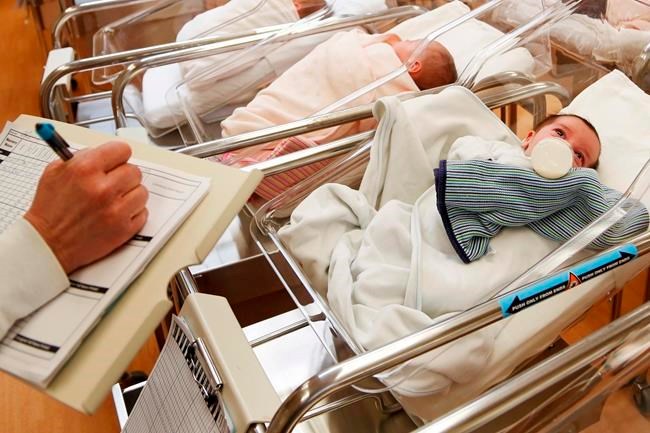
FILE - This Feb. 16, 2017 file photo shows newborn babies in the nursery of a postpartum recovery center in upstate New York. According to a government report released Wednesday, May 15, 2019, U.S. birth rates reached record lows for women in their teens and 20s, leading to the fewest babies in 32 years. (AP Photo/Seth Wenig, File)

Whether more U.S. women are postponing motherhood or forgoing it entirely isn’t yet clear.

If trends continue, experts said, the U.S. can expect labour shortages including in elder care when aging baby boomers need the most support.

“I keep expecting to see the birth rates go up and then they don’t,” said demographer Kenneth M. Johnson of University of New Hampshire’s Carsey School of Public Policy.

He estimates 5.7 million babies would have been born in the past decade if fertility rates hadn’t fallen from pre-recession levels.

“That’s a lot of empty kindergarten rooms,” said Johnson, who wasn’t involved in the report.

Other experts are not concerned, predicting today’s young women will catch up with childbearing later in their lives. The only two groups with slightly higher birth rates in 2018 were women in their late 30s and those in their early 40s.

“Our fertility rates are still quite high for a wealthy nation,” said Caroline Sten Hartnett, a demographer at the University of South Carolina.

American women are starting families sooner than most other developed nations, according to other research . Other countries are seeing similar declines in birth rates.

Young Americans still want to have children, but they don’t feel stable enough to have them yet, said Karen Benjamin Guzzo, who studies families at Bowling Green State University in Ohio.

The U.S. could do more to encourage childbearing with parental leave, preschool expansion and child care subsidies and other policies aimed at helping young adults struggling with student loan debt and housing costs, Guzzo said.

Brandy Loshaw, 39, of Webster, New York, said despite a stable career as a dental hygienist “I would never be able to afford the added expense of a child and live comfortably.” She said she is grateful she “can never remember a time in my life that I wanted children.”

Pollution and climate change worry her. “I would hate to bring a child into a world that could fall apart around them,” Loshaw said.

Births were down across racial groups, with small declines for Hispanics, whites, blacks and Asians. The number of babies born to native Hawaiian and Pacific Islanders was stable.

The Centers for Disease Control and Prevention report also found:

—Overall, the U.S. birth rate for women ages 15 to 44 was 59 births per 1,000 women, an all-time low.

—Last year, there were 2% fewer births than in 2017.

—Births to teenagers again reached a record low. The number of births to mothers ages 15 through 19 was 179,607, down 8%.

—The rate for premature births — delivery at less than 37 weeks — rose for the fourth straight year to just over 10%, from 9.9%.

___

Follow AP Medical Writer Carla K. Johnson on Twitter: @CarlaKJohnson

___

The Associated Press Health and Science Department receives support from the Howard Hughes Medical Institute’s Department of Science Education. The AP is solely responsible for all content.


Report Error Submit a Tip

More Stories

Perfumer battling city hall to keep his shop open

Gabrielle Piché 5 minute read Preview

Perfumer battling city hall to keep his shop open

Gabrielle Piché 5 minute read Yesterday at 5:45 PM CDT

Michael O’Malley has been here before — fighting the City of Winnipeg to keep his business open.

He usually spends his days concocting scents. He’s owned La Parfumerie, a Wolseley shop, since 1993.

Twenty-seven natural perfumes line shelves on 145 Evanson St.’s bottom floor. O’Malley lives above the space.

Now, he’s required to change the home’s zoning or shut out walk-in customers. Either would kill the company, O’Malley said.

Read
Yesterday at 5:45 PM CDT

Legislation needed on vacant buildings

Editorial 4 minute read Preview

Legislation needed on vacant buildings

Editorial 4 minute read 2:00 AM CDT

There is something deeply backwards about a system that lets a property owner keep a building boarded up indefinitely while neighbours are left to live with the consequences.

Read
2:00 AM CDT

Wab Kinew as ‘communicator in chief’

Paul G. Thomas 6 minute read Preview

Wab Kinew as ‘communicator in chief’

Paul G. Thomas 6 minute read Yesterday at 2:00 AM CDT

Premier Wab Kinew and his party have been riding high in the polls longer than normal for a government one year or less away from its first re-election contest. One reason is his ubiquitous, dominating communications presence as NDP leader and premier.

The argument here is that Kinew has supplemented his prerogatives as premier and party leader (such as appointing cabinet ministers and approving party nominations) with the skilful use of communications to advance his policy agenda, boost his personal popularity and maintain the competitive advantage of his party over the opposition Progressive Conservatives.

Communications has always been a significant part of politics and policy making. However, in the contemporary political and media environments, communications considerations have moved from the background to the foreground of decision-making by political parties, including when they are performing in the role of government. Campaigning and governing now overlap in what has been described as a permanent election campaign.

Political parties use communications strategies for several purposes: to establish an image of the leader which makes a positive emotional connection with voters; to promote a coherent message and to keep party members on message; and to gain favourable media coverage for its policies and other actions on almost a daily basis.

Read
Yesterday at 2:00 AM CDT

Jets defenceman spent whole summer working on getting to the next level

Ken Wiebe 8 minute read Preview

Jets defenceman spent whole summer working on getting to the next level

Ken Wiebe 8 minute read Updated: Yesterday at 1:57 PM CDT

Tyrel Bauer makes no apologies for the pugilistic piece of his path.

The Winnipeg Jets defenceman is ready to drop the gloves and throw down when the situation calls for it and he takes great pride in protecting his teammates.

It’s a big part of the reason Bauer will be among the 23 players submitted by the Jets on the opening-day roster on Monday.

“I’ve fought and clawed, both metaphorically and literally and now I just want to show that I can play as well,” Bauer said during a chat with the Free Press during training camp. “(Toughness) is always something that I have, it’s always something in my back pocket and something that I take a lot of pride in doing, for my teammates, for the city and the people who invest in this hockey club. That will never change.

Read
Updated: Yesterday at 1:57 PM CDT

Today’s horoscope

Georgia Nicols 4 minute read Preview

Today’s horoscope

Georgia Nicols 4 minute read 2:00 AM CDT

MOON ALERT: Avoid shopping (except food and gas) and important decisions after 6 p.m. The moon is in Taurus.

ARIES (March 21-April 19)

You might find you identify with your possessions more than usual. In fact, this could be why you might be tempted to be a bit extravagant or go overboard buying something. This same sense of largesse might creep into your financial negotiations. Be aware of this.

TAURUS (April 20-May 20)

Read
2:00 AM CDT

Canada resorting to its tried and true playbook

Niigaan Sinclair 5 minute read Preview

Canada resorting to its tried and true playbook

Niigaan Sinclair 5 minute read Yesterday at 6:00 AM CDT

In 1846, Britain faced an emergency influenced by the Irish famine, so leaders repealed the country’s “Corn Laws” and restrictions on imported food and grain, transitioning to a system of free trade.

This created a crisis in the then Province of Canada, which had relied on British “preferential” status to prop up its agricultural and resource industries.

As a result, Canada looked south for new markets and eventually negotiated a free trade agreement with the United States.

This required land to be acquired and converted for industrial use quickly, so Canada quickly dispatched Commissioner William Robinson to negotiate with Indigenous communities along Lake Huron and Lake Superior for land.

Read
Yesterday at 6:00 AM CDT