Respect the soil in your garden: Don’t add plastic to it

Advertisement

Advertise with us

Before it's too late, I must address one of my pet peeves: deliberately putting plastic in soil.

Read this article for free:


or

Already have an account? Log in here »

To continue reading, please subscribe:

Subscribe and receive a limited-edition Free Press branded hat or tote.

Digital Subscription

One year of digital access for only $205*

  • Enjoy unlimited reading on winnipegfreepress.com
  • Read the E-Edition, our digital replica newspaper
  • Access News Break, our award-winning app
  • Play interactive puzzles

*First annual payment billed as $205.00 + GST for one year. This annual subscription will automatically renew at $233.00 + GST every 52 weeks (10% off the regular annual price of $259.35). Offer available to new and qualified returning subscribers only. Cancel any time.

To continue reading, please subscribe:

Add Free Press access to your Brandon Sun subscription for only an additional

$1 for the first 4 weeks*

  • Enjoy unlimited reading on winnipegfreepress.com
  • Read the E-Edition, our digital replica newspaper
  • Access News Break, our award-winning app
  • Play interactive puzzles
Start now

*Your next Brandon Sun subscription payment will increase by $1.00 and you will be charged $17.95 plus GST for four weeks. After four weeks, your payment will increase to $24.95 plus GST every four weeks.

Hey there, time traveller!
This article was published 21/05/2019 (2645 days ago), so information in it may no longer be current.

Before it’s too late, I must address one of my pet peeves: deliberately putting plastic in soil.

Take, for instance, black plastic sheeting sold as mulch. This stuff appears at first to be a cure-all for weed problems. Lay it on the ground, cut holes only where you will set plants, and weeds will die from lack of light, presumably ending all your weed problems for years to come.

But other problems arise. An impermeable sheet of plastic over the ground can leave plant roots and soil microorganisms gasping for air. Roots set in the openings might develop even greater breathing problems when all the water falling on the plastic floods those holes.
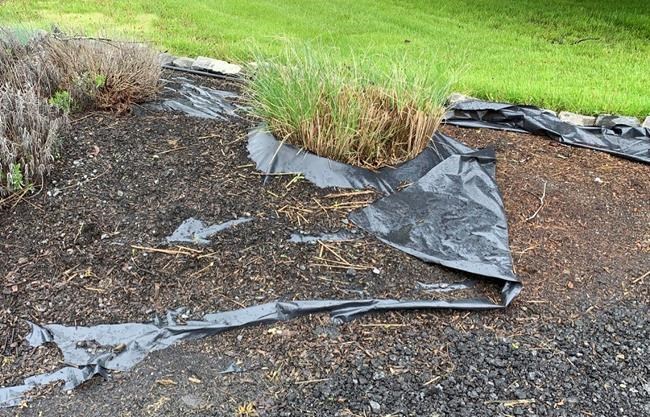
This undated photo shows a mulched planting bed in New Paltz, N.Y. Even if black plastic were as effective, long-term, at controlling weeds as hoped, it often falls short in its appearance in the landscape as shown here. (Lee Reich via AP)

And the plastic eventually starts to tear and break apart, which creates a general mess.

GEOTEXTILES?

Geotextiles, introduced more recently, are offered as an alternative to solid black plastic sheeting. These are woven or spun plastic fabrics that resist tearing and have many small holes to allow passage of air and water.

Both black plastic and geotextiles are widely used by farmers, gardeners and landscapers. If you don’t like the way these synthetic mulches look — surely the case when they are used in landscaping — you cover them. Wood chips look natural and are widely used for this purpose. And anyway, geotextiles need a thin cover of something to shade out the minimal light that makes its way through the tiny holes.

But problems arise again. Over time, plenty of weeds eventually sneak in to grow in the wood chips covering the plastic. Over time, the chips or other coverings also slide around to expose the plastic or geotextile beneath — not a pretty sight!

Furthermore, even if black plastic or geotextiles don’t do their jobs forever, they’ll be in the soil that long, or almost. Try to make over the landscape in the future and you will be wrestling with and cutting geotextiles or collecting scraps of black plastic.

PLASTIC PEANUTS, NO

Another, fortunately less frequently suggested use of plastic in the soil is plastic “peanuts.”

Mixed into the soil, the reasoning goes, they should increase aeration. While they would undoubtedly make a soil lighter, and thus seemingly better aerated, all that extra air is pretty much locked up in the peanuts.

It has also been suggested that a layer of plastic peanuts be put in the bottoms of flowerpots to enhance drainage, as layers of gravel have been used. In this case, that layer of peanuts is worse than useless, just as the traditional layer of gravel was. The effect in both cases is to create a “perched” water table inside the pot, giving the roots less depth of well-aerated soil.

Also, spent potting soil can be spread on the ground or added to a compost pile, but do you want the peanuts there also?

ENVIRONMENTALLY FRIENDLY ALTERNATIVES

Enough plastic makes its way into our soils inadvertently, from misplaced plant tags to those stickers now ubiquitous on fruit skins to pieces of old plastic pots.

Deliberately embedding a permanent, synthetic blanket in the ground or mixing plastic peanuts into the soil brings no benefits that could not be had in a more nature-friendly way. Paper mulch, for instance, biodegrades and can stave off weeds for a season. Perlite or vermiculite are two minerals that can lighten a soil more effectively than styrofoam peanuts.

Removing plastic put on or in the soil becomes difficult or well-nigh impossible.

Deliberately putting plastic in the ground is disrespectful of the skin — that is, soil — that covers our planet and sustains much of the life here.

___

http://www.leereich.com/blog

http://leereich.com

Report Error Submit a Tip

More Stories

Opera group hits pub to stage shows for sophisticated palates

Conrad Sweatman 3 minute read Preview

Opera group hits pub to stage shows for sophisticated palates

Conrad Sweatman 3 minute read 2:00 AM CDT

Opera’s famous drinking songs — La Traviata’s Brindisi, Don Giovanni’s Fin ch’han dal vino, Carmen’s Votre Toast — tend to flow with references to women and wine, not beer.

But that hasn’t stopped Winnipeggers from sipping 1919s or Generics at local bar and brewery Little Brown Jug over the past few years to the strains of Verdi, Puccini and Mozart.

Currently in its eighth season, Opera by the Pint has its next LBJ event Wednesday at 7 p.m. (The artists also perform at the Public Brewhouse and Gallery in Steinbach at 7 p.m. on Thursday.)

This week’s program focuses on musical hits, while also featuring traditional Filipino ballads and Mexican art songs.

Read
2:00 AM CDT

A better approach, but not yet enough

Editorial 4 minute read Preview

A better approach, but not yet enough

Editorial 4 minute read 2:00 AM CDT

In late June, when the Winnipeg Police Service launched a 10-day ‘crackdown’ on open drug use and illegal drug sales in areas in and around downtown, it did so without consulting or informing community outreach and social services agencies working in the targeted areas.

Inevitably, the WPS action drew criticism from several front-line agencies, which issued a collective statement just two days after the police operation began, pointing out that heavy-handed policing would drive vulnerable people away from the help they desperately need.

“Every day we work to build trust with people who have experienced trauma, discrimination, and barriers to care,” Kate Sjoberg, executive director of Resource Assistance for Youth, said at the time. “Actions that create fear around accessing services can undo months or years of relationship-building and place people at greater risk of preventable harm.”

At the time, WPS Chief Gene Bowers held up his hand and said, “That’s on me.”

Read
2:00 AM CDT

Take advantage of hydroelectric potential

Jerry Storie 5 minute read Preview

Take advantage of hydroelectric potential

Jerry Storie 5 minute read 2:00 AM CDT

Manitoba Hydro tells us that we are going to need significant new electricity generation over the coming decades.

Hydro, like every other utility in the world has recognized this fact. Around the world, new generating capacity is being built. Countries that have access to hydroelectric potential are building dams and planning for the future. Other countries, without the natural advantage rivers provide, are building nuclear energy capacity. And yes, in almost all those countries solar and wind generating capacity are being developed as quickly as possible.

All that additional energy capacity is needed to fuel our endless need for technology, data storage and a thousand other things. Quickly moving to electric vehicles from combustion engines will also drive up demand.

Although it is tempting to think that ever larger and better battery storage will help, it will only help in how energy is distributed. The introduction of more and better battery storage is not likely to limit the total demand for energy. The enthusiasm for battery storage is understandable, but it is certainly possible that battery storage will effectively increase our use of energy, simply because it can be so reliably accessed from our battery storage systems.

Read
2:00 AM CDT

Hometown hero hits CEBL championship clinching shot

Taylor Allen 4 minute read Preview

Hometown hero hits CEBL championship clinching shot

Taylor Allen 4 minute read Yesterday at 6:34 PM CDT

Chapter 1 of Winnipeg Sea Bears basketball was capped by hometown hero Chad Posthumus.

It was May 27, 2023, and the late, great centre out of River East Collegiate had a put-back basket off a Teddy Allen miss to give the Sea Bears a 90-85 victory over the Vancouver Bandits in Winnipeg’s inaugural game, in front of what was then a record crowd of 7,303.

So, on Saturday, it was rather poetic that Simon Hildebrandt — another Winnipegger and a player Posthumus used to mentor — was the one to put an exclamation mark on the franchise’s latest and greatest chapter.

Hildebrandt drilled a wide-open three in Target Score Time to crown the Sea Bears as the 2026 CEBL champions.

Read
Yesterday at 6:34 PM CDT

Foster mom pleads guilty to assault that left six-year-old-girl paralyzed

Dean Pritchard 4 minute read Preview

Foster mom pleads guilty to assault that left six-year-old-girl paralyzed

Dean Pritchard 4 minute read Friday, Aug. 14, 2026

A Winnipeg foster mother has admitted to violently assaulting her ill foster daughter and leaving her paralyzed after the girl resisted the woman’s efforts to provide her with medication, a court has heard.

Marilyn Keno, 26, pleaded guilty Friday to one count of aggravated assault.

Keno remains in custody and will be sentenced at a later date following the completion of a court-ordered pre-sentence report.

The maximum sentence for aggravated assault is 14 years in prison. Crown attorney Alanna Littman and defence lawyer Jeremy Kostiuk did not disclose what sentences they will be recommending.

Read
Friday, Aug. 14, 2026

Lasting legacy or pining for a pipe dream?

Laura Cameron 5 minute read 2:00 AM CDT

The federal government is investing in major infrastructure, promising to expedite “projects of national interest” and pitching them to private investors at a summit in September.

The Manitoba government has its sights set on a pipeline and LNG export terminal at Churchill. Instead, Manitoba should be putting forward feasible, future-facing infrastructure proposals that would leave a positive lasting legacy of energy affordability, independence and security for Manitobans.

A pipeline and LNG terminal at Churchill are not viable for several reasons — the technical challenges of building a pipeline over thawing permafrost; the prohibitive cost of ice-breaking tankers to move LNG through the Arctic; and a forecasted global oversupply of LNG and uncertain long-term export markets.

Given these challenges, a private company coming out of the woodwork to invest seems exceptionally unlikely. Private proponents are also not interested in building oil pipelines to the west, and Prime Minister Mark Carney has now made clear his priority to work with Premier Danielle Smith on a West Coast pipeline, which would cost upwards of $35 billion (on top of the over $34 billion in public funds already spent on the Trans Mountain pipeline). It would seem this pours more cold water on the idea of a third publicly funded pipeline to Hudson Bay.