Espalier: how to train plants for the tracery of branches

Advertisement

Advertise with us

Espalier is a way of training and pruning plants so their branches lie in an orderly and ornamental two-dimensional form. The beauty comes from the tracery of the branches. Espalier is a way to create a living border in a garden, or decorate a fence or wall.

Read this article for free:


or

Already have an account? Log in here »

To continue reading, please subscribe:

Subscribe and receive a limited-edition Free Press branded hat or tote.

Digital Subscription

One year of digital access for only $205*

  • Enjoy unlimited reading on winnipegfreepress.com
  • Read the E-Edition, our digital replica newspaper
  • Access News Break, our award-winning app
  • Play interactive puzzles

*First annual payment billed as $205.00 + GST for one year. This annual subscription will automatically renew at $233.00 + GST every 52 weeks (10% off the regular annual price of $259.35). Offer available to new and qualified returning subscribers only. Cancel any time.

To continue reading, please subscribe:

Add Free Press access to your Brandon Sun subscription for only an additional

$1 for the first 4 weeks*

  • Enjoy unlimited reading on winnipegfreepress.com
  • Read the E-Edition, our digital replica newspaper
  • Access News Break, our award-winning app
  • Play interactive puzzles
Start now

*Your next Brandon Sun subscription payment will increase by $1.00 and you will be charged $17.95 plus GST for four weeks. After four weeks, your payment will increase to $24.95 plus GST every four weeks.

Hey there, time traveller!
This article was published 24/03/2020 (2372 days ago), so information in it may no longer be current.

Espalier is a way of training and pruning plants so their branches lie in an orderly and ornamental two-dimensional form. The beauty comes from the tracery of the branches. Espalier is a way to create a living border in a garden, or decorate a fence or wall.

Hang fruit on those branches and you have a plant offering superb flavour as well as beauty. The reason for that good flavour is that the espalier form allows leaves and fruits to bathe in light and air.

Espaliers have a long tradition in northern Europe, and have mostly been applied to apples and pears. Here in North America, our climates and day lengths are quite different, and so attempts at espalier here often fall short of expectations. Sure, you can bend branches in all sorts of designs, but they won’t be thoroughly clothed in the requisite flowers and then fruits.
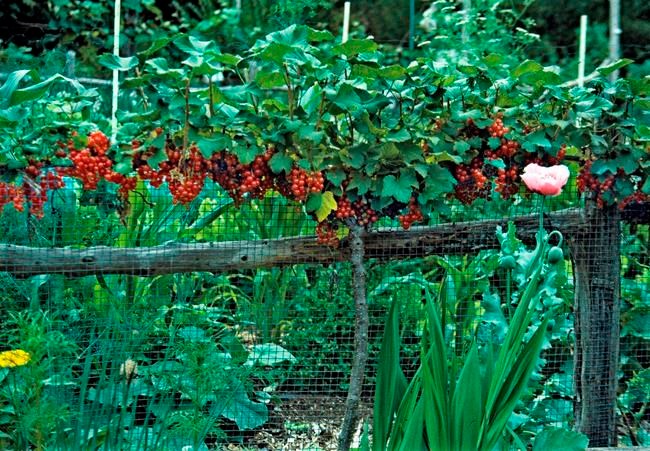
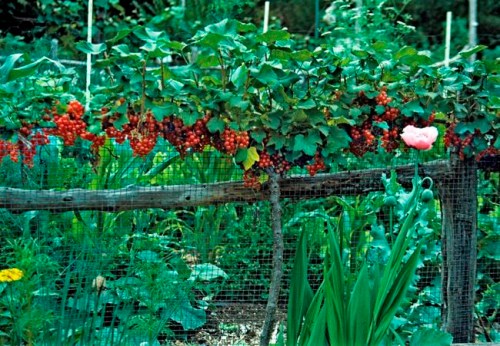
This undated photo shows a red currant espalier in New Paltz, N.Y. Red currant plants are especially easy to train and prune as decorative (and edible) espaliers. (Lee Reich via AP)

ESPALIERS THAT WORK HERE

No need to abandon espalier on this side of the Atlantic: One fruit plant that works very well as an espalier everywhere is red currant. Red currant espaliers have the additional advantage of only needing pruning two times per year. In contrast, pear or apple espaliers require monthly or more frequent pruning sessions.

A real plus for red currant espaliers is their fruits. They’re beautiful! The bright red fruits, dangling from the branches like translucent, red jewels, add much to the show.

The espalier technique I will describe can also be applied to white currants and gooseberries.

My red currant espaliers decorate the fence enclosing my vegetable garden. Each currant plant is trained to the shape of a T, with a single trunk capped by two fruiting arms that grow in opposite directions along the fence, which provides support.

HOW PLANTS TICK

Knowing a little about what makes plants tick helps in growing an espalier, and makes doing so all the more interesting.

“Apical dominance” is the tendency for the uppermost shoots on any plant to grow strongest. Plant hormones, produced in the growing tips of upright stems and at the high points of arching stems, suppress growth of shoots lower down.

By merely changing the orientation of a stem you can influence how strongly various parts of that stem grows. The plant also has a say in this, and may turn a growing stem upwards in an attempt to gain apical dominance over other stems.

Also keep in mind that horizontally oriented stems are weaker growing, more fruitful, and develop more side branches than vertically oriented stems.

PRACTICAL APPLICATION

Use these concepts in training and maintaining any espalier. To initially develop a strong trunk on my red currant, I chose the strongest shoot on my plant, removed all others, and then tied that retained shoot to the fence to keep it upright and vigorous.

Once this trunk-to-be grew just above the top of the 3-foot-high fence, I cut its top back to the 3-foot height, releasing the remaining buds from the suppressing effect of apical dominance. I selected two shoots that started to grow from the upper portion of the trunk to become fruiting arms, training them along the fence in opposite directions and removing all others.

To keep these developing arms growing vigorously, I left their ends free to turn upwards as I tied portions closest to the trunk to a horizontal position. As the shoots lengthened, I kept tying down the older portions.

Maintenance pruning and fruiting began even as arms were developing. The arms, because of their horizontal orientation, exhibit little apical dominance, so side branches develop freely.

Two simple cuts keep the form neat while encouraging abundant fruit production. First, just before the berries start reddening, I cut each side branch back to about 5 inches long. I perform the second cut in winter, cutting those side branches back again, this time to about an inch.

The only problem I have with my red currant espaliers, which hang onto their beautiful berries for weeks, is picking the fruits. To do so would ruin the plants’ appearance, so I don’t. I have some other plants, growing as bushes, for the fruit harvest.

___

Lee Reich writes regularly about food for The Associated Press. He has authored a number of books, including “The Pruning Book” and “Grow Fruit Naturally.” He blogs at http://www.leereich.com/blog. He can be reached at garden@leereich.com.

___

http://www.leereich.com/blog

http://leereich.com

Report Error Submit a Tip

More Stories

National Black Canadians Summit celebrates culture, combats racism

Gabrielle Piché 4 minute read Preview

National Black Canadians Summit celebrates culture, combats racism

Gabrielle Piché 4 minute read Saturday, Sep. 19, 2026

Despite the event’s name — the National Black Canadians Summit — Bruce Miller felt he should attend.

He booked a ticket. And so, this weekend, the Indigenous Manitoban joined roughly 1,500 people flocking to the RBC Convention Centre.

It’s a full schedule — addresses from a former Canadian governor general, sessions on Black mental health and anti-Black racism.

The annual event draws politicians, artists and other professionals from across the country.

Read
Saturday, Sep. 19, 2026

New Jets show promise despite loss to experienced Oilers

Mike McIntyre 8 minute read Preview

New Jets show promise despite loss to experienced Oilers

Mike McIntyre 8 minute read Updated: Yesterday at 9:34 AM CDT

Preseason hockey games are always more about the process than the result, and that’s especially true when the opposing rosters appear to be a major mismatch on paper.

So a 5-2 loss by an inexperienced group of Winnipeg Jets skaters against a star-studded Edmonton Oilers squad on Saturday night in the Alberta capital was neither surprising nor alarming.

There was, however, plenty to like from the visitors’ perspective despite the outcome.

Let’s break it down.

Read
Updated: Yesterday at 9:34 AM CDT

Espalier: how to train plants for the tracery of branches

Lee Reich, The Associated Press 4 minute read Preview

Espalier: how to train plants for the tracery of branches

Lee Reich, The Associated Press 4 minute read Tuesday, Mar. 24, 2020

Espalier is a way of training and pruning plants so their branches lie in an orderly and ornamental two-dimensional form. The beauty comes from the tracery of the branches. Espalier is a way to create a living border in a garden, or decorate a fence or wall.

Hang fruit on those branches and you have a plant offering superb flavour as well as beauty. The reason for that good flavour is that the espalier form allows leaves and fruits to bathe in light and air.

Espaliers have a long tradition in northern Europe, and have mostly been applied to apples and pears. Here in North America, our climates and day lengths are quite different, and so attempts at espalier here often fall short of expectations. Sure, you can bend branches in all sorts of designs, but they won't be thoroughly clothed in the requisite flowers and then fruits.

ESPALIERS THAT WORK HERE

Read
Tuesday, Mar. 24, 2020

U.S. expats in city prepare to cast their ballots

Nicole Buffie 4 minute read Preview

U.S. expats in city prepare to cast their ballots

Nicole Buffie 4 minute read 6:00 AM CDT

American expats are making their voices heard from north of the border for the upcoming U.S. midterm elections.

Jean Dunmire sported a button emblazoned with the word “VOTE” and an American and Canadian flag as she walked out of the Bill and Helen Norrie Library Sunday afternoon. She had just registered to vote in the midterms from afar for the first time.

“I think it’s really important this time around because a lot of the senators and representatives in the House of Representatives are being reelected and I definitely want to see some changes. Things have gone way off the rails with (U.S. President Donald) Trump and he’s just destroying the country,” Dunmire said.

The 76-year-old moved to Lethbridge, Alta., from California in 1969 before settling in Manitoba in 1973. She’s voted in the last two presidential elections but felt it important to cast a ballot in the midterms owing to ongoing conflict in her home country.

Read
6:00 AM CDT

Serious crash at West Kildonan intersection known for collisions

Nicole Buffie 3 minute read Preview

Serious crash at West Kildonan intersection known for collisions

Nicole Buffie 3 minute read Updated: Yesterday at 6:09 PM CDT

Residents in West Kildonan say an intersection that was the site of a serious car crash Sunday morning is notoriously dangerous.

Rob Lick heard a loud bang around 7 a.m. and rushed out of his home on Leila to see what the commotion was. He saw two crushed SUVs, a white and black one, in the intersection. Police vehicles arrived shortly after.

“It sounded like when (garbage trucks) drop a big dumpster,” he said. “I heard somebody crying or wailing, they were standing by the vehicle so I don’t know who exactly it was or if someone was injured.”

The sound of sirens followed shortly after when emergency crews came to the scene. The intersection was immediately blocked off.

Read
Updated: Yesterday at 6:09 PM CDT

‘We’re small, but we’re strong and mighty’: Lögberg-Heimskringla newspaper celebrates 140 years in Manitoba

Aaron Epp 6 minute read Preview

‘We’re small, but we’re strong and mighty’: Lögberg-Heimskringla newspaper celebrates 140 years in Manitoba

Aaron Epp 6 minute read 6:00 AM CDT

A “friend” of the Icelandic community is now 140 years old.

Lögberg-Heimskringla, a Winnipeg-based newspaper that serves the Icelandic diaspora throughout North America, has published continuously for nearly a century-and-a-half. Staff and supporters celebrated the anniversary Saturday afternoon during a gathering at the Scandinavian Cultural Centre.

“Whatever else it may be, Lögberg-Heimskringla is a friend in print — a familiar cultural institution that has enriched our lives and understanding, informing us and entertaining us at the same time,” editor Stefan Jonasson wrote in the paper’s anniversary issue, published on Sept. 15.

“It has served as a vessel to convey the Icelandic culture and heritage in North America through the course of several generations and changing circumstances, preserving memories from the past, imagining what lies ahead and reinventing itself along the way.”

Read
6:00 AM CDT