Mohawk-language Bible published after decades-long effort by one Quebec man

Advertisement

Advertise with us

KANESATAKE - Harvey Satewas Gabriel still remembers the first time he heard a preacher read Bible passages in the Mohawk language back in the 1950s. He watched the United Church minister open the book and translate the Scripture into Mohawk straight off the page as he read, the words sounding like “honey” to the then-17-year-old from Kanesatake, Que.

Read this article for free:


or

Already have an account? Log in here »

To continue reading, please subscribe:

Subscribe and receive a limited-edition Free Press branded hat or tote.

Digital Subscription

One year of digital access for only $205*

  • Enjoy unlimited reading on winnipegfreepress.com
  • Read the E-Edition, our digital replica newspaper
  • Access News Break, our award-winning app
  • Play interactive puzzles

*First annual payment billed as $205.00 + GST for one year. This annual subscription will automatically renew at $233.00 + GST every 52 weeks (10% off the regular annual price of $259.35). Offer available to new and qualified returning subscribers only. Cancel any time.

To continue reading, please subscribe:

Add Free Press access to your Brandon Sun subscription for only an additional

$1 for the first 4 weeks*

  • Enjoy unlimited reading on winnipegfreepress.com
  • Read the E-Edition, our digital replica newspaper
  • Access News Break, our award-winning app
  • Play interactive puzzles
Start now

*Your next Brandon Sun subscription payment will increase by $1.00 and you will be charged $17.95 plus GST for four weeks. After four weeks, your payment will increase to $24.95 plus GST every four weeks.

Hey there, time traveller!
This article was published 30/08/2023 (1074 days ago), so information in it may no longer be current.

KANESATAKE – Harvey Satewas Gabriel still remembers the first time he heard a preacher read Bible passages in the Mohawk language back in the 1950s. He watched the United Church minister open the book and translate the Scripture into Mohawk straight off the page as he read, the words sounding like “honey” to the then-17-year-old from Kanesatake, Que.

Gabriel went home and asked his mother why there was no Mohawk Bible. She said, “That’s a big project, who’s going to translate that?” he recalls.

That conversation would spark a decades-long passion that culminates this fall with the publication of a complete Mohawk-language Bible — most of it translated by Gabriel himself.
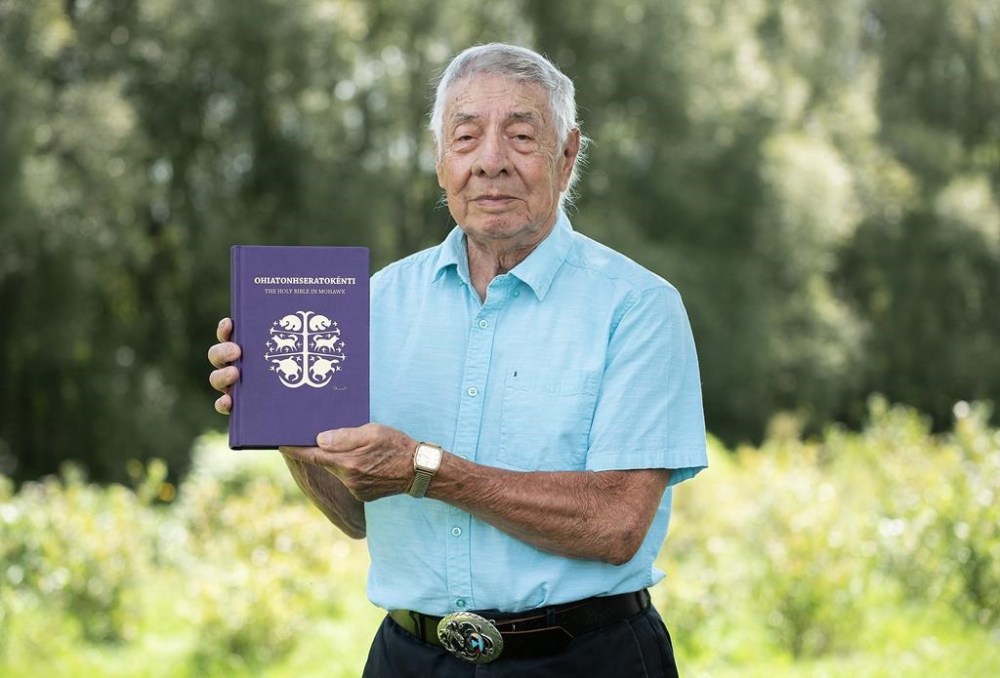
Harvey Satewas Gabriel poses with a copy of the Bible which he translated from English into Mohawk at his home in Kanesatake, Que., Sunday, Aug. 27, 2023. THE CANADIAN PRESS/Graham Hughes.

The 83-year-old estimates it took him about 17 years, on and off, to complete the translation, including 58 books he translated single-handedly.

Gabriel said that early conversation with his mother stuck with him. However, it wasn’t until around 1980 that he first started translating Bible passages, when he was asked to give readings in Mohawk at his church, Kanesatake United.

The process became more formal in the 1990s, when he was invited to join a group of elders who gathered to translate Second Corinthians. While that group disbanded after a few years, Gabriel kept going on his own, working evenings and weekends prior to his retirement from a Montreal company in 2005.

“I kept going because when you start something for the Creator, you can’t stop,” he said in a recent interview in the garden of his Kanesatake home. “It’s so interesting. Every verse is different. I was wondering what the next verse says.”

The newly printed Bible has a purple cover — the colour of the Iroquois Confederacy flag — and an illustration depicting the turtle, wolf and bear clans. The title reads “Ohiatonhseratokénti” — a word Gabriel says means “holy pages.”

When asked what motivated him, Gabriel’s answer is simple: “language.”

He was once told, and believes, that translating the word of God into his language means “it can never be lost.” Already, he said, young people who are learning Mohawk have told him they are eager to use the Bible as a resource.

Gabriel, who has also written a Mohawk dictionary, is not the first member of his family to take language preservation to heart: his great-grandfather, Sosé Onasakenrat, translated the Four Gospels in the mid-1800s.

His mother, Gladys Jacobs, was a residential school survivor who managed to avoid losing her language by speaking it in the schoolyard with her sister and friends, he said. After that, she would only allow Mohawk to be spoken in her home.

Gabriel said that while he had no formal training, translating the Bible “wasn’t too difficult” because he is a fluent Mohawk speaker, and had his great-grandfather’s translations as a model.

With funding from the Canadian Bible Society, he worked with several Biblical language professors to verify the accuracy of his work, translating his own words back into English for them to compare to the works in Hebrew.

According to Gabriel, one of the professors was astounded by the accuracy of the translation, telling him it was “side by side with the Hebrew.”

“That tells me my language is as old as Hebrew,” Gabriel said.

Gabriel said that eventually, funding for the project dried up, and his translation sat on shelves for a few years until his wife of 56 years, Susan, decided to make a renewed push to get it published.

Susan Gabriel connected with the United Church of Canada Foundation, who stepped in with funding to help with the final translation, proofreading, layout and printing.

Royal Orr, a board member for the foundation, said he believes the Mohawk Bible is one of only a handful of complete Indigenous-language Bible translations. The fact that Gabriel translated about 80 per cent of it himself — with support from his wife and others — is a sign of his “diligence, dedication and faith,” as well as his remarkable artistry, he said.

“When you’re translating the Bible, there’s everything from legal texts to narrative to poetry to letters,” Orr said in a phone interview. “It’s all of these forms of writing.”

A series of events will be held this fall to celebrate the publication, including a dedication at the Kanesatake United Church on Sept. 9 followed by celebrations in Montreal and Caledonia, Ont.

Gabriel said he will donate the proceeds of the sales of the Bible to Indigenous language organizations.

This report by The Canadian Press was first published Aug. 30, 2023.

Report Error Submit a Tip

The Free Press acknowledges the financial support it receives from members of the city’s faith community, which makes our coverage of religion possible.
More Stories

Lac du Bonnet slowly healing from devastating fire

Nicole Buffie 6 minute read Preview

Lac du Bonnet slowly healing from devastating fire

Nicole Buffie 6 minute read Yesterday at 6:32 PM CDT

LAC DU BONNET — Fifteen months after devastating wildfires ripped through Lac du Bonnet, claiming two lives and destroying more than a dozen homes, residents are trying their best to build back better.

Along the winding gravel path that is Wendigo Road outside Lac du Bonnet, new timber peeks through patches of charred forest. Homes and cottages are beginning to take shape after fire raced through the neighbourhood at record speed and levelled at least 18 homes on the road.

Table saws and nail guns ring in the distance while Brian Curtis plots out where his new cottage will go. Curtis bought his previous cottage 19 years ago and had recently levelled the foundation.

He and his wife, Pam, had been thinking about long-term renovations when the May 13, 2025 fire swept away all their work and memories.

Read
Yesterday at 6:32 PM CDT

Local medical scrubs retailer feeling abandoned by U of M, RRC Polytech nursing programs

Maggie Macintosh 4 minute read Preview

Local medical scrubs retailer feeling abandoned by U of M, RRC Polytech nursing programs

Maggie Macintosh 4 minute read Thursday, Aug. 6, 2026

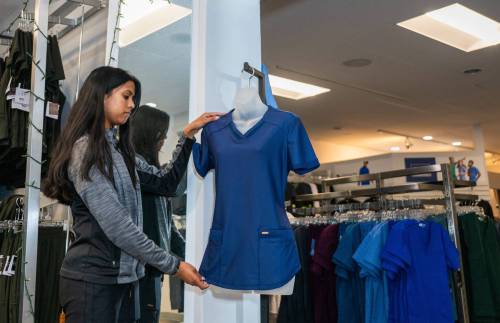
A Winnipeg uniform store is appealing to medical students to shop locally for scrubs this back-to-school season as it grapples with growing competition online and an apparent shutout by local campuses.

Unimor Healthwear has long ordered uniforms in bulk in navy blue, burgundy and pewter, as nurses-in-training are required to wear those colours based on where they’re enrolled in the province.

“It’s not like it used to be,” Evan Schwartz said about customer traffic to his store at 98 Sherbrook St.

The company’s director estimated he spent about $15,000 to stock up on scrubs in pewter in preparation for the launch of Red River College Polytechnic’s upcoming nursing intake.

Read
Thursday, Aug. 6, 2026

Venezuela: unfinished business for the U.S.

Gwynne Dyer 5 minute read 2:01 AM CDT

Experienced imperialists understand that you can’t just take over a country and expect it to run itself. It takes time and work to turn it into an obedient and profitable colony and two months is not enough. Donald Trump moved on to his next target too soon and given how Iran’s been working out for him, he probably hasn’t thought of Venezuela in months.

U.S. Secretary of State Marco Rubio, who acts as Trump’s viceroy for Venezuela, hasn’t been there since the U.S. kidnapped President Nicolás Maduro and his wife in January. (In fact, he may never have been there at all — I can find no evidence of it.) But he does think about Venezuela. In fact, he controls the country very tightly from his Washington office.

He and Trump’s choice for interim president, Delcy Rodríguez, talk online every day, we are told. (She was the vice-president under Maduro, so she was the obvious choice if Trump wanted a local collaborator with supporters in the army and the secret police.) Rubio collects the government’s income and he tells her what she can spend her share on.

It’s an awkward arrangement, because the cabinet is still the core Chavista leaders, minus only Maduro himself. Trump thinks Rodríguez is a “terrific person” and doesn’t worry about elections: Venezuelans “wouldn’t even know how to have an election right now.” But Rubio understands that they really do expect an election to be part of the “transition.”

Champion curler Meleschuk never lost his passion for the game

Joshua Frey-Sam 9 minute read Preview

Champion curler Meleschuk never lost his passion for the game

Joshua Frey-Sam 9 minute read 3:00 AM CDT

At the height of his curling career, Orest Meleschuk balanced ferocity and finesse like almost no one else.

The Winnipeg product was a fierce competitor skilful enough to thread a rock through a window and find the button.

Known as “The Big O,” he curled competitively for over six decades, finding success at the local, provincial, national and global level, and his longevity on the pebble was notable before lengthy careers became the norm.

Meleschuk is still tied with his good friend John Usackis for the most appearances in the Manitoba men’s provincial playdowns, at 30.

Read
3:00 AM CDT

Asian supermarket T&T to open at Polo Park

Gabrielle Piché 5 minute read Preview

Asian supermarket T&T to open at Polo Park

Gabrielle Piché 5 minute read Thursday, Aug. 6, 2026

Live seafood, more than 150 varieties of baked bread and rows of Asian produce are being promised for CF Polo Park — in two years time.

Read
Thursday, Aug. 6, 2026

Watching while we work

Tory McNally 7 minute read Preview

Watching while we work

Tory McNally 7 minute read 2:01 AM CDT

For many employees, the idea that their employer might be tracking how long they spend at their keyboard, how often they move their mouse, or whether they are actively working throughout the day feels unsettling. For many employers, however, workplace surveillance is increasingly viewed as another management tool, particularly as hybrid and remote work become more common. The recent news that TD plans to monitor certain employees’ activity during the workday has reignited a conversation that has been quietly growing for several years: where is the line between legitimate oversight and excessive monitoring?

The reality is that workplace surveillance is nothing new. Employers have long monitored attendance, reviewed security camera footage, tracked company vehicles using GPS, audited expense reports, and reviewed internet usage on company-owned devices. What has changed is the sophistication of the technology. Today’s software can record login times, monitor application usage, track keystrokes, capture screenshots, analyze email activity, and even generate reports ranking employees based on their perceived productivity.

This naturally raises an important question. Does increased surveillance actually make people work harder?

The answer is not nearly as straightforward as many organizations hope.

Read
2:01 AM CDT