Food recalls are pretty common for things like rocks, insects and plastic

Advertisement

Advertise with us

Rocks in Trader Joe’s cookies. Insects in its broccoli-cheese soup. Pieces of plastic in Banquet frozen chicken strips.

Read this article for free:


or

Already have an account? Log in here »

To continue reading, please subscribe:

Subscribe and receive a limited-edition Free Press branded hat or tote.

Digital Subscription

One year of digital access for only $205*

  • Enjoy unlimited reading on winnipegfreepress.com
  • Read the E-Edition, our digital replica newspaper
  • Access News Break, our award-winning app
  • Play interactive puzzles

*First annual payment billed as $205.00 + GST for one year. This annual subscription will automatically renew at $233.00 + GST every 52 weeks (10% off the regular annual price of $259.35). Offer available to new and qualified returning subscribers only. Cancel any time.

To continue reading, please subscribe:

Add Free Press access to your Brandon Sun subscription for only an additional

$1 for the first 4 weeks*

  • Enjoy unlimited reading on winnipegfreepress.com
  • Read the E-Edition, our digital replica newspaper
  • Access News Break, our award-winning app
  • Play interactive puzzles
Start now

*Your next Brandon Sun subscription payment will increase by $1.00 and you will be charged $17.95 plus GST for four weeks. After four weeks, your payment will increase to $24.95 plus GST every four weeks.

Hey there, time traveller!
This article was published 10/09/2023 (1119 days ago), so information in it may no longer be current.

Rocks in Trader Joe’s cookies. Insects in its broccoli-cheese soup. Pieces of plastic in Banquet frozen chicken strips.

In recent weeks, U.S. consumers have seen high-profile food recalls for an unappetizing reason: They’re contaminated with foreign objects that have no place on a dinner plate. And while no one wants to bite down on stainless steel in peanut butter or bone fragments in smoked sausage, this type of contamination is one of the top reasons for food recalls in the U.S.

Food safety experts and federal agencies use the terms “extraneous” or “foreign” materials to describe things like metal fragments, rubber gaskets and bits of bugs that somehow make it into packaged goods.
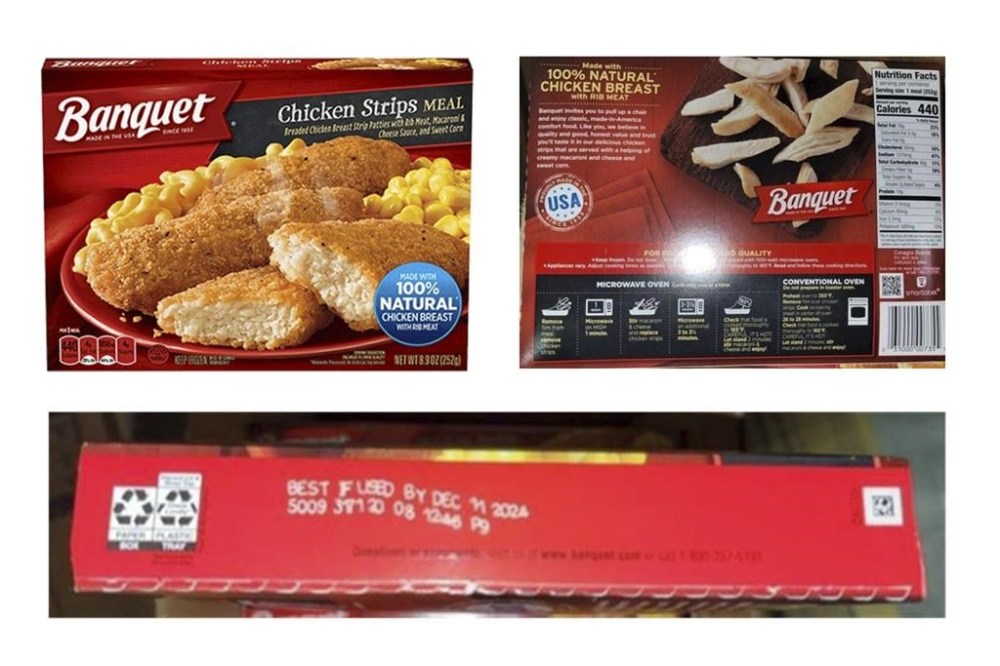
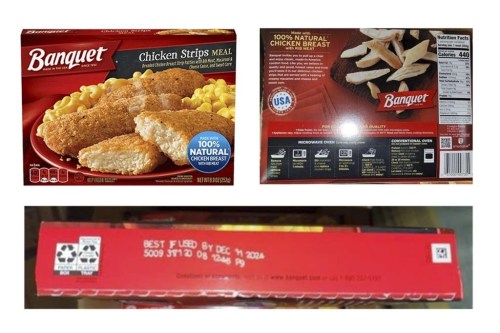
This combination of photos provided by the U.S. Department of Agriculture shows packaging for Banquet Brand Frozen Chicken Strips which was recalled by ConAgra Brands on Sept. 2, 2023, due to possible foreign matter contamination. In recent weeks, U.S. consumers have seen high-profile headlines about foods recalled for contamination with foreign objects. (USDA via AP)

“Extraneous materials” triggered nine recalls in 2022 of more than 477,000 pounds of food regulated by the U.S. Department of Agriculture’s Food Safety and Inspection Service — triple the number of recalls tied to food contaminated with toxic E. coli bacteria.

And the size of recalls can reach into the millions: In 2019, USDA reported 34 recalls of more than 16 million pounds of food, spurred in large part by a giant recall of nearly 12 million pounds of Tyson chicken strips tainted with pieces of metal.

Plastic pieces from frayed conveyor belts, wood shards from produce pallets, metal shavings or wire from machinery are all common. So are rocks, sticks and bugs that can make it from the field to the factory.

Some contamination may even be expected, the FDA acknowledges in a handbook.

“It is economically impractical to grow, harvest or process raw products that are totally free of non-hazardous, naturally occurring, unavoidable defects,” the agency wrote.

Both the USDA and FDA ask companies to promptly notify them when food is potentially contaminated with objects that may harm consumers. The agencies then determine whether recalls are necessary. Most recalls are voluntary and initiated by the companies, though the agencies can request or mandate the action.

Regulators said the Banquet issue was discovered when someone reported an oral injury after eating chicken strips. ConAgra Brands Inc., which owns Banquet, declined to comment beyond the firm’s news release. Trader Joe’s wouldn’t elaborate on how material got into the foods that led to its recent recalls.

Detection of unwanted objects has vastly improved in the past several years, said Keith Belk, director of the Center for Meat Safety and Quality at Colorado State University. Large manufacturers use magnets, metal detectors, X-ray devices and other technology to find unwanted materials in their products.

Still, “they’re going to miss things,” Belk said.

Those things have included pieces of gray nitrile glove that forced the recall of nearly 6,400 pounds of chicken tortilla soup in 2021 and pieces of copper wire that led to recall of nearly 5,800 pounds frozen beef shepherd’s pie in 2022.

There are also two notorious examples from 2017: “extraneous golf ball materials” that triggered a recall of frozen hash browns and a dead bat found in bagged salad that led the Centers for Disease Control and Prevention to recommend rabies treatment for two people.

In recent years, firms have become increasingly cautious and are recalling products more frequently than before, said Nathan Mirdamadi, a consultant with Commercial Food Sanitation, which advises the industry about food safety.

That may be because consumers don’t like finding weird things in their food. When they do, lawsuits may follow, experts said.

“It’s never good business to injure your customers,” Mirdamadi added.

Actual contamination may affect only a small amount of product, but firms recall all food produced within a certain window just to be safe. And while some of the food may be able to be “reconditioned” or treated for safety and sold again, “most of the time, it’s going to landfills,” Mirdamadi said.

Consumers who find foreign materials in food should notify manufacturers, experts said, but also realize that recalls are likely to stick around.

“The thing is, there’s never going to be a day where there’s zero risk associated with consuming a food product,” Belk said.

___

AP Business Reporter Dee-Ann Durbin contributed to this report.

___

The Associated Press Health and Science Department receives support from the Howard Hughes Medical Institute’s Science and Educational Media Group. The AP is solely responsible for all content.


Report Error Submit a Tip

More Stories

Clock ticks down on destruction of records documenting residential school abuses

Marsha McLeod 13 minute read Preview

Clock ticks down on destruction of records documenting residential school abuses

Marsha McLeod 13 minute read Yesterday at 12:49 PM CDT

In less than a year, a private company is set to destroy the largest cache of records detailing the widespread abuse of Indigenous children at residential schools in Canada.

The destruction, which was ordered by an Ontario court in 2014 and later upheld by the Supreme Court, is set to take place on Sept. 19, 2027.

This countdown is igniting emotional conversations that seek to balance the immense historical value of the records alongside the confidentiality survivors were promised as part of the process of providing detailed testimony about abuses they’d suffered.

The records were created as part of the Indian Residential Schools Settlement Agreement, a class-action settlement stemming from survivors who began suing the federal government in the late 1990s over the harm they’d been subjected to at residential schools.

Read
Yesterday at 12:49 PM CDT

U of W Collegiate students thank residential school survivors with the lessons they’ve learned

Maggie Macintosh 6 minute read Preview

U of W Collegiate students thank residential school survivors with the lessons they’ve learned

Maggie Macintosh 6 minute read Yesterday at 6:49 PM CDT

It’s become a back-to-school tradition for teachers to invite Indigenous elders to their classrooms to share first-hand accounts about the ongoing impacts of Canada’s residential school system.

This fall, the University of Winnipeg Collegiate was among the schools that sent an invitation — but its purpose wasn’t to educate students about the system’s horrors.

“Truth and Reconciliation week is so emotional and draining for residential school survivors,” said Christine M’Lot, a longtime instructor of the school’s Grade 9 truth and reconciliation course.

“I wanted to do something a little bit different and offer a thank you.”

Read
Yesterday at 6:49 PM CDT

Nearly four in 10 Manitobans hope Canada restarts trade talks after U.S. midterm elections, poll reveals

Gabrielle Piché 4 minute read Preview

Nearly four in 10 Manitobans hope Canada restarts trade talks after U.S. midterm elections, poll reveals

Gabrielle Piché 4 minute read Yesterday at 7:00 AM CDT

Disorganized — that’s what Marcus Langlois calls recent United States tariffs.

He expects suppliers’ prices to increase — on mugs, pens, hoodies — for his employer, Dreamcatcher Promotions, if the United States–Canada trade war persists.

Still, he’s not pining for a quick trade deal.

“I think it should wait,” said Langlois, Dreamcatcher Promotions’ vice-president. “Let’s hope that it’s later on with proper negotiations happening.”

Read
Yesterday at 7:00 AM CDT

Alouettes not short on reasons why they want to beat Bombers

Taylor Allen 6 minute read Preview

Alouettes not short on reasons why they want to beat Bombers

Taylor Allen 6 minute read Yesterday at 7:55 PM CDT

MONTREAL — Clinching top spot in the East isn’t the only reason why Tyson Philpot is itching to beat the Winnipeg Blue Bombers.

“Obviously, my brother (Jalen) plays for the (Calgary) Stampeders, so I’d love to help push the Stampeders above them and help him get in the playoffs,” said the star receiver for the Montreal Alouettes after Friday’s walkthrough.

While the Als are sitting comfortably at 11-3, the Bombers (7-7) are trying to fend off Calgary (7-8) while also keeping pace with B.C. and Saskatchewan, who both entered the week at 8-6.

But there’s another reason that applies to everyone on the Als: they want revenge for the embarrassing 44-28 loss they suffered in Winnipeg in Week 13.

Read
Yesterday at 7:55 PM CDT

Deadpool drops by Children’s Hospital to say thanks on behalf of Olympian’s family

Kelly-Anne Riess 4 minute read Preview

Deadpool drops by Children’s Hospital to say thanks on behalf of Olympian’s family

Kelly-Anne Riess 4 minute read Yesterday at 6:21 PM CDT

For Olympian Justin Duff, rappelling down the side of a hospital was more than a test of nerve. It was a chance to give back to a place that helped his family through a frightening time.

On Friday, Duff, a former professional volleyball player who competed in the 2016 Olympics in Rio de Janerio, was one of several local community leaders and emergency-service workers who descended the side of the Health Sciences Centre Children’s Hospital for the fifth-annual Suspended Superheroes fundraiser.

Dressed as Deadpool, Duff took his time while making his way down the building, pausing at each floor’s window to wave and smile at the children and parents inside.

“Being able to bring a little bit of joy to these kids who are really fighting, it’s a great thing to do,” he said.

Read
Yesterday at 6:21 PM CDT

Confidence vote was gamble for MLA, Tories: political expert

Alex Lambert 5 minute read Preview

Confidence vote was gamble for MLA, Tories: political expert

Alex Lambert 5 minute read Thursday, Oct. 1, 2026

BRANDON — A Progressive Conservative MLA’s decision to put forward a confidence motion against the party’s former leader carries a lot of risk for her and the Tories, a political science expert says.

Obby Khan resigned as leader of the PCs on Monday after Jodie Byram (Agassiz) initiated a confidence vote against him the previous week.

The majority of the PC caucus voted in favour of Khan, but he resigned a few days later, citing continued efforts to undermine him by a minority of MLAs.

Brandon University political science Prof. Kelly Saunders said while she doesn’t know what Byram’s motivations were for triggering the vote, such a move carries a lot of risk.

Read
Thursday, Oct. 1, 2026