The problem with leaf blowers, and what you can do instead

Advertisement

Advertise with us

When I was a kid, I used to help my mother clear leaves the old-fashioned way — with a rake.

Read this article for free:


or

Already have an account? Log in here »

To continue reading, please subscribe:

Subscribe and receive a limited-edition Free Press branded hat or tote.

Digital Subscription

One year of digital access for only $205*

  • Enjoy unlimited reading on winnipegfreepress.com
  • Read the E-Edition, our digital replica newspaper
  • Access News Break, our award-winning app
  • Play interactive puzzles

*First annual payment billed as $205.00 + GST for one year. This annual subscription will automatically renew at $233.00 + GST every 52 weeks (10% off the regular annual price of $259.35). Offer available to new and qualified returning subscribers only. Cancel any time.

To continue reading, please subscribe:

Add Free Press access to your Brandon Sun subscription for only an additional

$1 for the first 4 weeks*

  • Enjoy unlimited reading on winnipegfreepress.com
  • Read the E-Edition, our digital replica newspaper
  • Access News Break, our award-winning app
  • Play interactive puzzles
Start now

*Your next Brandon Sun subscription payment will increase by $1.00 and you will be charged $17.95 plus GST for four weeks. After four weeks, your payment will increase to $24.95 plus GST every four weeks.

Hey there, time traveller!
This article was published 23/04/2024 (870 days ago), so information in it may no longer be current.

When I was a kid, I used to help my mother clear leaves the old-fashioned way — with a rake.

These days, I don’t see many rakes in my neighborhood. It seems everyone has a leaf blower or a landscaper who uses one, often at ungodly hours, which disrupts humans as well as wildlife.

The near-constant cacophony has led many communities around the country to restrict or completely ban gas blowers, which typically are louder than electric or battery-operated models, and pollute more, too. Some municipalities offer residents rebates or trade-in programs to replace the gas equipment with electric.
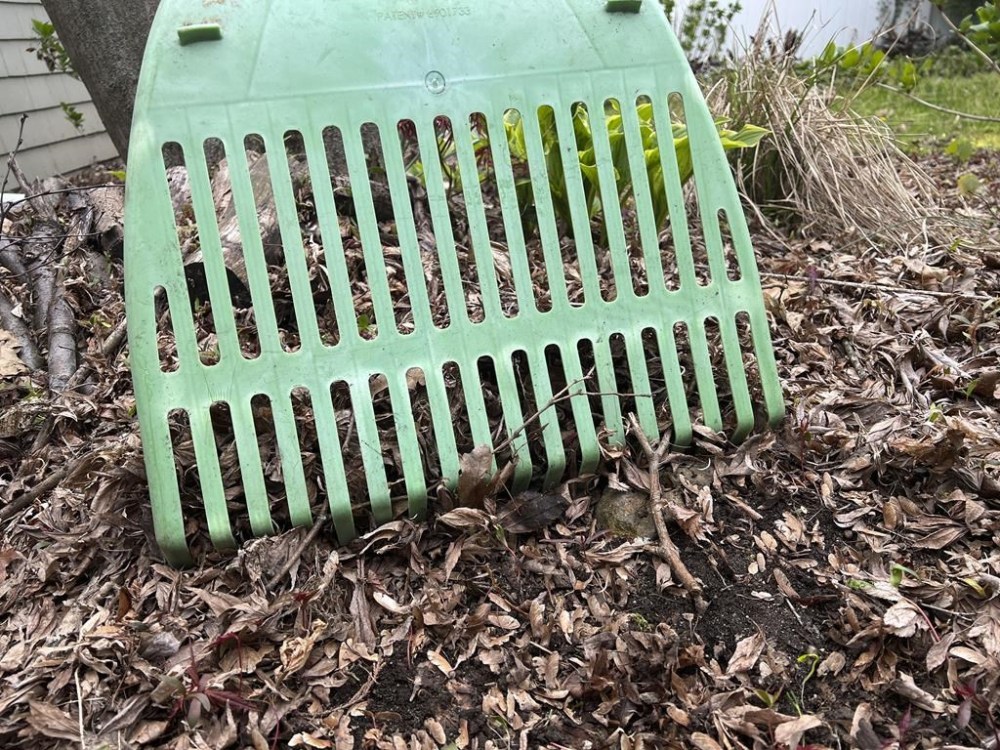
This April 21, 2024, image provided by Jessica Damiano shows a garden rake in use to clear leaves on Long Island, New York. (Jessica Damiano via AP)

HEALTH AND ENVIRONMENTAL WOES

The noise isn’t merely a nuisance. According to the U.S. Centers for Disease Control and Prevention, prolonged exposure to noise louder than 70 decibels may damage your hearing. Gas-powered leaf blowers can register as high as 100 decibels at the source (the levels decrease with distance).

Most electric models range from 59 to 70 decibels. For context, a motorcycle engine registers at about 95 decibels; normal conversation is around 50. And it’s worth noting that each 10 decibel increase is not merely 10 points louder but 10 times louder, so 80 decibels is a tenfold increase over 70.

Gas-powered leaf blowers also expel fumes and pollutants like carbon monoxide. Both gas and electric blowers stir up particulate matter, dust, mold, pollen, and pathogen-containing bird and animal feces into the air that we (and insects and wildlife) breathe. Folks with respiratory issues or allergies may be especially sensitive.

Both types also blow away mulch, contribute to soil erosion and disrupt delicate ecosystems. The soil depletion makes plants more vulnerable to disease and infestations, which could lead to higher pesticide usage.

The machines’ forceful blasts – which travel up to 200 mph, can displace, injure and kill pollinators and other insects. Birds, too, can become startled into changing their feeding, nesting and mating habits.

SO, WHAT TO DO?

Share this information with your friends and neighbors. If you hire a landscaper, express your concerns and ask them to use electric equipment. If enough people do that, the demand will hopefully effect change.

If you have the time and inclination, rake. On hard surfaces, use a broom. Those are sustainable alternatives that also provide good exercise and some peaceful time alone with your thoughts.

Clear the lawn, but consider leaving leaves where they fall in beds and borders.

Leaf sweepers, which operate like push mowers, capture and collect leaves, twigs and other garden debris in an attached bag. This offers an additional advantage over blowers, which simply move debris out of the way or into a pile that needs to be gathered before reuse or disposal. Electric models are also available.

If you must use a blower, opt for an electric or cordless rechargeable model as a cleaner, quieter compromise. The initial price tag might be higher, but you’ll quickly recoup the cost with savings on gas and oil.

And if a gas-powered model is truly your only option, do yourself, your neighbors, and the birds and bees a favor by running it sparingly and only at half-throttle.

—-

Jessica Damiano writes regular gardening columns for the AP and publishes the award-winning Weekly Dirt Newsletter. You can sign up here for weekly gardening tips and advice.

___

For more AP gardening stories, go to https://apnews.com/hub/gardening.

Report Error Submit a Tip

More Stories

Winkler-based internet provider delivering high-speed service to 30 rural and First Nations Manitoba communities

Nicole Buffie 3 minute read Preview

Winkler-based internet provider delivering high-speed service to 30 rural and First Nations Manitoba communities

Nicole Buffie 3 minute read Tuesday, Sep. 8, 2026

Valley Fiber says it is undertaking one of its largest fibre optic projects and is building infrastructure that will deliver internet to 10,000 homes and businesses in rural and First Nations communities across Manitoba.

“These communities will now have access to the fastest internet network in Manitoba, and it will power their lives and their business,” Ryan Klassen, chief executive officer of the Winkler-based internet provider, said Tuesday from Fisher River Cree Nation.

The province has granted Valley Fiber use of two of its underused cables on the existing Manitoba Hydro fibre optic network for up to 20 years as part of the project, which will connect nearly 30 communities — including Buffalo Point, Hollow Water, Black River and Peguis First Nations, along with Fisher River and Fox Lake Cree Nations — to high-speed internet.

Construction should be finished by 2027.

Read
Tuesday, Sep. 8, 2026

Councillors say Main Street Project scuttles other agency’s efforts to house homeless

Scott Billeck 5 minute read Preview

Councillors say Main Street Project scuttles other agency’s efforts to house homeless

Scott Billeck 5 minute read Tuesday, Sep. 8, 2026

A Winnipeg outreach agency that’s been largely shut out of government funding says it has found housing for more people in the last five months than Manitoba’s homeless strategy that began last year.

Read
Tuesday, Sep. 8, 2026

‘Huge resource gaps’: judge shortage leads to circuit court cuts

Dean Pritchard 4 minute read Preview

‘Huge resource gaps’: judge shortage leads to circuit court cuts

Dean Pritchard 4 minute read Updated: Yesterday at 6:33 PM CDT

A shortage of judges is forcing Manitoba’s provincial court to slash sittings across the province.

The court announced in a notice to the profession Wednesday that it will be reducing the number of annual court sittings at nine rural circuit locations and St. Boniface provincial court in Winnipeg by 68 sittings, effective April 1, 2027.

The reductions are necessary to balance “access to justice needs with the complement of judicial resources currently insufficient to maintain the current court schedule,” said the notice, signed by provincial court Chief Judge Ryan Rolston.

Affected circuit courts include Altona, Arborg, Beausejour, Easterville, Cranberry Portage, Lundar, Grand Rapids, Moose Lake, and Pine Falls.

Read
Updated: Yesterday at 6:33 PM CDT

Cultivating compassion in young people

Jordan Laidlaw 5 minute read 2:00 AM CDT

We live in the unenviable era of rising American imperialism and the emergence of a precarious new world order.

As U.S. President Donald Trump escalates his annexation threats over Canada, Greenland and Venezuela; deteriorates decades-long relations with NATO; and offers concessions to totalitarian North Korea; we must remain steadfast and vigilantly united against these ominous — and markedly unusual — sociopolitical developments.

We have so much to learn from our past. As historical patterns suggest, these threats are not idle nor mere political rhetoric. Rather, these threats should be treated with utmost seriousness. As Winston Churchill so famously uttered, “Those that fail to learn from history are doomed to repeat it.”

As a Canadian public educator, I hold the vehement conviction that we need to instruct our youth on the societal dangers of imperialism, while simultaneously exploring the “contentious” concepts of sharing and acceptance.

DNA on beer can helps solve killing

Dean Pritchard 4 minute read Preview

DNA on beer can helps solve killing

Dean Pritchard 4 minute read Yesterday at 2:00 AM CDT

Two years after 74-year-old James Monaghan was stabbed in his Sherburn Street home, DNA found on a beer can led police to his killer.

Shara Harper, 29, pleaded guilty to manslaughter and on Tuesday was sentenced to six years in prison.

A neighbour found Monaghan dead in his home on July 29, 2022. He had been stabbed twice in the chest and back.

The investigation into Monaghan’s killing had stalled until June 2024, when DNA found on an empty beer can in Monaghan’s home was confirmed to be a match for Harper.

Read
Yesterday at 2:00 AM CDT

South Winnipeg neighbourhood will be first to go geothermal

Chris Kitching 4 minute read Preview

South Winnipeg neighbourhood will be first to go geothermal

Chris Kitching 4 minute read Updated: Yesterday at 7:28 PM CDT

A new neighbourhood in south Winnipeg will be Manitoba’s first to use a shared, large-scale geothermal system to heat and cool hundreds of homes over coming decades.

The province is giving up to $4 million to the developers of Southwood Circle, just north of the University of Manitoba’s Fort Garry campus, for a district geothermal system as part of the NDP’s goal to reach net-zero greenhouse gas emissions by 2050.

“It means a whole neighbourhood can tap into geothermal, which means low-carbon heating and cooling for at least 1,000 homes,” Premier Wab Kinew said at a news conference Wednesday.

Geothermal systems, equipped with pumps and pipes, use underground temperatures to heat and cool one or more buildings. Proponents point to long-term energy and cost savings compared with conventional heating and cooling systems.

Read
Updated: Yesterday at 7:28 PM CDT