Surging auto insurance rates squeeze drivers, fuel inflation

Advertisement

Advertise with us

NEW YORK (AP) — Relentlessly rising auto insurance rates are squeezing car owners and stoking inflation.

Read this article for free:


or

Already have an account? Log in here »

To continue reading, please subscribe:

Subscribe and receive a limited-edition Free Press branded hat or tote.

Digital Subscription

One year of digital access for only $205*

  • Enjoy unlimited reading on winnipegfreepress.com
  • Read the E-Edition, our digital replica newspaper
  • Access News Break, our award-winning app
  • Play interactive puzzles

*First annual payment billed as $205.00 + GST for one year. This annual subscription will automatically renew at $233.00 + GST every 52 weeks (10% off the regular annual price of $259.35). Offer available to new and qualified returning subscribers only. Cancel any time.

To continue reading, please subscribe:

Add Free Press access to your Brandon Sun subscription for only an additional

$1 for the first 4 weeks*

  • Enjoy unlimited reading on winnipegfreepress.com
  • Read the E-Edition, our digital replica newspaper
  • Access News Break, our award-winning app
  • Play interactive puzzles
Start now

*Your next Brandon Sun subscription payment will increase by $1.00 and you will be charged $17.95 plus GST for four weeks. After four weeks, your payment will increase to $24.95 plus GST every four weeks.

Hey there, time traveller!
This article was published 26/04/2024 (876 days ago), so information in it may no longer be current.

NEW YORK (AP) — Relentlessly rising auto insurance rates are squeezing car owners and stoking inflation.

Auto insurance rates rose 2.6% in March and are up 22% from a year ago. Premium costs have been marching steadily higher since 2022, even as inflation at the consumer level steadily cooled from its 9.1% peak in the middle of that year. Consumers have had some relief as the rate of cost increases for food and energy, two key components of most budgets, has eased greatly.

But auto insurance and car ownership costs have become a sticking point for consumers and the Federal Reserve in its battle to rein inflation back to its goal of 2%.
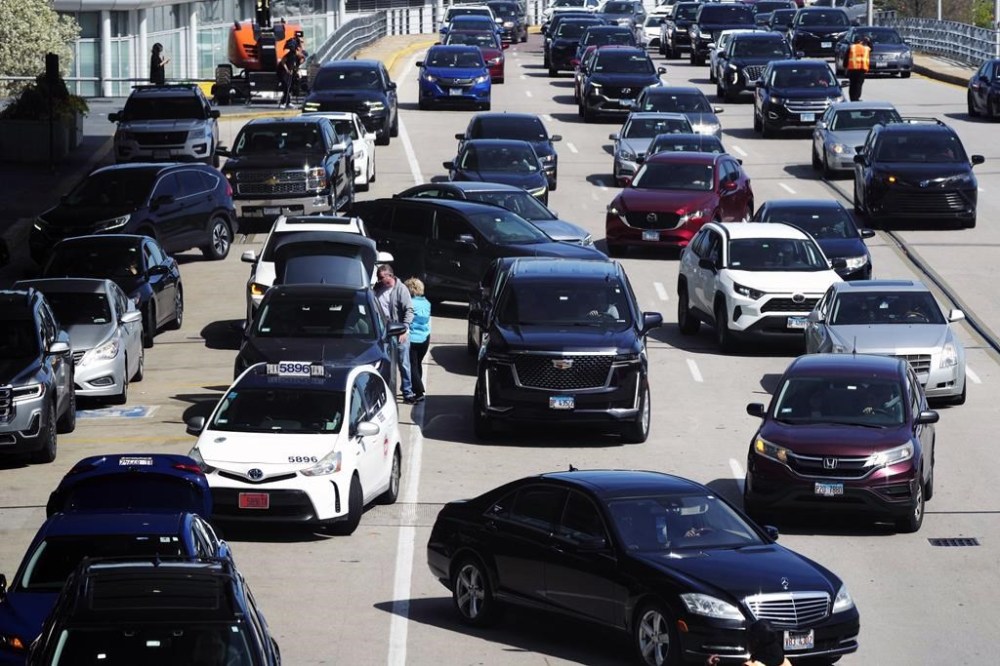
FILE - Heavy traffic is seen at O'Hare International Airport in Chicago, Monday, April 15, 2024. Relentlessly rising auto insurance rates are squeezing car owners and stoking inflation. Auto insurance rates rose 2.6% in March and are up 22% from a year ago. (AP Photo/Nam Y. Huh, File)

Typically, individuals would see a noticeable increase in their premiums because of speeding tickets and other moving violations. Adding new drivers or a general increase in claims in the area were other reasons.

But the persistent rise in rates over the last two years has been far more sweeping. New vehicle prices starting spiking during the pandemic, mainly because of a worldwide shortage of computer chips amid production cuts and supply chain bottlenecks. Dealers spent much of 2021 with few or no cars in stock.

Car price increases eased heading into 2024, with the average at $47,338 in January, down from a peak of $48,516 in late 2022, according to Edmunds.com.

Higher value for cars, along with more advanced technology and intricate parts, has raised the overall cost of repairs. Overall maintenance and repair costs jumped 8.2% in March from a year ago, according to the U.S. Bureau of Labor Statistics. That’s eased a bit over the last year. The rate of increase was as high as 14.2% in early 2023.

“The severity is really the thing that has influenced rates more over the last two years than anything,” said Greg Smolan, vice president of insurance operations at AAA Northeast. “A fender bender in the past didn’t have all the sensors and cameras.”

Higher overall auto prices and auto repair costs prompted insurers to start raising premiums as overall car values jumped. Price increases for insurance rates, like many other increases from food to clothing, have been sticky and are less likely to drop at the same rate as broader inflation, if at all.

That has been beneficial for insurers who have seen profits surge. Wall Street is expecting bigger leaps in 2024.

“Our sole concentration last year was to get the right rate,” said Progressive CEO Tricia Griffith, during a fourth-quarter earnings conference call. “We feel like we’re in a really great position now.”

Progressive’s profit jumped 50% and its revenue surged nearly 18% to $62.1 billion in 2023. Wall Street expects its profit to skyrocket nearly 80% in 2024 on a 14% jump in revenue.

Allstate reported a modest profit in 2023 after reporting a loss a year earlier. Wall Street expects its profit to surge 13-fold as revenue rises 10% to $62.9 billion in 2024.

“Companies are getting a lot closer to rate adequacy now,” Smolan said. “I think you’ll see some flattening out of the real large increases.”

The process of obtaining auto insurance can be confusing and overwhelming, considering the differing mix of requirements in each state, extra options and the confusing industry and legal jargon used by insurers. The first step for many should be gaining a better understanding about auto insurance, according to the Insurance Information Institute.

Consumers should shop around by getting at least three different quotes and from different types of insurance companies. Also, comparing costs before buying a car could help give consumers a better sense of the true cost of owning a specific car. Premiums are based in part on a car’s price, along with prospective repair costs and safety data.

Deductibles could be a major factor in determining monthly premium costs. That’s the amount of money that a driver is responsible for paying toward a claim. Higher deductibles usually mean lower premiums.

Bundling multiple policies under one insurer could come with a discount. This is common for homeowners using the same company for their home and auto policies. There may also be discounts for insuring more than one vehicle under the same company.

Defensive driving courses also help give drivers discounts on insurance. The timing and standards vary by state, but courses are usually offered in-person and online. Companies including Progressive and Geico often offer multi-year discounts for taking such a course. They can usually steer policy holders toward reputable companies offering the course and certificate.
Report Error Submit a Tip

More Stories

Kinew delivered what most of us wanted; now we’ll have to deal with the consequences

Dan Lett 5 minute read Preview

Kinew delivered what most of us wanted; now we’ll have to deal with the consequences

Dan Lett 5 minute read Updated: Yesterday at 8:43 AM CDT

Premier Wab Kinew has decided to adopt permanent daylight savings time, which means a permanent end to the spring forward, fall back tradition of adjusting our clocks. And absolutely no one is surprised.

Read
Updated: Yesterday at 8:43 AM CDT

Manitoba abandoning spring, fall clock changes

Carol Sanders 8 minute read Preview

Manitoba abandoning spring, fall clock changes

Carol Sanders 8 minute read Updated: Yesterday at 8:48 AM CDT

Time’s up for the time change in Manitoba.

Manitobans won’t be setting their clocks back an hour in November. The province has decided to permanently stay on daylight time after surveying residents on the twice annual clock adjustment.

“We heard from Manitobans loud and clear — no more changing the clocks in Manitoba,” Premier Wab Kinew said in a news release Thursday.

Most of the 72,000 votes submitted in an online EngageMB survey — 92 per cent — said they would like to see the practice end. The survey asked if they preferred earlier sunrises in winter with standard time or the later sunsets in summer with daylight time. More than half of survey participants (58 per cent) indicated a preference to stay on permanent daylight time; 34 per cent voted to eliminate the time change but stay on standard time.

Read
Updated: Yesterday at 8:48 AM CDT

Siloam Mission, WFPS discussing on-site paramedic to reduce staggering number of emergency calls

Scott Billeck 4 minute read Preview

Siloam Mission, WFPS discussing on-site paramedic to reduce staggering number of emergency calls

Scott Billeck 4 minute read Yesterday at 2:00 AM CDT

Winnipeg’s fire-paramedic service and its largest homeless-serving organization are discussing what it would look like to station at least one paramedic at Siloam Mission, as emergency calls to the downtown facility surge.

The ongoing discussions come as Winnipeg Fire Paramedic Service crews were dispatched 1,771 times during the first eight months of the year to the two adjacent Siloam properties at 303 Stanley St. and 300 Princess St.

WFPS said most of the calls were related to overdoses or other consequences of substance use, with the total nearly double the 854 calls recorded over the same period last year. By comparison, there were 831 calls during the same span in 2024, and 591 in 2023.

“The number of emergency calls isn’t sustainable for us as a service, but it’s certainly not sustainable for them as an agency trying to provide services,” WFPS chief Ryan Sneath told the Free Press. “And they recognize that they’re impacting emergency services, not them specifically, but the site in a significant way.”

Read
Yesterday at 2:00 AM CDT

Family account spiced with magic realism, geopolitical intrigue and a ghost story

Reviewed by Zilla Jones 4 minute read Preview

Family account spiced with magic realism, geopolitical intrigue and a ghost story

Reviewed by Zilla Jones 4 minute read 2:01 AM CDT

Tom Lin’s second novel Babylon, South Dakota moves beyond a historical account of an immigrant family’s struggle, delightfully blending and bending genres.

Lin is a Chinese-born novelist whose family emigrated to the U.S. when he was four years old. His debut novel, The Thousand Crimes of Ming Tsu, won the 2022 Andrew Carnegie Medal for Excellence in Fiction, making him the youngest ever recipient of that award. He earned a PhD in English from the University of California Davis and is currently an assistant professor of English and creative writing at the University of Iowa.

Babylon, South Dakota takes place in an unspecified time period that can be understood to be during the Mao era — likely the 1950s or ’60s. A young Chinese couple, the Hsuis, immigrate to the rural community that gives the book its title. They take the names Saul and Mei and settle on a 160-acre homestead left to them by a distant relative.

Saul’s dream is to breed and sell chrysanthemums from seeds he brought from China, while Mei wants to raise livestock. They speak no English, know nothing of life in the United States, are unprepared for the harshness of winter and the isolation of the farm and bring nothing with them except some gold, which Mei hides around the house for emergencies. Their only link to the outside world is a discarded and marginally functioning TV set, which Saul rescues and rigs up.

Read
2:01 AM CDT

Not falling back means time loop remains unclosed

Jen Zoratti 4 minute read 2:01 AM CDT

I demand restitution. Where’s my hour?

In the traditional fall-back, spring-forward time change set up — you know, ol’ trusty that’s been effect for lo these 63 years — we lost an hour in the spring that we got back in the fall.

That was the social contract: you commit to feeling like you’re on cold medication for a week in March because you know a glorious extra hour of sleep will be returned to you in November. (Unless, of course, you have little kids, but look: we all make our choices.)

Well, that transaction, flawed as it was, isn’t happening this year. That hour you sacrificed to the sun gods in the spring? Gone. Not coming back. We’ve sprung forward and we shan’t be falling back — not in November, and (possibly) not ever. The scale shall remain unbalanced and the loop shall remain unclosed as Manitoba has adopted permanent daylight time.

Canada must not accept another Iranian autocracy

David Matas 5 minute read 2:01 AM CDT

Iran is a state run by a radical government victimizing its citizens and its neighbours. How do we change that? Any regime change that repeats the mistakes of the past is not a solution.

What went wrong in the past which led to the current regime? One answer is the U.K. and American aided coup which led to the ouster in 1953 of a democratically elected government headed at the time by Mohammad Mossadegh and its replacement with an American friendly autocrat, the Shah of Iran, Mohammad Reza Pahlavi.

The Shah imposed his rule through the Iranian National Intelligence and Security Organization — SAVAK, the acronym of its Persian name. SAVAK systematically inflicted torture, arbitrary killings and extra-judicial killings on perceived opponents of the regime. It was only a matter of time before repression of a regime directed to serving foreign interests would be overthrown.

What replaced the regime of the Shah, in 1979, the current regime of the mullahs, is a regime as intolerant and violent as the regime of the Shah and then some. That was not inevitable. But neither was it surprising. The vicious nature of the current regime, following the example set by the Shah, and its hatred for the United States, reacting to the U.S. aided imposition of the Shah, both echoes and reacts to the past. In 1979, the U.S. reaped what it sowed in 1953.