Manitoba Métis president ticketed for fishing without a licence, province says

Advertisement

Advertise with us

WINNIPEG - A recent interaction between a conservation officer and David Chartrand, president of the Manitoba Métis Federation, appears set to become the latest skirmish in the battle over Indigenous hunting and fishing rights in the province.

Read this article for free:


or

Already have an account? Log in here »

To continue reading, please subscribe:

Subscribe and receive a limited-edition Free Press branded hat or tote.

Digital Subscription

One year of digital access for only $205*

  • Enjoy unlimited reading on winnipegfreepress.com
  • Read the E-Edition, our digital replica newspaper
  • Access News Break, our award-winning app
  • Play interactive puzzles

*First annual payment billed as $205.00 + GST for one year. This annual subscription will automatically renew at $233.00 + GST every 52 weeks (10% off the regular annual price of $259.35). Offer available to new and qualified returning subscribers only. Cancel any time.

To continue reading, please subscribe:

Add Free Press access to your Brandon Sun subscription for only an additional

$1 for the first 4 weeks*

  • Enjoy unlimited reading on winnipegfreepress.com
  • Read the E-Edition, our digital replica newspaper
  • Access News Break, our award-winning app
  • Play interactive puzzles
Start now

*Your next Brandon Sun subscription payment will increase by $1.00 and you will be charged $17.95 plus GST for four weeks. After four weeks, your payment will increase to $24.95 plus GST every four weeks.

Hey there, time traveller!
This article was published 19/07/2024 (809 days ago), so information in it may no longer be current.

WINNIPEG – A recent interaction between a conservation officer and David Chartrand, president of the Manitoba Métis Federation, appears set to become the latest skirmish in the battle over Indigenous hunting and fishing rights in the province.

Chartrand was given a ticket last month for angling without a licence on a lake near the northern community of Cranberry Portage, the government’s central communications agency said Friday. Chartrand has until Aug. 14 to respond. Such tickets can carry fines of $298.

Chartrand said he has not been charged with anything, was not breaking the law, and was exercising his right to fish.

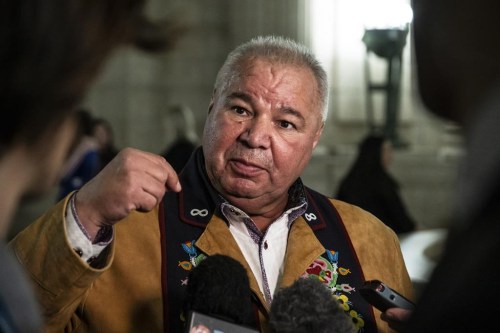
President of the Manitoba Métis Federation David Chartrand speaks to media after the completion of the 43rd Manitoba legislature throne speech at the Manitoba Legislative Building in Winnipeg on Nov. 21, 2023. THE CANADIAN PRESS/Aaron Vincent Elkaim

“One of the officers was trying to figure out what he had to do, and I think he was not properly briefed,” Chartrand said in an interview this week.

“It was more of a warning, I guess, in my view because I had a quick discussion with him to please do his homework.”

Chartrand said he later returned to the dock, the conservation officer did as well and they both went their separate ways. He said he will fight any charges in court if need be.

The Manitoba government recognizes Métis natural resource harvesting rights, which includes the right to fish without a licence, in most of southern, central and western Manitoba, along with a small area in the northwest. The area does not include lakes close to Cranberry Portage.

The federation has called for an expansion to more northern areas, which the province has been considering. Chartrand said Métis citizens should not face charges “all the way to Churchill,” a town on the coast of Hudson Bay in the northeast.

First Nations communities in the north are not on board with that idea. While the Manitoba Métis Federation says it has historical ties to communities across the north, some First Nations chiefs say treaty rights based on people who were on the land thousands of years ago take precedence.

“We object to the expansion of Métis harvesting rights in the north and, very importantly, prior to any discussion of lands or harvesting rights with the Métis, First Nations land claims and other related issues must be resolved,” Chief Angela Levasseur of Nisichawayasihk Cree Nation said.

“We are the rights-holders of our lands and our territories, and any government or any other ethnicity must come to us first before they try to do anything,” Chief David Monias of Pimicikimak Cree Nation said.

Chartrand said he wants to work with First Nations on what he describes as mutual rights.

“Without doubt, First Nations have rights. I’ll never question that, and I hope they don’t question me.”

Dana Rudy, deputy minister of Economic Development, Investment, Trade and Natural Resources, said a decision was made in late June to back off enforcement against Métis harvesters in the areas currently being discussed with the federation.

The areas, proposed by the federation in 2016, do not go as far as Churchill but include a stretch of northern Manitoba in and around Cranberry Portage.

“At this point in time, because the discussions are underway, conservation officers are forgoing the enforcement actions in the expanded area,” Rudy said.

The NDP government has been dealing with controversy over recent changes to the moose hunt. The government reduced the number of moose hunting licences available to non-Indigenous hunters this year by 75 per cent in some parts of northern Manitoba.

Some First Nations leaders wanted the government to cut further to protect the moose population. The Manitoba Wildlife Federation, which represents licensed hunters and anglers, said the government had no evidence that the moose population was in decline and in need of further restrictions.

This report by The Canadian Press was first published July 19, 2024.

Report Error Submit a Tip

More Stories

Real journalists matter in an AI world

Paul Deegan 4 minute read Preview

Real journalists matter in an AI world

Paul Deegan 4 minute read 2:00 AM CDT

An algorithm can decide what you see, but it doesn’t report the news. Nunatsiaq News, an award-winning newspaper in Nunavut, recently reported that a so-called “news” website was posting AI-generated articles about the north by stealing real news stories produced by real journalists.

The articles were supposedly written by Nunavut correspondent Leah Qammaniq — a fake journalist, with a fake photo and a fake bio.

Governor General Louise Arbour warned us of fake news in her installation speech in June. She said, “We must continue to protect the public space in which our national debates take place: from schools and universities to the media, political parties, unions and civil society organizations …With instant access to vast amounts of information, it is very tempting to pay little attention to the reliability of sources. The lines between knowledge and belief, between truth and falsehood, between facts and assumptions, are increasingly blurred. AI could be threatening not only the way we live and work, but also the control we exercise over our own destiny.”

The Government of Canada has recognized the problem as well. Its recent discussion paper, Enhancing trust in artificial intelligence through increased transparency, stated, “Canadians encounter news reporting, product reviews, and audio-visual content across the internet, often without any indication of whether it was written by a person, generated by an AI system, or produced through some combination of both … A particular concern within this broader landscape is that generative AI greatly enables the creation and dissemination of deceptive or misleading content.”

Read
2:00 AM CDT

Telekinetic teen hits small screen

Denise Duguay 4 minute read Preview

Telekinetic teen hits small screen

Denise Duguay 4 minute read 2:00 AM CDT

At desperate times like these, it’s good to be reminded that one person can make a difference. A telekinetic high schooler, grieving lover, ambitious law firm, frantic father and spiritual climber offer a variety of inspiring lessons in this new offering of TV recommendations.

Carrie (series premières Wednesday, Oct. 7 on Prime Video)Famously over-the-top filmmaker Brian De Palma (Phantom of the Paradise, Dressed to Kill, Scarface) directed the 1976 Carrie into its status as one of the scariest films of the time and beyond. It became better known than the debut horror novel by Stephen King from which it was adapted. It even trumped the three adaptations that followed. This new TV series looks ready to challenge that supremacy. Taking the title role made famous by Sissy Spacek, Manitoba actress Summer H. Howell (see Randall King’s interview at wfp.to/carrie) plays a homeschooler thrilled to finally be allowed to attend public high school. But when the mean girls begin circling and blood manifests in scary new ways, the new girl’s telekinetic potential blossoms in spectacular fashion. Also of horrific note as Halloween approaches: Below (Netflix miniseries premièring Thursday) stars Josh Hartnett as a fisherman trying to protect his family and town from a mysterious sea creature; Eternally Yours (sitcom premièring Thursday, Oct. 8, on CBS/Global) is a new vampire comedy; and Crystal Lake (thriller series premières Oct. 15 on Crave) stars Linda Cardellini (DTF St. Louis) as Pam Voorhees, single mom of a tormented kid named Jason, in this Friday the 13th origin story. Boo!


Small Prophets (series Canadian première Wednesday, Oct. 7, on Apple TV)Canadian fans of British TV have been champing at the bit for this quirky series since its acclaimed U.K. première in February. It’s a shaggy, quietly hilarious character study in the vein of Detectorists (2014-22, AcornTV), both of which were created by Mackenzie Crook (Pirates of the Caribbean), who also starred in Detectorists and plays a supporting role in Small Prophets. When the new story opens, Michael Sleep (Detectorists’ Pearce Quigley) is living a life of quiet desperation, visiting his father (Sir Michael Palin) and pining for the return of his disappeared beloved, Clea. Until, that is, Dad shares a loony alchemical recipe that sparks hope in Michael that he might be able to summon spirits to then summon Clea to … the garden shed? Not as creepy as it sounds? A tale of hope, frustratingly indirect action, meddlesome and ineffectual neighbours and, of course, true, true love.

Read
2:00 AM CDT

Seven Wilsons, one regional spirit

Hersh Seth 5 minute read Preview

Seven Wilsons, one regional spirit

Hersh Seth 5 minute read 2:00 AM CDT

In Dryden, Ont., a 34-metre suspension bridge crosses the Wabigoon River rapids. It is named after a man who paid for a quarter of the bridge himself. A plaque recognizes Roy Wilson’s “many contributions to City Revitalization” and mentions his 40 years in the Rotary Club, whose motto is “service above self”.

My father sold business machines from the 1970s through the ’90s, during the shift from carbon copy machines and typewriters to photocopiers, fax machines, and early office computers and printers. His sales territory — which he covered mostly by car but also by propeller plane — was Saskatchewan, the Northwest Territories, Manitoba, and northwestern Ontario, though much of it really belonged to the Wilsons.

In business machines, selling the machine was only half the job — the other half was ensuring a technician would fix it in January. Wilson’s set the standard for dealers across most of my dad’s regions. My father worked with Roy’s son Greg (who would later go on to become mayor of Dryden) but really respected Roy for teaching Greg to run the company with the towns they served as the priority.

Wilson’s service routes went beyond where roads stopped. Even if customers lived north of the highway system, Wilson’s still found a way to help, using three company planes based at the Dryden airport. As a result, a stationery shop from a paper mill town served all of northwestern Ontario and later northern Manitoba. Imagine a photocopier strapped into a small plane, a technician beside it, and a gravel runway waiting at the other end.

Read
2:00 AM CDT

Manitoba Métis president ticketed for fishing without a licence, province says

Steve Lambert, The Canadian Press 4 minute read Preview

Manitoba Métis president ticketed for fishing without a licence, province says

Steve Lambert, The Canadian Press 4 minute read Friday, Jul. 19, 2024

WINNIPEG - A recent interaction between a conservation officer and David Chartrand, president of the Manitoba Métis Federation, appears set to become the latest skirmish in the battle over Indigenous hunting and fishing rights in the province.

Chartrand was given a ticket last month for angling without a licence on a lake near the northern community of Cranberry Portage, the government's central communications agency said Friday. Chartrand has until Aug. 14 to respond. Such tickets can carry fines of $298.

Chartrand said he has not been charged with anything, was not breaking the law, and was exercising his right to fish.

"One of the officers was trying to figure out what he had to do, and I think he was not properly briefed," Chartrand said in an interview this week.

Read
Friday, Jul. 19, 2024

Band keeps plight of MMIWG close to heart on new track

Ben Waldman 6 minute read Preview

Band keeps plight of MMIWG close to heart on new track

Ben Waldman 6 minute read 2:00 AM CDT

Gabrielle Fontaine won’t stop talking about them and neither will her bandmates.

As a teenager, the Winnipeg songwriter — whose late father Vince was the passionate leader of musical projects including Eagle & Hawk — would volunteer at Wiping Away the Tears, an annual gathering hosted by Ka Ni Kanichihk that offers space for healing, ceremony and support for relatives of missing and murdered Indigenous women, girls and two-spirit people.

Though Indigenous people make up less than five per cent of the Canadian population, Indigenous women make up 16 per cent of all female homicide victims and 11 per cent of missing women, according to the Assembly of First Nations.

Seeking a way to help in the community, Fontaine regularly volunteered as a child-minder during memorial events, an experience she says shaped her outlook as a musical storyteller.

Read
2:00 AM CDT

MPI lowers speed limit on tech upgrade with ‘IT roadmap’ following Project Nova debacle

Carol Sanders 5 minute read Preview

MPI lowers speed limit on tech upgrade with ‘IT roadmap’ following Project Nova debacle

Carol Sanders 5 minute read Updated: Yesterday at 9:44 PM CDT

Manitoba Public Insurance is now using an “IT road map” and phasing in new technology and systems after pulling the plug last year on its failed $164-million overhaul known as Project Nova, its annual report says.

Read
Updated: Yesterday at 9:44 PM CDT