How Justin Trudeau captured the zeitgeist, and how he lost it

Advertisement

Advertise with us

TORONTO - In his early days as prime minister, Justin Trudeau was "cool." In the year that followed his majority sweep into power, he appeared in the pages of Vogue, on the cover of a Marvel comic book and on "The Daily Show," chatting with an up-and-coming Hasan Minhaj.

Read this article for free:


or

Already have an account? Log in here »

To continue reading, please subscribe:

Subscribe and receive a limited-edition Free Press branded hat or tote.

Digital Subscription

One year of digital access for only $205*

  • Enjoy unlimited reading on winnipegfreepress.com
  • Read the E-Edition, our digital replica newspaper
  • Access News Break, our award-winning app
  • Play interactive puzzles

*First annual payment billed as $205.00 + GST for one year. This annual subscription will automatically renew at $233.00 + GST every 52 weeks (10% off the regular annual price of $259.35). Offer available to new and qualified returning subscribers only. Cancel any time.

To continue reading, please subscribe:

Add Free Press access to your Brandon Sun subscription for only an additional

$1 for the first 4 weeks*

  • Enjoy unlimited reading on winnipegfreepress.com
  • Read the E-Edition, our digital replica newspaper
  • Access News Break, our award-winning app
  • Play interactive puzzles
Start now

*Your next Brandon Sun subscription payment will increase by $1.00 and you will be charged $17.95 plus GST for four weeks. After four weeks, your payment will increase to $24.95 plus GST every four weeks.

Hey there, time traveller!
This article was published 08/01/2025 (633 days ago), so information in it may no longer be current.

TORONTO – In his early days as prime minister, Justin Trudeau was “cool.” In the year that followed his majority sweep into power, he appeared in the pages of Vogue, on the cover of a Marvel comic book and on “The Daily Show,” chatting with an up-and-coming Hasan Minhaj.

But the same strategy experts and observers say put him in the public eye and won him the youth vote in 2015 may have brought damning scrutiny as political tides changed, particularly as his rivals adopted his online style.

“He created a movement in 2015 and he got a lot of young people engaged,” said Alfred Burgesson, who sat on the Prime Minister’s Youth Council from 2019 until 2021.
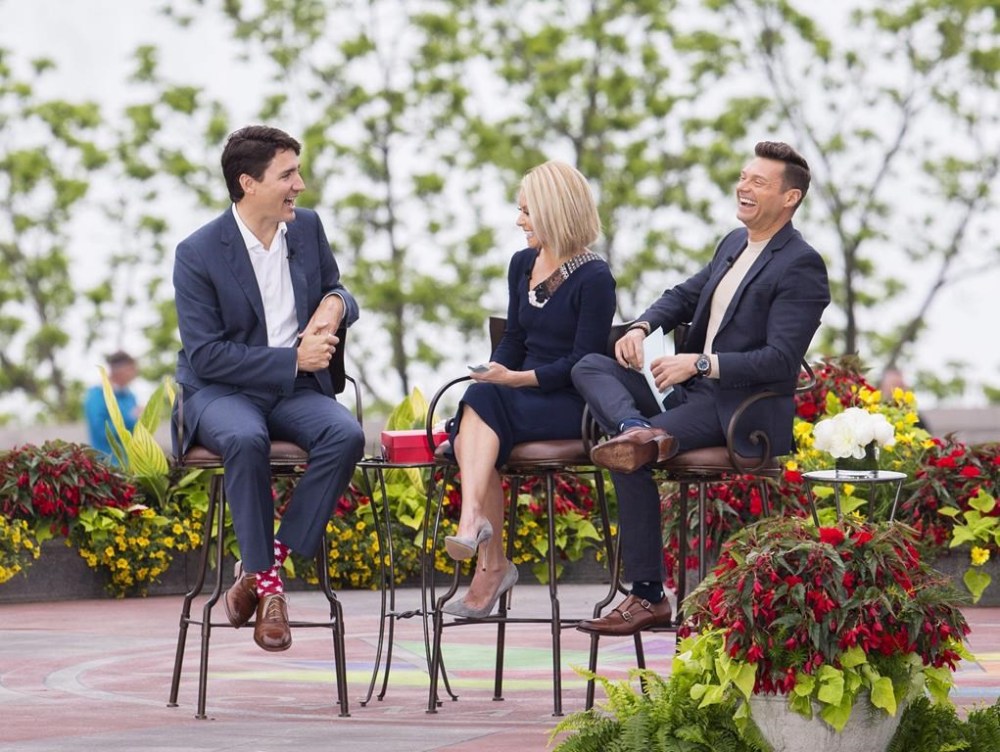
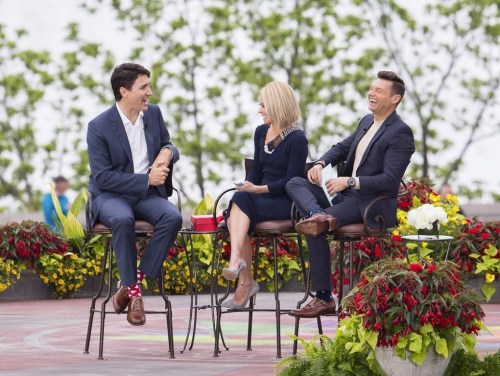
Prime Minister Justin Trudeau, left, speaks with Kelly Ripa, centre, and Ryan Seacrest during his appearance on Live with Kelly and Ryan in Niagara Falls, Ont., on June 5, 2017. THE CANADIAN PRESS/Aaron Lynett

“The same people that are asking for change today, or looking for a different leader today — a lot of these young people, they started to pay attention because of it.”

Trudeau announced plans to step down as prime minister and Liberal leader on Monday following weeks of pressure from within his party. He said he would resign just as soon as a new leader is chosen.

And though sentiment has changed over the years, Burgesson, who is now 28, said Trudeau helped many young people feel seen and heard, in part by establishing the youth council.

At the time, he said, the way people talked about Trudeau was “incredibly positive.”

Elections Canada data from the 2015 election showed that 57 per cent of voters aged 18 to 24 cast a ballot, an increase of 18.3 percentage points from the almost 39 per cent recorded in the 2011 election. And research conducted by Abacus Data following the 2015 vote suggested Liberals won the support of 45 per cent of young voters.

Mireille Lalancette, a professor of political communications at the Université du Québec à Trois-Rivières, noted that Trudeau was the first major party leader in Canada to use Instagram in 2015.

“People were using Twitter, but Instagram is more of an identity-centric, image-centric medium,” she said.

Trudeau used those images to project a persona that was at once youthful and confident, sensitive and thoughtful: a leader worthy of respect, she said.

“These were his best years because people were rooting for him. He was also really popular. He was also able to reach out to the younger generation,” Lalancette said.

He was a self-proclaimed feminist, an optimist who promised “sunny ways.” He presented himself as a family man, Lalancette noted, and said he valued reconciliation with Indigenous Peoples.

He also reached out beyond Canada’s borders.

His “steamy” photo shoot for Vogue magazine with Sophie Grégoire Trudeau made waves internationally in December 2015. He graced the cover of Rolling Stone a couple years later. His likeness — though not his voice — appeared on “The Simpsons” in a 2019 episode that saw Lisa Simpson nurse a crush on him.

“There was a moment where he was really a supernova,” said Alex Marland, a professor of political science at Acadia University.

“Back here in Canada, we were getting all sorts of news stories that were talking about how he was being mobbed in the Philippines, or if he was going out to Switzerland, there were people there wanting to meet him.”

Marland said Canadians had a sort of parasocial relationship with Trudeau at that time. He’d grown up in the public eye because of his father, former prime minister Pierre Trudeau, so people felt like they knew him.

“They did not like anybody criticizing Justin Trudeau, because they saw him as almost a family member,” he said.

But Marland said that started to change in 2018 when Trudeau and his family took a much-ridiculed trip to India. They were photographed, over and over again, wearing clothes more appropriate for a wedding than a state visit.

“People started seeing it as: he’s a bit of a phoney,” he said.

“And all of a sudden, now, for some people, they were able to move away from giving him the benefit of the doubt to realizing that instead of (being) authentic, he was actually manipulating them.”

Politicians seldom go out on a high note, Marland said, but in Trudeau’s case the highs were higher and the lows were lower. His image had become so big, Marland said, that when it didn’t match up with reality, people noticed.

“What was growing over time was the disconnect between promise and delivery, and that’s a fundamental problem when you’re dealing with a brand,” he said.

“As a brand, Justin Trudeau was failing on a lot of promises because he was creating expectations and he was not fulfilling them.”

He was dogged by a litany of scandals, from the SNC-Lavalin affair that saw two female cabinet ministers — justice minister Jody Wilson-Raybould and health minister Jane Philpott — resign, to the surfacing of old photos and video of Trudeau wearing black- and brownface.

Trudeau didn’t live up to his feminist, culturally sensitive promise.

Although Canadians re-elected Trudeau in 2019, he was knocked down to a minority government. The Liberals were unable to regain majority in 2021.

Marland pointed to a famous photo of Trudeau flanked by his cabinet, which was the first in Canada to achieve gender parity, walking up to the governor general’s residence in 2015 to be sworn in.

Compare that, he said, to the image of the prime minister standing alone at a lectern as he announced his resignation.

“That in itself captures what has happened,” Marland said.

This report by The Canadian Press was first published Jan. 8, 2025.

Note to readers: This is a corrected story. An earlier version misspelled the first name of Alfred Burgesson.

Report Error Submit a Tip

More Stories

Khan should’ve taken high road: Goertzen

Carol Sanders 5 minute read Preview

Khan should’ve taken high road: Goertzen

Carol Sanders 5 minute read Yesterday at 6:39 PM CDT

The veteran Progressive Conservative who championed Obby Khan’s leadership bid says the former Blue Bomber dropped the ball by dissing his Tory teammates before he stepped down.

“I wouldn’t recommend it, and I didn’t recommend it,” Kelvin Goertzen (Steinbach) said in an interview Friday.

Khan resigned as PC leader and quit the caucus Monday saying some members were secretly plotting his ouster, even after he won a confidence vote on Sept. 25.

On Tuesday, Khan lashed out in a CJOB interview, naming the alleged plotters, saying constituents deserved to know which of their elected representatives “lacked moral integrity.” Khan told the Free Press he was “deeply emotionally hurt,” and felt stabbed in the back.

Read
Yesterday at 6:39 PM CDT

Volunteer pop-up library axed from Manitoba Youth Centre

Matthew Frank 4 minute read Preview

Volunteer pop-up library axed from Manitoba Youth Centre

Matthew Frank 4 minute read Updated: 11:25 AM CDT

Manitoba Corrections has cancelled a pop-up library program at the Manitoba Youth Centre, leaving inmates without librarian services and fewer options to borrow certain books.

The Prison Libraries Committee, part of the non-profit Manitoba Library Association, operated and funded the volunteer program since 2024 before it was shut down by the province last month. The group previously partnered with the province to offer the service because the facility has no dedicated library of its own.

“It is concerning that community members who are incarcerated, especially youth, are losing out on meaningful programming, access to information and rehabilitation efforts, which are offered at no cost to (Manitoba) Corrections. We urge Manitoba Justice to promote more library services and programming, not less,” said a Sept. 24 letter from the non-profit addressed to the justice minister.

Ashley Huot, chair of the Prison Libraries Committee, said she was puzzled when she received an email last month from Manitoba Corrections stating that the pop-up library was no longer needed.

Read
Updated: 11:25 AM CDT

Clock ticks down on destruction of records documenting residential school abuses

Marsha McLeod 13 minute read Preview

Clock ticks down on destruction of records documenting residential school abuses

Marsha McLeod 13 minute read Yesterday at 12:49 PM CDT

In less than a year, a private company is set to destroy the largest cache of records detailing the widespread abuse of Indigenous children at residential schools in Canada.

The destruction, which was ordered by an Ontario court in 2014 and later upheld by the Supreme Court, is set to take place on Sept. 19, 2027.

This countdown is igniting emotional conversations that seek to balance the immense historical value of the records alongside the confidentiality survivors were promised as part of the process of providing detailed testimony about abuses they’d suffered.

The records were created as part of the Indian Residential Schools Settlement Agreement, a class-action settlement stemming from survivors who began suing the federal government in the late 1990s over the harm they’d been subjected to at residential schools.

Read
Yesterday at 12:49 PM CDT

Province looks to seize notorious drug den

Erik Pindera 5 minute read Preview

Province looks to seize notorious drug den

Erik Pindera 5 minute read 12:00 PM CDT

Provincial justice officials are trying to seize a Dominion Street drug den that has been the source of trouble in the West End for years.

The owner of 982 Dominion St., 45-year-old Robert Edward Johnson, was most recently arrested in June along with several others after a lengthy Winnipeg Police investigation into thefts and illicit drug sales connected to the house.

“The residence has a reputation within the neighbourhood as being a location where individuals habitually attend for the purpose of purchasing and/or consuming controlled substances,” reads a statement of claim filed by the province’s director of civil forfeiture in the Court of King’s Bench last week.

“For several years, the residence has been associated with criminal activity, violence, and disorder, resulting in numerous police attendances and complaints from members of the surrounding community.”

Read
12:00 PM CDT

Health minister warns $1.2 billion in annual federal funding set to expire in March

Scott Billeck 4 minute read Preview

Health minister warns $1.2 billion in annual federal funding set to expire in March

Scott Billeck 4 minute read Thursday, Oct. 1, 2026

Manitoba’s health minister is warning of possible cuts to health care with $1.2 billion in annual funding from Ottawa set to expire next year.

“We’re very concerned that what would be the largest cut to health care in a generation is right in front of us,” Health Minister Uzoma Asagwara said Thursday at the Manitoba legislature. “It means that services that Manitobans depend on will be in jeopardy and be at risk.

“Any reductions, any cuts from Canada, will have direct impacts on the health outcomes of Manitobans.”

Asagwara, who serves as the provincial and territorial health minister lead, chaired a virtual meeting Tuesday with provincial and territorial health ministers to discuss federal funding for health care, mental health care and substance use services, which is scheduled to expire March 31, 2027.

Read
Thursday, Oct. 1, 2026

Gordon Bell rings in a century

Maggie Macintosh 13 minute read Preview

Gordon Bell rings in a century

Maggie Macintosh 13 minute read Updated: Yesterday at 8:06 PM CDT

Mischka Valencia had gotten used to the hum of heavy machinery at Gordon Bell High School.

“Ever since I’ve been here, it’s all been under construction,” the Grade 12 student said, standing on the sidelines of the brightly painted revamped outdoor basketball court. “I had no idea this was a court.”

The Filipina teenager landed in Winnipeg several months after the inner-city campus had transformed into a construction site.

It was the fall of 2023 and Mischka’s priorities were fitting in, befriending classmates and learning a third language via first-period French.

Read
Updated: Yesterday at 8:06 PM CDT