Climate change and overfishing threaten Vietnam’s ancient tradition of making fish sauce
Advertisement
Read this article for free:
or
Already have an account? Log in here »
To continue reading, please subscribe:

Digital Subscription
One year of digital access for only $205*
- Enjoy unlimited reading on winnipegfreepress.com
- Read the E-Edition, our digital replica newspaper
- Access News Break, our award-winning app
- Play interactive puzzles
*First annual payment billed as $205.00 + GST for one year. This annual subscription will automatically renew at $233.00 + GST every 52 weeks (10% off the regular annual price of $259.35). Offer available to new and qualified returning subscribers only. Cancel any time.
To continue reading, please subscribe:
Add Free Press access to your Brandon Sun subscription for only an additional
$1 for the first 4 weeks*
- Enjoy unlimited reading on winnipegfreepress.com
- Read the E-Edition, our digital replica newspaper
- Access News Break, our award-winning app
- Play interactive puzzles
*Your next Brandon Sun subscription payment will increase by $1.00 and you will be charged $17.95 plus GST for four weeks. After four weeks, your payment will increase to $24.95 plus GST every four weeks.
Read unlimited articles for free today:
or
Already have an account? Log in here »
Hey there, time traveller!
This article was published 26/03/2025 (558 days ago), so information in it may no longer be current.
DA NANG, Vietnam (AP) — Bui Van Phong faced a choice when the Vietnam War ended 50 years ago: Stay in his small village, helping his parents carry on the family’s centuries-old tradition of making fish sauce, or join the hundreds of thousands of people fleeing his country for a better life.
Phong chose to stay behind and nurtured a business making the beloved condiment, known as nuoc mam in Vietnam, that is now in its fourth generation with his son, Bui Van Phu, 41, at the helm. Fish sauce from the village has been recognized by Vietnam as an indelible part of the country’s heritage and the younger Bui is acutely aware of what that means.
“It isn’t just the quality of fish sauce. It is also the historical value,” he said.
But that heritage is under threat, and not only from giant conglomerates that mass-produce fish sauce in factories. Climate change and overfishing are making it harder to catch the anchovies essential to the condiment that underlies so much of Vietnam and southeast Asia’s food.
Anchovies thrive in large schools in nutrient-rich waters near the shore. But climate change is warming the oceans, depleting oxygen levels in the water. Scientists have long feared that this would lead to smaller fish, as large fish that need more oxygen may migrate or adapt over time by shrinking. Renato Salvatteci, who studies fisheries at the Christian-Albrecht University of Kiel in Germany, said his research into warmer periods millenia ago found support for this in the fossil record.
“If we continue with this trend of deoxygenation, anchovies will not be OK with that,” he said. “Every species has a limit.”
Breaching that limit will have global consequences.
Warming oceans threaten the ocean ecology and the marine life that inhabits it. It may result in the proliferation of smaller, less nutritious fish and increase costs of fishing and consequently food. Anchovies, for instance, have an outsized role on marine ecology. They’re food for other fish that people eat, like mackerel. They are also vital to make fish meal, used to feed farmed fish.
Overfishing compounds the problem, and geopolitical tensions in the contested waters of the South China Sea — responsible for about 12% of the global fish catch — make management difficult. The destructive industrial fishing practice of dragging large nets along the seabed, scooping up everything in a net’s path, has prevailed since the 1980s. But despite increased fishing, the amount of fish being caught has stagnated, according to a 2020 analysis of fishing trends.
Even if the world can limit long-term global warming to 2.7 degrees Fahrenheit (1.5 degrees Celsius) above pre-industrial levels and halve fishing intensity, the South China Sea will still lose more than a fifth of its fish stocks, warned a 2021 assessment by scientists from the University of British Columbia in Canada. In the most pessimistic scenario — temperatures rising by 7.7 degrees Fahrenheit (4.3 degrees) — nearly all the fish disappear.
Phu, who teaches information technology by day, also works hard to perfect the fish sauce art handed down by his ancestors.
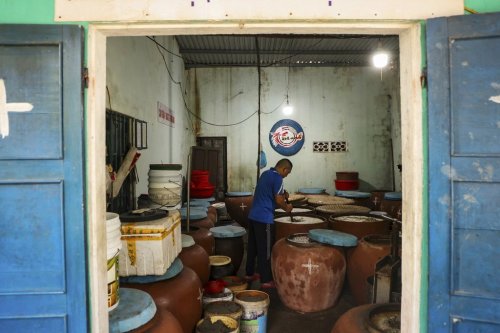
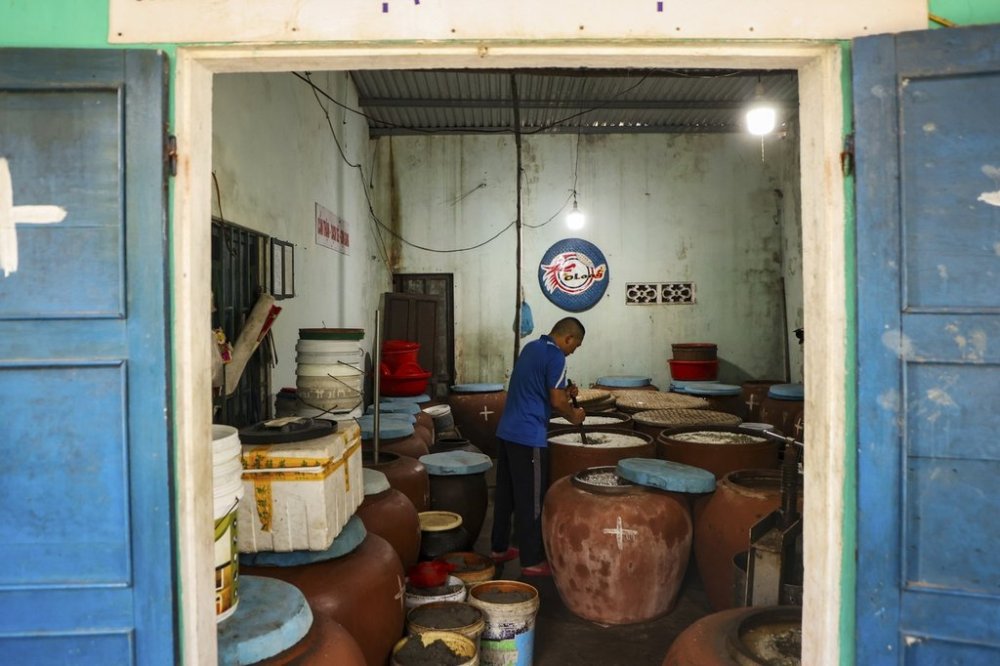
The anchovies are usually caught between January to March when they congregate off the coast of Da Nang. If they are the right species and size, they get mixed gently with sea salt and put in special tera cotta barrels. Sometimes worms or other ingredients are added to bring in different flavors. Phu ferments this for up to 18 months — stirring the mix several times a week — before it can be strained, bottled and sold to customers.
The sea salt imparts different flavor depending on where it comes from. So does the amount of salt used, and makers have their own recipes; the Bui family uses three parts fish to one part salt. The time allowed for fermentation, and the potential addition of other fish, also affect the flavor of the final product.
But it is harder to get the perfect anchovies. The fish catch has decreased — fishermen in markets across Vietnam rue the fact that much of the fish they sell now was considered bait-size in previous decades — and it’s only the good relationships he has with anchovy fishermen that allow him to get the fish directly, avoiding high market prices. The unmistakeable aroma of fermenting fish cloaks the homes of families that still make traditional fish sauce. But Phu said that many families are thinking of getting out of the business because of high anchovy prices.
That may affect Vietnamese plans for a bigger share of the global fish sauce market — projected to increase in value from $18.5 billion in 2023 to nearly $29 billion by 2032, according to a report by Introspective Market Research. Vietnam, along with Thailand, is the world’s largest exporter of fish sauce and is hoping improvements in food safety to satisfy standards in lucrative markets like the U.S., Europe and Japan will help cement a national brand that helps advertise Vietnamese culture to the world.
It’s hard to overemphasize how deeply the condiment is enmeshed in Vietnamese culture. Students living abroad speak of how its taste transports them back home and a top chef says it’s the foundation for flavor in the country’s cuisine. The varying taste of different brews also means everyone — from top businessmen to daily wage workers — has their own opinions about which is the best.
Phu said that each family has their own secrets about making fish sauce. And, nearly fifty years since his father chose to stay back and take care of the family business, he’d like to pass those on to his own son. But he knows that it’ll depend on whether enough anchovies thrive in the sea for the craft to be viable.

“Fish sauce to me is not just a condiment for cooking. But it is our craft, our culture, our tradition that need to be preserved, safeguarded and inherited,” he said.
___
Associated Press journalist Hau Dinh contributed to this report.
___
The Associated Press’ climate and environmental coverage receives financial support from multiple private foundations. AP is solely responsible for all content. Find AP’s standards for working with philanthropies, a list of supporters and funded coverage areas at AP.org.