Climate change is making coffee more expensive. Tariffs likely will too
Advertisement
Read this article for free:
or
Already have an account? Log in here »
To continue reading, please subscribe:

Digital Subscription
One year of digital access for only $205*
- Enjoy unlimited reading on winnipegfreepress.com
- Read the E-Edition, our digital replica newspaper
- Access News Break, our award-winning app
- Play interactive puzzles
*First annual payment billed as $205.00 + GST for one year. This annual subscription will automatically renew at $233.00 + GST every 52 weeks (10% off the regular annual price of $259.35). Offer available to new and qualified returning subscribers only. Cancel any time.
To continue reading, please subscribe:
Add Free Press access to your Brandon Sun subscription for only an additional
$1 for the first 4 weeks*
- Enjoy unlimited reading on winnipegfreepress.com
- Read the E-Edition, our digital replica newspaper
- Access News Break, our award-winning app
- Play interactive puzzles
*Your next Brandon Sun subscription payment will increase by $1.00 and you will be charged $17.95 plus GST for four weeks. After four weeks, your payment will increase to $24.95 plus GST every four weeks.
Read unlimited articles for free today:
or
Already have an account? Log in here »
Hey there, time traveller!
This article was published 30/04/2025 (445 days ago), so information in it may no longer be current.
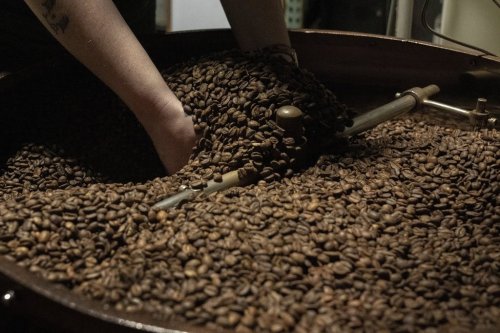
ROCHESTER, N.Y. (AP) — With her purple-and-pink hair swaying, Reneé Colón stands on a stepladder in the rented corner of a warehouse, pouring Brazilian coffee beans into her groaning old roasting machine.
The beans are precious because they survived severe drought in a year when environmental conditions depressed coffee production globally, doubling the price of raw beans in just months.
“Unfortunately, coffee is going to become more scarce,” said Colón, founder and roaster at Fuego Coffee Roasters. “Seeing that dramatic loss of the Brazilian crop is a perfect example.”

___
EDITOR’S NOTE: This story is a collaboration between Rochester Institute of Technology and The Associated Press.
___
Losses from heat and drought have cut production forecasts in Brazil and Vietnam, the world’s largest coffee growers. Global production is still expected to increase, but not as much as commodity market investors had expected. That’s sent coffee prices up, largely because of continued high demand in Europe, the U.S., and China.
Prices peaked in February but have remained high, forcing roasters like Colón to weigh how much of that cost to absorb and how much to pass on to consumers.
The beans Colón was roasting cost her $5.50 per pound in early March, more than double what they cost in September. And that was for mixed, midrange beans. Specialty coffees — grown in delicate climates to slow growth and add flavor — can cost even more.
President Donald Trump’s current 10% tariffs cover most coffee-producing countries, including Brazil, Ethiopia and Colombia, and are expected to drive up costs for Americans. Amid his chaotic tariff pronouncements — at one point he threatened 46% tariffs on Vietnam imports and 32% on Indonesia imports before pausing them — American coffee roasters are rethinking their supply chains.
“With all these changes in coffee maybe we should open our own damn farm,” Colón muses.
Rural New York isn’t an option, of course. The world’s best coffee thrives near the equator, where seasons are long, and in high altitudes, where slow growing allows beans to gather flavor. But Puerto Rico, where Colón and her husband have roots, isn’t a serious option, either — labor costs are too high and she worries about the increasing risk of crop-damaging hurricanes.
She shrugs off buying coffee from Hawaii and California, which she says is either poor quality, overpriced or both.
In February, global coffee green exports were down 14.2% from a year earlier, according to the International Coffee Organization’s market report. The shortage led to the highest price ever for raw coffee in February, breaking the record set in 1977 when severe frost wiped out 70% of Brazil’s coffee plants.
Climate isn’t the only thing driving up prices, said Daria Whalen, a buyer for San Francisco-based Ritual Coffee Roasters. Inflation is driving up the cost of labor, fertilizers, and borrowing, she said.
She described being in Mexico in April seeking to finalize contracts between Trump’s fits and starts on tariffs. It reminded her of being in Colombia a month earlier as Trump threatened and then backed away from tariffs that would have affected coffee prices.
“It was kind of like roller coaster day, because at the end of the day it didn’t exist,” Whalen said.
Some of the recent rise in coffee prices may be from importers buying extra in anticipation of the tariffs. Colón believes prices will go still higher as import taxes begin being paid. And with consumer confidence hitting a 12-year low, Colón could see a decrease in demand for her premium coffee.
“It is tough on our end because it drives the price up, tough on the consumer end because they have to pay more and tough on the farmers’ end because they may be experiencing really significant losses,” Colón said.
Yet she’s committed to expanding.
In December, she and her husband took out a $50,000 loan to buy a custom coffee roaster from Turkey that will triple capacity. They’re trying to increase sales by adding new wholesale clients like coffee shops, and selling directly to homes via a beans-of-the-month-style subscription service.
The Colóns have raised the wholesale price on a pound of roasted beans by 25 cents. They’re considering doing the same for pour-overs and espresso drinks at their two retail locations.
At one of those, called Melo, one couple said they don’t look at the coffee’s price on the receipt. For them, it’s a treat.
“We know we could go find coffee cheaper somewhere else,” said Rob Newell, a high school biology teacher, as he held a cooing infant daughter alongside his wife, who is also a teacher. “Maybe it’s just because we’re new parents, but you get, like, cabin fever staying in the house all day.”
Colón is also seeking to cut costs.
The warehouse where she roasts has some extra space, so she’s weighing stacking up more bags of raw beans there to save as much as $500 on monthly storage costs in port cities.
She’s tried to cultivate relationships with farmers to minimize price spikes and control bean quality. She described working with a farmer in Colombia as coffee prices were spiking in February to lock in a one-year contract that avoided the worst of the increase.

And like many small business owners, she’s had to get used to the complexity of tariffs.
In January, she turned down a pitch from a Montreal coffee importer who suggested the U.S. dollar’s strength in Canada would allow her to save money by importing through their warehouse. She feared that tariffs on Canada could increase prices. Plus, the coffee would have to cross an extra border, risking delays. And the value of the dollar has been up and down.
“I want things to be less complicated instead of more,” she said.
___
The Associated Press’ climate and environmental coverage receives financial support from multiple private foundations. AP is solely responsible for all content. Find AP’s standards for working with philanthropies, a list of supporters and funded coverage areas at AP.org.