Travelers no longer have to remove their shoes during security screenings at US airports

Advertisement

Advertise with us

Travelers racing to catch a flight at U.S. airports no longer are required to remove their shoes during security screenings, Homeland Security Secretary Kristi Noem said Tuesday.

Read this article for free:


or

Already have an account? Log in here »

To continue reading, please subscribe:

Subscribe and receive a limited-edition Free Press branded hat or tote.

Digital Subscription

One year of digital access for only $205*

  • Enjoy unlimited reading on winnipegfreepress.com
  • Read the E-Edition, our digital replica newspaper
  • Access News Break, our award-winning app
  • Play interactive puzzles

*First annual payment billed as $205.00 + GST for one year. This annual subscription will automatically renew at $233.00 + GST every 52 weeks (10% off the regular annual price of $259.35). Offer available to new and qualified returning subscribers only. Cancel any time.

To continue reading, please subscribe:

Add Free Press access to your Brandon Sun subscription for only an additional

$1 for the first 4 weeks*

  • Enjoy unlimited reading on winnipegfreepress.com
  • Read the E-Edition, our digital replica newspaper
  • Access News Break, our award-winning app
  • Play interactive puzzles
Start now

*Your next Brandon Sun subscription payment will increase by $1.00 and you will be charged $17.95 plus GST for four weeks. After four weeks, your payment will increase to $24.95 plus GST every four weeks.

Hey there, time traveller!
This article was published 08/07/2025 (449 days ago), so information in it may no longer be current.

Travelers racing to catch a flight at U.S. airports no longer are required to remove their shoes during security screenings, Homeland Security Secretary Kristi Noem said Tuesday.

Noem said the end of the ritual put in place almost 20 years ago was immediately effective nationwide. She said a pilot program showed the Transportation Security Administration had the equipment needed to keep airports and aircraft safe while allowing people to keep their shoes on.

“I think most Americans will be very excited to see they will be able to keep their shoes on, and it will be a much more streamlined process,” Noem said.
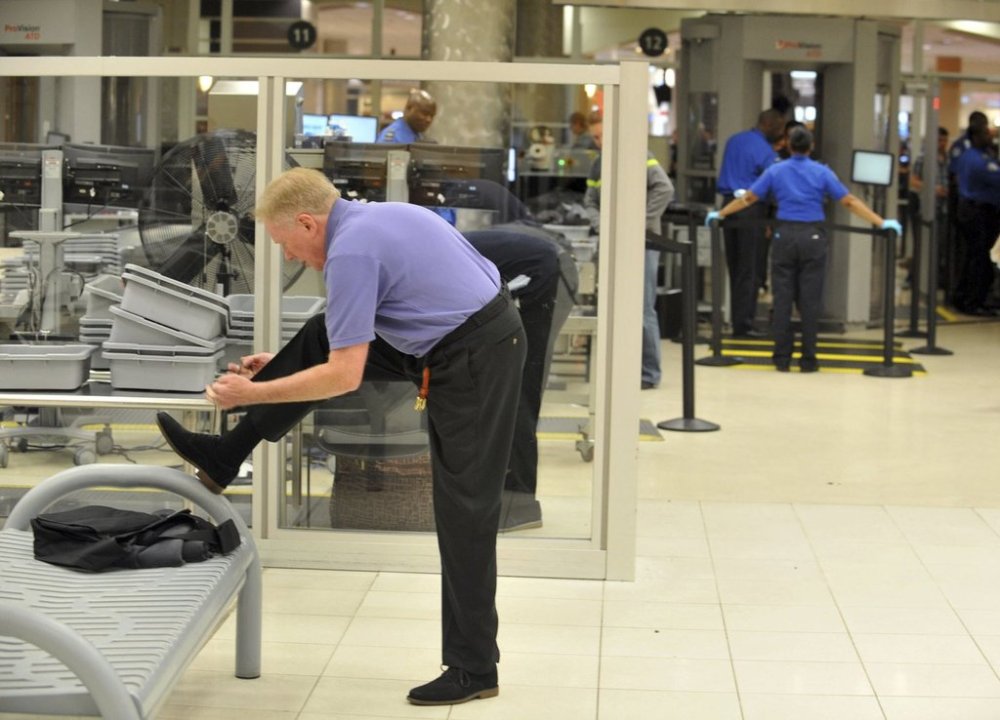
FILE - A traveler removes his shoes at Hartsfield-Jackson Atlanta International Airport on Wednesday, Jan. 15, 2014 in Atlanta. (Kent D. Johnson/Atlanta Journal-Constitution via AP, File)

While shoe removal no longer is standard procedure at airport security checkpoints, some travelers still may be asked to take off their footwear “if we think additional layers of screening are necessary,” she added.

The travel newsletter Gate Access first reported that the TSA planned to make the security screening change soon.

Security screening sans shoes became a requirement in 2006, several years after “shoe bomber” Richard Reid’s failed attempt to take down a flight from Paris to Miami in late 2001.

All passengers between the ages of 12 and 75 were required to remove their shoes, which were scanned along with carry-on bags and other separated items such as outerwear.

Travelers previously were able to skirt the requirement if they participated in the TSA PreCheck program, which costs around $80 for five years. The program allows airline passengers to get through the screening process without taking off their shoes, belts or light jackets, and without having to take their laptops and bagged toiletries out.

PreCheck will remain the easier option for the time being since people going through regular screening stations still will have to put items besides shoes on a conveyor belt for scanning, Noem said.

TSA plans to review other rules and procedures to see how airport screenings can be simplified and expedited, she said. The agency is testing separate lanes for military personnel and families with young children, and expects to pilot other changes in the next six to eight months, Noem said.

In recent years, federal authorities have explored facial recognition technology and implemented Real ID requirements as a way to verify the identities of passengers.

The Transportation Security Administration began in 2001 when President George W. Bush signed legislation for its creation two months after the 9/11 attacks. TSA hired federal employees as agents to replace the workers for private companies that airlines had used to handle security.

Although regular air travelers are familiar with the intricacies of going through airport security, long lines during busy times and bags getting pulled aside for infractions such as forgotten water bottles can make the process fraught.

President Donald Trump’s transportation secretary, Sean Duffy, asked the public in an April social media post what would make travel more seamless. The following day, Duffy posted on X that, “It’s clear that TSA is the #1 travel complaint. That falls under the Department of Homeland Security. I’ll discuss this with @Sec_Noem.”

Trump fired TSA Administrator David Pekoske in January in the middle of a second five-year term. Trump had appointed Pekoske during his first term in the White House, and President Joe Biden reappointed him.

No reason was given for Pekoske’s departure. The administrator position remains vacant, according to the TSA website.

___

Lisa Leff contributed from Sonoma, California.
Report Error Submit a Tip

More Stories

Canada resorting to its tried and true playbook

Niigaan Sinclair 5 minute read Preview

Canada resorting to its tried and true playbook

Niigaan Sinclair 5 minute read Monday, Sep. 28, 2026

In 1846, Britain faced an emergency influenced by the Irish famine, so leaders repealed the country’s “Corn Laws” and restrictions on imported food and grain, transitioning to a system of free trade.

This created a crisis in the then Province of Canada, which had relied on British “preferential” status to prop up its agricultural and resource industries.

As a result, Canada looked south for new markets and eventually negotiated a free trade agreement with the United States.

This required land to be acquired and converted for industrial use quickly, so Canada quickly dispatched Commissioner William Robinson to negotiate with Indigenous communities along Lake Huron and Lake Superior for land.

Read
Monday, Sep. 28, 2026

Travelers no longer have to remove their shoes during security screenings at US airports

Michelle Chapman, The Associated Press 3 minute read Preview

Travelers no longer have to remove their shoes during security screenings at US airports

Michelle Chapman, The Associated Press 3 minute read Wednesday, Jul. 9, 2025

Travelers racing to catch a flight at U.S. airports no longer are required to remove their shoes during security screenings, Homeland Security Secretary Kristi Noem said Tuesday.

Noem said the end of the ritual put in place almost 20 years ago was immediately effective nationwide. She said a pilot program showed the Transportation Security Administration had the equipment needed to keep airports and aircraft safe while allowing people to keep their shoes on.

“I think most Americans will be very excited to see they will be able to keep their shoes on, and it will be a much more streamlined process,” Noem said.

While shoe removal no longer is standard procedure at airport security checkpoints, some travelers still may be asked to take off their footwear “if we think additional layers of screening are necessary,” she added.

Read
Wednesday, Jul. 9, 2025

Billions of dollars spent on health, but scattershot financial reporting leaves decision-makers, Manitobans in the dark, auditor general says

Nicole Buffie 3 minute read Preview

Billions of dollars spent on health, but scattershot financial reporting leaves decision-makers, Manitobans in the dark, auditor general says

Nicole Buffie 3 minute read Yesterday at 5:20 PM CDT

Manitoba’s auditor general says significant gaps in health-sector financial reporting make it difficult to understand how billions of dollars in public funds are spent.

Auditor General Tyson Shtykalo is calling for clearer, more transparent reporting in his latest report, titled Observations on Health Sector Financial Reporting and Accountability in Manitoba.

“Manitoba spends nearly $10 billion annually on health care, but current financial reporting does not provide a clear picture of how that money is spent, what services cost, or the financial pressures facing the system,” Shtykalo said in a news release.

While some financial information is available, the reports do not provide a “complete, consistent, or easily understood” picture of how health-care funds are spent, the report said.

Read
Yesterday at 5:20 PM CDT

Retiree sues neighbour over alleged dog attack

Scott Billeck 2 minute read Yesterday at 2:00 AM CDT

A Winnipeg man is suing his neighbour over an alleged dog attack he says occurred while he was helping him with a lawnmower.

Arthur Cabel, a retiree who lives on Selkirk Avenue, is seeking unspecified damages from neighbour Saisamone Saegone, according to a statement of claim filed in the Manitoba Court of King’s Bench last week.

Cabel claims he went to Saegone’s home in the afternoon on Sept. 23, 2024, to help him with his lawnmower.

According to the lawsuit, Saegone’s large dog, initially in a fenced backyard, escaped, approaching Cabel and “mauling, attacking and biting him.”

Manitoba PCs choose Narth as interim leader; ‘deeply hurt’ Khan blasts former caucus colleagues

Carol Sanders 7 minute read Preview

Manitoba PCs choose Narth as interim leader; ‘deeply hurt’ Khan blasts former caucus colleagues

Carol Sanders 7 minute read Updated: Yesterday at 9:46 PM CDT

Manitoba’s Progressive Conservative caucus chose MLA Konrad Narth as interim party leader Tuesday to replace Obby Khan, who quit a day earlier after he said he was stabbed in the back by a small group of caucus members plotting in secret to oust him.

Read
Updated: Yesterday at 9:46 PM CDT

Obsessed stalker who shot, killed young woman at bus stop in 1993 dies behind bars at age 74

Erik Pindera 3 minute read Preview

Obsessed stalker who shot, killed young woman at bus stop in 1993 dies behind bars at age 74

Erik Pindera 3 minute read Yesterday at 5:53 PM CDT

A Winnipeg man who stalked a woman for several years before shooting her dead in the street in 1993 has died in Stony Mountain prison.

On Monday, 74-year-old Ronald Edd Bell died of apparent natural causes at the federal prison just north of Winnipeg, the Correctional Service of Canada said.

Bell had been in prison since May 30, 1994, when he was given a life sentence with no chance of parole for 18 years for killing Terry-Lyn Babb, 25, on Jan. 21, 1993.

Bell walked up behind an unsuspecting Babb, who was waiting at a bus stop at Sherbrook Street and Wolseley Avenue, and shot her in the head with a pistol in front of horrified witnesses, says the Free Press report of his sentencing hearing.

Read
Yesterday at 5:53 PM CDT