Less selection, higher prices: How tariffs are shaping the holiday shopping season
Advertisement
Read this article for free:
or
Already have an account? Log in here »
To continue reading, please subscribe:

Digital Subscription
One year of digital access for only $205*
- Enjoy unlimited reading on winnipegfreepress.com
- Read the E-Edition, our digital replica newspaper
- Access News Break, our award-winning app
- Play interactive puzzles
*First annual payment billed as $205.00 + GST for one year. This annual subscription will automatically renew at $233.00 + GST every 52 weeks (10% off the regular annual price of $259.35). Offer available to new and qualified returning subscribers only. Cancel any time.
To continue reading, please subscribe:
Add Free Press access to your Brandon Sun subscription for only an additional
$1 for the first 4 weeks*
- Enjoy unlimited reading on winnipegfreepress.com
- Read the E-Edition, our digital replica newspaper
- Access News Break, our award-winning app
- Play interactive puzzles
*Your next Brandon Sun subscription payment will increase by $1.00 and you will be charged $17.95 plus GST for four weeks. After four weeks, your payment will increase to $24.95 plus GST every four weeks.
Read unlimited articles for free today:
or
Already have an account? Log in here »
Hey there, time traveller!
This article was published 20/07/2025 (445 days ago), so information in it may no longer be current.
NEW YORK (AP) — With summer in full swing in the United States, retail executives are sweating a different season. It’s less than 22 weeks before Christmas, a time when businesses that make and sell consumer goods usually nail down their holiday orders and prices.
But President Donald Trump’s vacillating trade policies, part of his effort to revive the nation’s diminished manufacturing base and to reduce the U.S. deficit in exported goods, have complicated those end-of-year plans. Balsam Hill, which sells artificial trees and other decorations online, expects to publish fewer and thinner holiday catalogs because the featured products keep changing with the tariff — import tax — rates the president sets, postpones and revises.
“The uncertainty has led us to spend all our time trying to rejigger what we’re ordering, where we’re bringing it in, when it’s going to get here,” Mac Harman, CEO of Balsam Hill parent company Balsam Brands, said. “We don’t know which items we’re going to have to put in the catalog or not.”
Months of confusion over which foreign countries’ products may become more expensive to import has left a question mark over the holiday shopping season. U.S. retailers often begin planning for the winter holidays in January and typically finalize the bulk of their orders by the end of June. The seesawing tariffs already have factored into their calculations.
The consequences for consumers? Stores may not have the specific gift items customers want come November and December. Some retail suppliers and buyers scaled back their holiday lines rather than risking a hefty tax bill or expensive imports going unsold. Businesses still are setting prices but say shoppers can expect many things to cost more, though by how much depends partly on whether Trump’s latest round of “reciprocal” tariffs kicks in next month.
The lack of clarity has been especially disruptive for the U.S. toy industry, which sources nearly 80% of its products from China. American toy makers usually ramp up production in April, a process delayed until late May this year after the president put a 145% tariff on Chinese goods, according to Greg Ahearn, president and CEO of the Toy Association, an industry trade group.
The U.S. tariff rate may have dropped significantly from its spring high — a truce in the U.S.-China trade war is set to expire on Aug. 12 — but continues to shape the forthcoming holiday period. Manufacturing activity is way down from a year ago for small- and medium-sized U.S. toy companies, Ahearn said.
The late start to factory work in China means holiday toys are only now arriving at U.S. warehouses, industry experts said. A big unknown is whether tariffs will keep stores from replenishing supplies of any breakout hit toys that emerge in September, said James Zahn, editor-in-chief of the trade publication Toy Book.
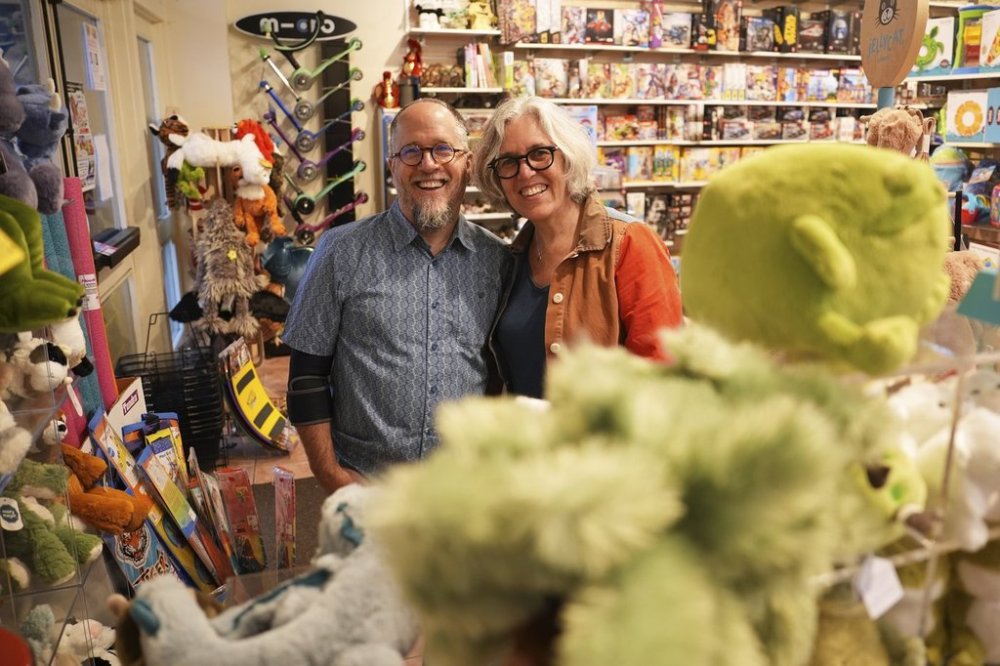
In the retail world, planning for Christmas in July usually involves mapping out seasonal marketing and promotion strategies. Dean Smith, who co-owns independent toy stores JaZams in Princeton, New Jersey, and Lahaska, Pennsylvania, said he recently spent an hour and a half running through pricing scenarios with a Canadian distributor because the wholesale cost of some products increased by 20%.
Increasing his own prices that much might turn off customers, Smith said, so he explored ways to “maintain a reasonable margin without raising prices beyond what consumers would accept.” He ordered a lower cost Crazy Forts building set so he would have the toy on hand and left out the kids’ edition of the Anomia card game because he didn’t think customers would pay what he would have to charge.
“In the end, I had to eliminate half of the products that I normally buy,” Smith said.
Hilary Key, owner of The Toy Chest in Nashville, Indiana, said she tries to get new games and toys in early most years to see which ones she should stock up on for the winter holidays. This year, she abandoned her product testing for fear any delayed orders would incur high import taxes.
Meanwhile, vendors of toys made in China and elsewhere bombarded Key with price increase notices. For example, Schylling, which makes Needoh, Care Bear collectibles and modern versions of nostalgic toys like My Little Pony, increased prices on orders by 20%, according to Key.
All the price hikes are subject to change if the tariff situation changes again. Key worries her store won’t have as compelling a product assortment as she prides herself on carrying.
“My concern is not that I’ll have nothing, because I can bring in more books. I can bring in more gifts, or I can bring in just things that are manufactured in other places,” she said. “But that doesn’t mean I’m going to have the best stock for every developmental age, for every special need.”
The retail industry may have to keep taking a whack-a-mole approach to navigating the White House’s latest tariff ultimatums and temporary reprieves. Last week, the president again reset the rates on imports from Brazil, the European Union, Mexico, and other major trading partners but said they would not take effect until Aug. 1.
The brief pause should extend the window importers have to bring in seasonal merchandise at the current baseline tariff of 10%. The Port of Los Angeles had the busiest June in its 117-year history after companies raced to secure holiday shipments, and July imports look strong so far, according to Gene Seroka, the port’s executive director.
“In my view, we’re seeing a peak season push right now to bring in goods ahead of potentially higher tariffs later this summer,” Seroka said Monday.
The pace of port activity so far this year reflects a “tariff whipsaw effect” — imports slowing when tariffs kick in and rebounding when they’re paused, he said. “For us consumers, lower inventory levels, fewer selections and higher prices are likely as we head into the holidays.”

Smith, who co-owns the two JaZams stores with his partner, Joanne Farrugia, said they started placing holiday orders two months earlier than usual for “certain items that we felt were essential for us to have at particular pricing.” They doubled their warehouse space to store the stockpile. But some shoppers are trying to get ahead of higher prices just like businesses are, he said.
He’s noticed customers snapping up items that will likely be popular during the holidays, like Jellycat plush toys and large stuffed unicorns and dogs. Any sales are welcome, but Smith and Farrugia are wary of having to restock at a higher cost.
“We’re just trying to be as friendly as we can to the consumer and still have a product portfolio or profile that is gonna meet the needs of all of our various customers, which is getting more and more challenging by the day,” Smith said.
Balsam Brands’ Harman said he’s had to resign himself to not having as robust a selection of ornaments and frosted trees to sell as in years’ past. Soon, it will be too late to import meaningful additions to his range of products.
“Our purpose as a company is to create joy together, and we’re going to do our very best to do that this year,” Harman said. “We’re just not going to have a bunch of the items that consumers want this year, and that’s not a position we want to be in.”