Scientists thought this Argentine glacier was stable. Now they say it’s melting fast

Advertisement

Advertise with us

An iconic Argentinian glacier, long thought one of the few on Earth to be relatively stable, is now undergoing its “most substantial retreat in the past century,” according to new research.

Read this article for free:


or

Already have an account? Log in here »

To continue reading, please subscribe:

Subscribe and receive a limited-edition Free Press branded hat or tote.

Digital Subscription

One year of digital access for only $205*

  • Enjoy unlimited reading on winnipegfreepress.com
  • Read the E-Edition, our digital replica newspaper
  • Access News Break, our award-winning app
  • Play interactive puzzles

*First annual payment billed as $205.00 + GST for one year. This annual subscription will automatically renew at $233.00 + GST every 52 weeks (10% off the regular annual price of $259.35). Offer available to new and qualified returning subscribers only. Cancel any time.

To continue reading, please subscribe:

Add Free Press access to your Brandon Sun subscription for only an additional

$1 for the first 4 weeks*

  • Enjoy unlimited reading on winnipegfreepress.com
  • Read the E-Edition, our digital replica newspaper
  • Access News Break, our award-winning app
  • Play interactive puzzles
Start now

*Your next Brandon Sun subscription payment will increase by $1.00 and you will be charged $17.95 plus GST for four weeks. After four weeks, your payment will increase to $24.95 plus GST every four weeks.

Hey there, time traveller!
This article was published 07/08/2025 (406 days ago), so information in it may no longer be current.

An iconic Argentinian glacier, long thought one of the few on Earth to be relatively stable, is now undergoing its “most substantial retreat in the past century,” according to new research.

The Perito Moreno Glacier in the Southern Patagonian Ice Field for decades has been wedged securely in a valley. But it’s started losing contact with the bedrock below, causing it to shed more ice as it inches backward. It’s a change, illustrated in dramatic timelapse photos since 2020, that highlights “the fragile balance of one of the most well-known glaciers worldwide,” write the authors of the study in the journal Communications Earth & Environment.

They expect it to retreat several more kilometers in the next few years.

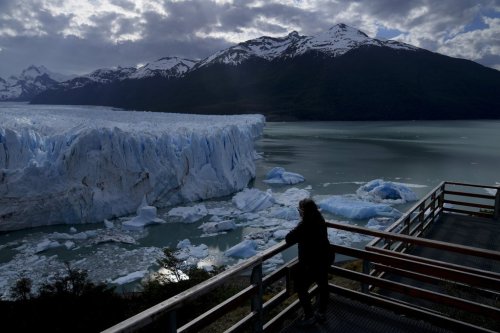
FILE - A tourist watches the Perito Moreno Glacier at Los Glaciares National Park, near El Calafate, Argentina, Nov. 1, 2021. (AP Photo/Natacha Pisarenko, File)

“We believe that the retreat that we are seeing now, and why it is so extreme in terms of values that we can observe, is because it hasn’t been climatically stable for a while now, for over a decade,” said Moritz Koch, a doctoral student at the Friedrich-Alexander University of Erlangen-Nuremberg and one of the study authors. “Now we see this very delayed response to climate change as it is slowly but surely detaching from this physical pinning point in the central part of the glacier.”

Koch and his team did extensive field work to get the data for their calculations. To measure ice thickness, they flew over the glacier in a helicopter with a radar device suspended beneath. They also used sonar on the lake and satellite information from above.

Every year, hundreds of thousands of people visit Glaciar Perito Moreno, which was declared a UNESCO World Heritage Site in 1981. It’s a site known to “calve” ice chunks that fall into Lake Argentino below.

The basic physics of climate change and glaciers are intuitive: heat melts ice, and global warming means more and faster glacial melting, said Richard Alley, an ice scientist at Pennsylvania State University who was not involved in the study. But much like a dropped coffee mug, it’s harder to predict when and exactly how they’re going to break apart.

He said people who deny climate change frequently point to anomalies like Perito Moreno, which for a long time wasn’t retreating when most other glaciers were.

Even without climate change, glaciers fluctuate a bit. But if the climate were stable, ordinary accumulation of snow and ice would offset the melting and movement, said Erin Pettit, a glaciologist at Oregon State University who was also not involved in the study.

Glacial melting, especially at the poles, matters because it could cause catastrophic sea level rise, harming and displacing people living in coastal and island areas. While the changes can be locally spectacular in places like Patagonia, Alley said the bigger concern is using studies like this one to understand “what might happen to the big guys” in Antarctica.

But even smaller glaciers have a powerful presence in communities, Pettit said. Ice has carved out many of the landscapes people love today, and they are intimately tied to many cultures around the world. Glaciers can be a source of drinking water or, when they collapse, a destructive force leaving mudslides in their wake.

“We are losing these little bits of ice everywhere,” Pettit said. “Hopefully we’re slowly gaining more respect for the ice that was here, even if it’s not always there.”

___

Follow Melina Walling on X @MelinaWalling and Bluesky @melinawalling.bsky.social.

___

The Associated Press’ climate and environmental coverage receives financial support from multiple private foundations. AP is solely responsible for all content. Find AP’s standards for working with philanthropies, a list of supporters and funded coverage areas at AP.org.

Report Error Submit a Tip

More Stories

Online fundraiser for ‘polite, modest farmer’ facing firearms charges sending message, neighbour says

Nicole Buffie 4 minute read Preview

Online fundraiser for ‘polite, modest farmer’ facing firearms charges sending message, neighbour says

Nicole Buffie 4 minute read 5:45 PM CDT

Thousands of dollars have been raised to help cover the legal fees of a Manitoba man charged after he allegedly fired a gun at thieves during a theft on his farm in August.

Read
5:45 PM CDT

Dynacare must treat workers fairly: health minister

Carol Sanders 4 minute read Preview

Dynacare must treat workers fairly: health minister

Carol Sanders 4 minute read 6:40 PM CDT

Manitoba’s health minister defended the government’s contract with Dynacare, saying the for-profit company is expected to treat its workers fairly — but wouldn’t say if that expectation was spelled out in the deal.

The 350 private lab workers, who are represented by the Manitoba Association of Health Care Professionals, have been without a contract since March 31 and went on strike on Sept. 8.

The Manitoba Labour Board ordered them back to work and they returned to the job one day later.

Health Minister Uzoma Asagwara was asked Wednesday about the lack of an essential services agreement and why the government didn’t intervene in March, knowing that a labour dispute could interrupt community lab services.

Read
6:40 PM CDT

Teenage e-scooter driver in critical condition after crash

Chris Kitching 6 minute read Preview

Teenage e-scooter driver in critical condition after crash

Chris Kitching 6 minute read Updated: 5:50 PM CDT

A teenager riding an e-scooter suffered life-threatening injuries when he was struck by an SUV in southwest Winnipeg on Monday night.

Witnesses provided first aid to the injured rider, who police said is under 18, after the collision happened at Waverley Street and Arbour Meadow Gate/Lake Crest Road at about 9:30 p.m.

“It feels like it happened in slow motion,” said driver Audrey Vanderspek, who was waiting at a red light when she witnessed the incident. “Maybe it’s because you’re helpless, that it just feels like everything slows down in the moment.”

Police said the electric scooter rider was crossing Waverley and was hit by a southbound 2010 Honda CR-V. The posted speed limit on that stretch of Waverley is 70 kilometres per hour.

Read
Updated: 5:50 PM CDT

Scientists thought this Argentine glacier was stable. Now they say it’s melting fast

Melina Walling, The Associated Press 4 minute read Preview

Scientists thought this Argentine glacier was stable. Now they say it’s melting fast

Melina Walling, The Associated Press 4 minute read Thursday, Aug. 7, 2025

An iconic Argentinian glacier, long thought one of the few on Earth to be relatively stable, is now undergoing its “most substantial retreat in the past century,” according to new research.

The Perito Moreno Glacier in the Southern Patagonian Ice Field for decades has been wedged securely in a valley. But it's started losing contact with the bedrock below, causing it to shed more ice as it inches backward. It's a change, illustrated in dramatic timelapse photos since 2020, that highlights “the fragile balance of one of the most well-known glaciers worldwide," write the authors of the study in the journal Communications Earth & Environment.

They expect it to retreat several more kilometers in the next few years.

“We believe that the retreat that we are seeing now, and why it is so extreme in terms of values that we can observe, is because it hasn’t been climatically stable for a while now, for over a decade,” said Moritz Koch, a doctoral student at the Friedrich-Alexander University of Erlangen-Nuremberg and one of the study authors. “Now we see this very delayed response to climate change as it is slowly but surely detaching from this physical pinning point in the central part of the glacier.”

Read
Thursday, Aug. 7, 2025

Winnipeg is one of nearly 40 municipalities to receive a failing grade from the Canadian Federation of Independent Business in the organization’s inaugural “municipal report card.”

The Manitoba capital ranked 33rd amongst the 66 municipalities assessed, earning an F, with an overall score of 4.84 out of 10.

The report, which the CFIB released on Tuesday, evaluated cost burden, regulatory burden and small-business friendliness using 11 indicators and data collected up to Dec. 31, 2025.

Winnipeg’s grade is a starting point and not the final word, said Brianna Solberg, CFIB’s director for the Prairies and northern Canada.

Federal Court awards OCN $27M, 62 years after construction of hydro dam

Nicole Buffie 5 minute read Preview

Federal Court awards OCN $27M, 62 years after construction of hydro dam

Nicole Buffie 5 minute read Updated: 12:02 PM CDT

The Federal Court has ordered Ottawa pay Opaskwayak Cree Nation $27 million over damages suffered due to the construction of the Grand Rapids hydro dam in the 1960s.

In a decision dated Sept. 3, Federal Court Justice Sébastien Grammond says the federal government had a fiduciary duty to protect the community from the impacts of the dam.

“When the Crown exercises a discretionary power over an Indigenous interest, it has a fiduciary duty and it must exercise the discretion in the best interests of the Indigenous group,” the ruling said. “Canada breached its fiduciary duty to OCN because it approved the (project) without ensuring that the impacts of the Grand Rapids dam on OCN’s traditional way of life were mitigated or compensated.”

The First Nation took the federal government to court in February over impacts on the community after the dam, located about 145 kilometres southeast of Opaskwayak Cree Nation, was installed on the Saskatchewan River in 1964. The case was heard over 14 days in a judge-alone trial in Winnipeg.

Read
Updated: 12:02 PM CDT