Provinces have different measles vaccine schedules. Is it time to harmonize them?
Advertisement
Read this article for free:
or
Already have an account? Log in here »
To continue reading, please subscribe:

Digital Subscription
One year of digital access for only $205*
- Enjoy unlimited reading on winnipegfreepress.com
- Read the E-Edition, our digital replica newspaper
- Access News Break, our award-winning app
- Play interactive puzzles
*First annual payment billed as $205.00 + GST for one year. This annual subscription will automatically renew at $233.00 + GST every 52 weeks (10% off the regular annual price of $259.35). Offer available to new and qualified returning subscribers only. Cancel any time.
To continue reading, please subscribe:
Add Free Press access to your Brandon Sun subscription for only an additional
$1 for the first 4 weeks*
- Enjoy unlimited reading on winnipegfreepress.com
- Read the E-Edition, our digital replica newspaper
- Access News Break, our award-winning app
- Play interactive puzzles
*Your next Brandon Sun subscription payment will increase by $1.00 and you will be charged $17.95 plus GST for four weeks. After four weeks, your payment will increase to $24.95 plus GST every four weeks.
Read unlimited articles for free today:
or
Already have an account? Log in here »
Hey there, time traveller!
This article was published 19/08/2025 (379 days ago), so information in it may no longer be current.
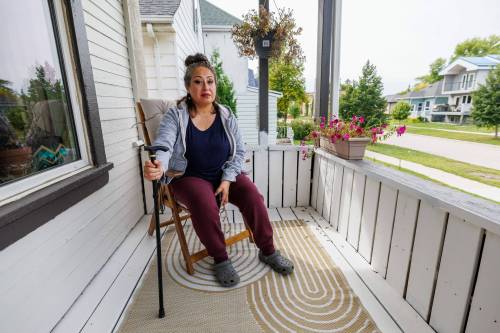
TORONTO – Moving from Ontario to New Brunswick didn’t just mean Jade Medeiros had to navigate a new province with two babies, she also had to figure out a new vaccination program.
When her family moved to Moncton in 2020, she learned her two and three-year-old were already behind on routine vaccinations because New Brunswick has a different schedule than Ontario.
“She had to get a whole bunch all at the same time, whereas in Ontario, it’s more spaced out,” said Medeiros, speaking about her younger daughter.
Each province and territory has its own vaccine schedule based on factors such as when a child would benefit from higher immunity from the shot, and what childhood vaccinations can be grouped together.
Amid a measles outbreak that’s led to nearly 5,000 cases across the country, some parents might notice the second shot to prevent the communicable disease is given at 18 months in some places, and between the ages of four and six in others.
The Canadian Paediatric Society has wanted to harmonize the vaccine schedule across the country since 1997, when it published a paper on the subject.
Its relevance has resurfaced as the country scrambles to strengthen public health messaging in the face of the measles outbreak, which threatens to end Canada’s elimination status in a matter of months.
Parents and health experts also worry that confusion around vaccine schedules and poor record keeping can contribute to lower vaccination rates, especially in light of a growing sentiment of vaccine skepticism in North America.
Childhood vaccination rates have tumbled over the last several years as mistrust and misinformation on immunization caught wind during the COVID-19 pandemic.
Only 76 per cent of seven-year-olds in Canada received both shots of the measles vaccine in 2023, compared to 86 per cent in 2019. Ninety-five per cent is needed to acquire herd immunity.
Dismantling roadblocks to childhood immunization has long been deemed an essential way to eliminate vaccine-preventable diseases such as measles. A vaccine schedule that’s easy to understand and follow can help streamline that process for families.
“I absolutely think they need to harmonize it across the board for all vaccines,” Medeiros said.
VACCINE SCHEDULES
In most provinces and territories the measles, mumps, rubella and varicella (chickenpox) vaccine, MMR-V, is given at 12 months and 18 months.
That’s the case in Alberta, Saskatchewan, Quebec, New Brunswick, Nova Scotia, Prince Edward Island, Newfoundland and Labrador, Northwest Territories and Nunavut.
However, in British Columbia babies get separate MMR and varicella shots at 12 months, and the combined MMR-V shot at around the age they enter school — at four to six years old.
In Yukon, they get separate MMR and varicella doses at 12 months and a second round of the two vaccines between ages four to six.
In Ontario, the MMR shot is at 12 months, followed by a varicella shot at 15 months, and then a combined MMR-V at four to six years old.
WHY DO PROVINCES HAVE DIFFERENT SCHEDULES?
Each province’s vaccine schedule has evolved based on the patterns and distribution of disease in a population, said Dr. Arlene King, a former Chief Medical Officer of Health in Ontario.
When King was Ontario’s top doctor, the province changed the childhood immunization schedule. The National Advisory Committee on Immunization recommended an additional chickenpox shot for better protection, and a combined MMR-V was introduced.
At the time, Ontario’s second dose was at 18 months, separate from a varicella vaccine. But in 2011, the province added a combined MMR-V dose at four to six years old, in addition to the varicella shot given to babies.
“The advantage of providing vaccine at four to six years, the second dose, is that you know that there is going to be full protection against the disease in a setting where they’re going to be a lot of opportunities for transmission, for instance, school,” King said.
Dr. Vinita Dubey, an associate medical officer of health in Toronto, said there is likely more scientific evidence in favour of spacing out the two measles doses, which gives the body more time to build robust immunity before the second dose.
“Especially as a child, and as infants and toddlers, their immune system develops more as they get older,” Dubey said.
But there’s also evidence that a closer schedule will protect the youngest and most vulnerable members of the population from getting sick. That’s because some infants don’t respond to the first dose, said Dr. Joan Robinson, a pediatric infectious diseases physician in Edmonton.
“So if that is the case, giving a second dose as close as possible to the first dose might result in a larger percentage of children being protected,” Robinson said.
She said no one really knows which schedule is better because Canada only introduced a second dose of measles in 1996, and its elimination status was achieved in 1998.
“Ever since then, we’ve not had enough measles anywhere across the country to be able to figure out which is the better schedule,” Robinson said.
‘DISTANT DREAM’ OF SHARED RECORD KEEPING
The Canadian Paediatric Society has repeatedly called for a harmonized immunization strategy, as is the case in the United States and United Kingdom. Both take a similar approach to Ontario, vaccinating kids with a second dose around the age they start school.
A position paper in 1997, which was echoed in a 2011 call to action, warned that children could be slipping through the cracks of a disharmonized schedule.
“Some diversity among provincial and territorial immunization programs would be harmless if all jurisdictions had and shared comprehensive record-keeping systems that could be easily accessed by providers,” Dr. Noni MacDonald, a pediatrician and a member of the group’s infectious diseases and immunization committee at the time, wrote.
“For most jurisdictions such systems are but a distant dream.”
Her words, written almost 30 years ago, still ring true today.
Dr. Jeffrey Pernica, co-chair of the Ontario Immunization Advisory Committee, has been outspoken on the need for an electronic vaccine registry, which would store a child’s immunization information, identify when they are due for a shot, and alert parents in advance.
The federal government’s website lists six provinces that have vaccine registries, including Alberta, British Columbia, Manitoba, Nova Scotia, Quebec and Saskatchewan. None of these systems are connected to one another.
“Ideally, the structure of the health system would be such that everyone got a reminder before their vaccines,” he said.
In Alberta, public health nurses use the vaccine registry to identify kids who are behind on their shots. Those children get a personalized letter and consent form for parents to sign that allows them to catch up on their vaccinations at school.
Jen Slater, a mother of two in Edmonton, said she can access her kids’ vaccination history on the government portal. “If you’re running behind, the government would reach out and remind you that your kids are due.”
The remaining provinces rely on family doctors, parents, or local public health offices to keep track, a disjointed system that some parents say they would be lost navigating on their own.
Pernica notes that millions of people in Ontario don’t have a family doctor, and even those that do are not necessarily reminded when it’s time to get a shot because the physicians don’t necessarily have the time or resources.
“The primary beneficiaries of a vaccine registry are not even public health. I think that the primary benefit would be people who don’t know whether they or their children are up to date with vaccines,” he said.
Nakita Buenbrazo, a mother of a four and a seven-year-old just outside of Hamilton, Ont., said she would have been lost without a family doctor keeping tabs on her kids’ vaccinations. Like many other parents, Buenbrazo is busy, juggling the day-to-day life of a parent with two kids, also running a business, and trusting the health-care system to keep kids up-to-date on their shots.
“I wouldn’t have stayed on top of it,” she said.
This report by The Canadian Press was first published Aug. 19, 2025
Canadian Press health coverage receives support through a partnership with the Canadian Medical Association. CP is solely responsible for this content.