That purple Hawaii vacation lei likely came from Thailand, and some lawmakers want to change that
Advertisement
Read this article for free:
or
Already have an account? Log in here »
To continue reading, please subscribe:

Digital Subscription
One year of digital access for only $205*
- Enjoy unlimited reading on winnipegfreepress.com
- Read the E-Edition, our digital replica newspaper
- Access News Break, our award-winning app
- Play interactive puzzles
*First annual payment billed as $205.00 + GST for one year. This annual subscription will automatically renew at $233.00 + GST every 52 weeks (10% off the regular annual price of $259.35). Offer available to new and qualified returning subscribers only. Cancel any time.
To continue reading, please subscribe:
Add Free Press access to your Brandon Sun subscription for only an additional
$1 for the first 4 weeks*
- Enjoy unlimited reading on winnipegfreepress.com
- Read the E-Edition, our digital replica newspaper
- Access News Break, our award-winning app
- Play interactive puzzles
*Your next Brandon Sun subscription payment will increase by $1.00 and you will be charged $17.95 plus GST for four weeks. After four weeks, your payment will increase to $24.95 plus GST every four weeks.
Read unlimited articles for free today:
or
Already have an account? Log in here »
HONOLULU (AP) — Dear Tourist: The flowers in that bright-purple lei you received on your Hawaii vacation almost certainly weren’t grown in the Aloha State.
The vast majority of those odorless orchids are imported from Thailand, where it is cheaper to grow and string them into the garlands synonymous with Hawaiian culture.
Some Hawaii lawmakers think the state should be doing more to help the producers of lei made with locally grown, fragrant flowers. Ideas include labeling requirements that would identify Hawaii-made garlands and a prohibition on state agencies buying imported lei, though some lei-sellers worry that such rules would make the garlands too expensive.
“You don’t come to Hawaii and not at least have a flower or a lei,” said Kuhio Lewis, CEO of the Hawaiian Council, a nonprofit that promotes Native Hawaiian culture and business. “For us to now be importing is not good. It’s actually embarrassing.”
Lei are synonymous with Hawaii
The custom of giving and wearing lei made of flowers, leaves, seeds or shells has always been associated with Hawaiian people, for whom the garlands represent love or the spirit of “aloha.” They were used not just for ceremonies but worn in everyday life by everyone from chiefs to children, according to a 2002 paper published by the University of Hawaii.
Today, people in Hawaii give and receive lei for all kinds of celebrations, including birthdays and promotions. High school, college and even elementary school graduates receive lei piled to their tops of their heads, their faces slowly vanishing behind a rising wall of flowers. Each year on the opening day of the Legislature, lawmakers meet a similar fate. Pregnant women are given open-ended strands, rather than a closed necklace, because of a tradition that says the latter represents the umbilical cord wrapping around their baby’s neck.
“We always are looking for ways that we can honor people through our Indigenous cultures, which is giving lei,” said state Rep. Darius Kila, who is Native Hawaiian.
Because lei-giving is so ingrained in Hawaii, lawmakers are constantly buying them and doling them out — at groundbreakings, to honor constituents or volunteers, or for staffers’ birthdays, for example.
An effort to regulate lei
Kila this year sponsored a bill, requested by the Hawaiian Council, that would have required a certain percentage of lei purchased by state officials to include flowers grown in-state. It also sought lei labels telling customers where the flowers were grown.
That measure failed, but a related bill in the Senate remains alive. It would create a work group to study whether local flower-growers and lei-makers can meet the rising demand for the garlands, and make recommendations for protecting the local industry.
“The growing commercialization of lei and lei materials has led to increased use of imported plant materials and manufactured components that are marketed using Hawaiian language, imagery, and place names,” the Senate bill states. That “may mislead consumers and undermine local growers, lei makers, and cultural practitioners.”
There is a hierarchy to the flowers
As Hawaii’s population and tourism boomed in the 20th century, lei-makers turned to nonnative ornamental plants such as carnations and jasmine to meet soaring demand, and those are still some of the most popular.
Kila, a Democrat from west Oahu, said he has a strict rule for himself and his staff: “I really try not for us to give out orchid lei, specifically the purple Thailand orchid lei.”
While shopping for lei recently in Honolulu’s Chinatown, home to a concentration of lei stands and flower shops, Kila sought out puakenikeni — also known as the “10-cent flower,” supposedly dating to the days when lei cost a dime —as well as ginger and tuberose. The blooms, which are not native, emit various degrees of jasmine-like sweetness.
“People want pikake” — a type of jasmine, said Francis Wong, owner of longtime Chinatown fixture Jenny’s Lei and Flowers. “That’s the top flower in Hawaii.”
Wong usually sources the aromatic white flowers from a farm in Nanakuli, near Kila’s hometown. But there are seasonal shortages in winter, he said.
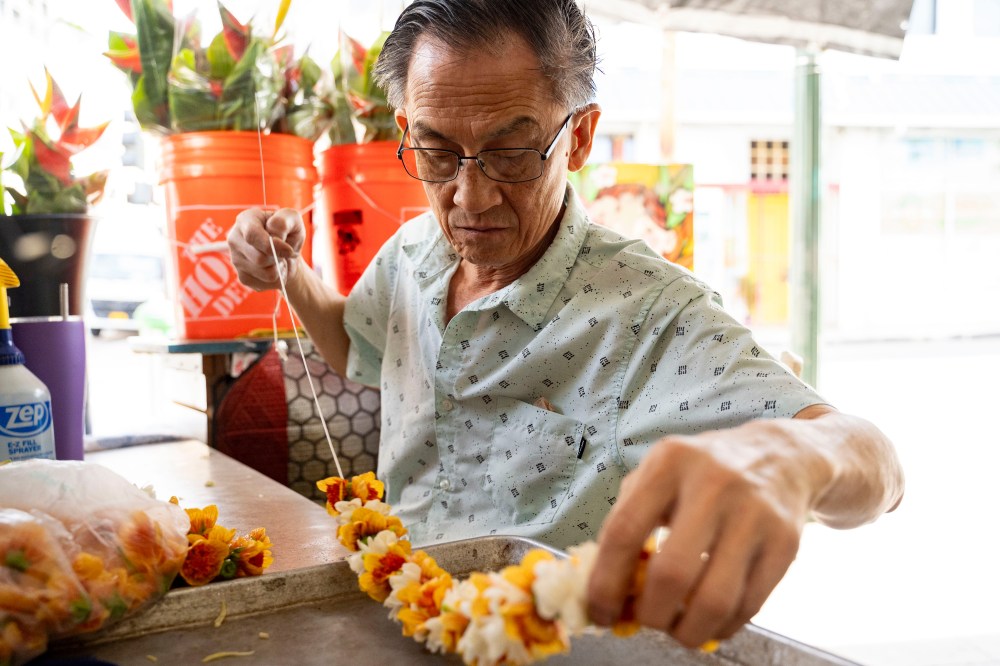
Wong and his wife, Pickoun Wong, who strings flowers together in the back of the store, have been renting the business for 18 years. They sell Thailand orchids to give customers a cheaper option, especially when local flowers are limited.
Locals always prefer local flowers, said Monty Pereira, general manager of Watanabe Floral. But imported flowers help stretch limited local supplies, he said. One popular lei blends Hawaii-grown tuberose with imported carnations.
The Thailand-grown orchids also meet a demand for lei outside of Hawaii, often from former residents who have moved to other states, he said.
Concerns about cost
Watanabe Floral is Hawaii’s biggest florist. It sells some 250,000 lei per year, accounting for about a quarter of its business, Pereira said.
He submitted testimony opposing Kila’s bill on purchasing parameters for state agencies, saying it could unintentionally reduce overall lei usage rather than strengthen the industry.

Restricting imported flowers could drive up the costs of lei, he said in an interview.
“If like 30 lei stands and florists are fighting for the same lei, that’s when lei is going to start to be $100, $150, $200,” he said. Last Mother’s Day, a three-strand pikake lei was going for $150.
And with the Trump administration’s tariffs, the Thailand orchid can now cost about as much as some local flowers, he said.
Pereira, who is Native Hawaiian, worries that people are increasingly turning to lei made with candy or ribbons rather than flowers, a style especially common at graduations.
“The bigger threat is making it so expensive that the people of Hawaii cannot afford to enjoy something that’s culturally significant to us,” he said.