Created as IDs, dog tags became a crucial link between military families and fallen troops
Advertisement
Read this article for free:
or
Already have an account? Log in here »
To continue reading, please subscribe:

Digital Subscription
One year of digital access for only $205*
- Enjoy unlimited reading on winnipegfreepress.com
- Read the E-Edition, our digital replica newspaper
- Access News Break, our award-winning app
- Play interactive puzzles
*First annual payment billed as $205.00 + GST for one year. This annual subscription will automatically renew at $233.00 + GST every 52 weeks (10% off the regular annual price of $259.35). Offer available to new and qualified returning subscribers only. Cancel any time.
To continue reading, please subscribe:
Add Free Press access to your Brandon Sun subscription for only an additional
$1 for the first 4 weeks*
- Enjoy unlimited reading on winnipegfreepress.com
- Read the E-Edition, our digital replica newspaper
- Access News Break, our award-winning app
- Play interactive puzzles
*Your next Brandon Sun subscription payment will increase by $1.00 and you will be charged $17.95 plus GST for four weeks. After four weeks, your payment will increase to $24.95 plus GST every four weeks.
Read unlimited articles for free today:
or
Already have an account? Log in here »
Family members often clench them as if they were still clasping their fallen loved one’s hands. Companions-in-arms have broken down reading them.
More than a century after a U.S. Army chaplain pushed for “dog tags” to become standard issue for troops, they remain one of the most powerful links for grieving military families to their lost loved ones.
“What they’re searching for is connection,” said Air Force Chaplain and Maj. Benjamin Quintanilla Jr. at Dover Air Force Base, where U.S. casualties from the wars in Afghanistan and now Iran have been repatriated. “So these dog tags become just a sacred symbol.”
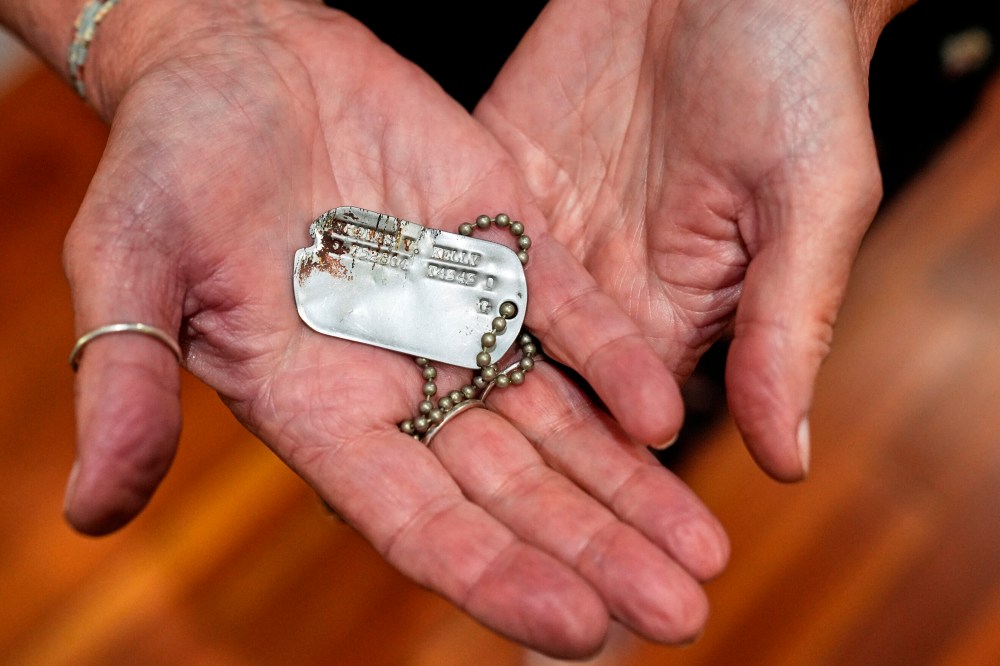
From the World Wars to Vietnam and conflicts in the Middle East, military identification tags have also been a symbol of Americans’ sacrifice in global conflicts.
It’s unclear why the small metal rounded rectangles — hanging on ball chains and listing name, rank, company and other information, depending on the era — are called dog tags, according to the Pentagon.
The need to identify those fallen in battle had been spotlighted by the American Civil War, when staggering numbers of soldiers were buried as “unknown” — such as 75% of the 17,000 Union troops at Vicksburg National Cemetery, according to the National Park Service.
At the end of the Spanish-American War, the 1898 conflict that propelled the United States into global power, Chaplain Charles C. Pierce, then in charge of the morgue in the Philippines, first requested that Army soldiers be issued tags.
By the U.S. entry into World War I, all combat soldiers were required to wear them. They were an official part of the uniform by World War II.
Today, advances in forensics make tags less crucial for identification. But the religious affiliation on them is still useful for chaplains in the battlefield to provide appropriate prayers to dying or fallen troops, Quintanilla said.
And it’s the symbolism of connection that makes them irreplaceable. Surviving families treasure the dog tags their loved ones wore — and the new ones placed in honor on the casket at dignified transfer ceremonies — so much that some keep wearing them or even have them tattooed.
For troops, they’re the simplest sign of belonging.

“I can trust somebody who is wearing the same identification as me,” said Quintanilla, who first joined the Air Force as a dental technician. “It means that I was a part of something greater than myself.”
___
Part of a recurring series, “American Objects,” marking the 250th anniversary of the United States. For more American objects, click here. For more stories on the anniversary, click here.
___
Associated Press religion coverage receives support through the AP’s collaboration with The Conversation US, with funding from Lilly Endowment Inc. The AP is solely responsible for this content.
The Free Press acknowledges the financial support it receives from members of the city’s faith community, which makes our coverage of religion possible.