How to test your lawn for grubs and what to do if you find them

Advertisement

Advertise with us

What does it mean when brown patches show up in a perfectly healthy lawn? The truth is, it could be anything from drought to dog urine, fungal diseases, pests or too much fertilizer. But many homeowners automatically blame grubs.

Read this article for free:


or

Already have an account? Log in here »

To continue reading, please subscribe:

Subscribe and receive a limited-edition Free Press branded hat or tote.

Digital Subscription

One year of digital access for only $205*

  • Enjoy unlimited reading on winnipegfreepress.com
  • Read the E-Edition, our digital replica newspaper
  • Access News Break, our award-winning app
  • Play interactive puzzles

*First annual payment billed as $205.00 + GST for one year. This annual subscription will automatically renew at $233.00 + GST every 52 weeks (10% off the regular annual price of $259.35). Offer available to new and qualified returning subscribers only. Cancel any time.

To continue reading, please subscribe:

Add Free Press access to your Brandon Sun subscription for only an additional

$1 for the first 4 weeks*

  • Enjoy unlimited reading on winnipegfreepress.com
  • Read the E-Edition, our digital replica newspaper
  • Access News Break, our award-winning app
  • Play interactive puzzles
Start now

*Your next Brandon Sun subscription payment will increase by $1.00 and you will be charged $17.95 plus GST for four weeks. After four weeks, your payment will increase to $24.95 plus GST every four weeks.

What does it mean when brown patches show up in a perfectly healthy lawn? The truth is, it could be anything from drought to dog urine, fungal diseases, pests or too much fertilizer. But many homeowners automatically blame grubs.

The problem with this is that it’s often not the case, and even if grubs are present, small populations are not problematic.

Treatment should only be applied after confirming a true grub infestation. Fortunately, there’s a simple way to check, but action must be taken during a specific window of time to be effective. And that time is nigh.
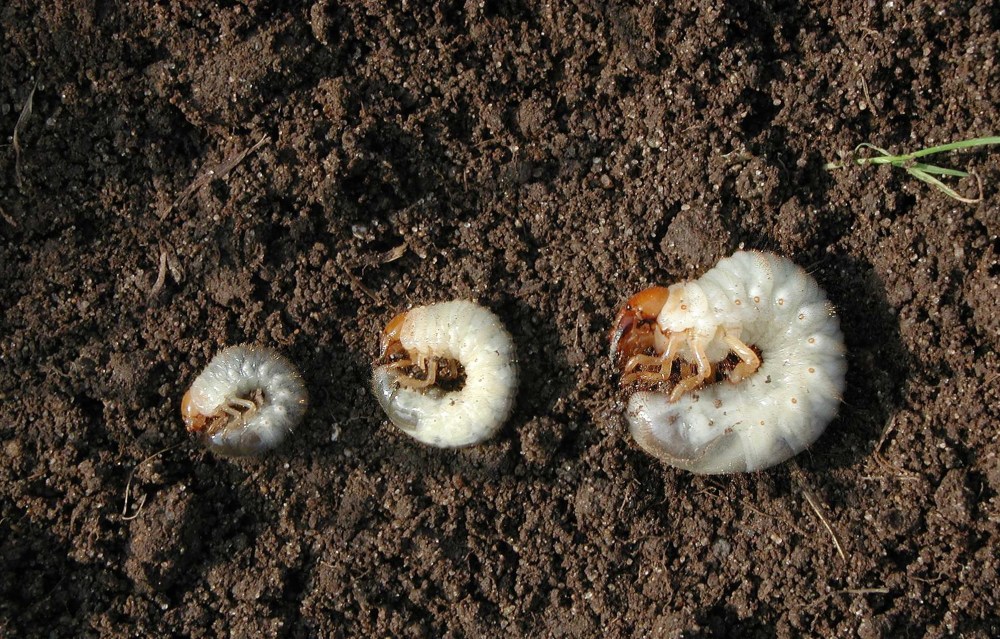
This image provided by Bugwood.org shows three species of white grubs: Japanese beetle (Popillia japonica), from left, European chafer (Amphimallon majalis) and June bug (Phyllophaga spp). (David Cappaert/Bugwood.org via AP)

How to know whether grubs are the culprit

Grubs are the early life forms of beetles, including European chafers, and Asiatic, Japanese and Oriental beetles. They live close to the surface under lawns and other plants, where they feed on roots, disconnecting the roots from the plants’ top growth.

Confirming their presence is easy: Dig up a 3- to 4-inch-deep (7.6 to 10 centimeters), 12-inch-square (930 square centimeters) section of symptomatic lawn that partially overlaps the border of healthy grass.

If there are grubs in the lawn, the whitish, brown-headed, half-inch to 1-inch-long (1 to 2.5 centimeters) beetle larvae, which resemble shrimp, will be visible either on the underlying soil or on the underside of the sod-like square you removed. They’re generally curled into the shape of the letter C.

Fewer than 10 grubs per square foot of soil is normal and does not indicate an infestation, so you should not take any action. Instead, seek out other potential causes.

If grubs are the problem, what’s the solution?

Treatment against grubs should only be applied if there are 10 or more of the insects present under the section of turf you removed. Heavily infested lawn sections will easily roll up like a carpet when you attempt to remove them, their roots severed by the feeding insects.

Because grubs are most vulnerable to pest-control measures when they are young, those measures will only be effective if applied in late summer.

Milky spore powder is a natural product that targets only Japanese beetle grubs. Unfortunately, it’s not always easy to discern between the species. If you are certain your grubs are the Japanese variety, you can give it a try, but success rates are mixed, with better outcomes reported in warmer regions.

Beneficial nematodes are microscopic, non-segmented worms that attack soil-dwelling insects, including all types of grubs. They’re a more universal approach, with higher success rates. They, too, are natural, as they already exist in the soil; you would just be adding more. The nematodes work by infecting grubs with a bacterium that can kill them in as little as 48 hours.

There are many nematode species available, so read package labels and look for the Heterorhabditis bacteriophora (Hb) strain, which specifically targets grubs.

To optimize effectiveness, water the soil well before applying either treatment.

Avoid using chemical treatments, which can be toxic to earthworms, honeybees and other pollinators, pets and wildlife. Some are even toxic to humans.

___

Jessica Damiano writes weekly gardening columns for The Associated Press. She publishes the Weekly Dirt Newsletter. Sign up here for weekly gardening tips and advice.

___

For more AP gardening stories, go to https://apnews.com/hub/gardening.

Report Error Submit a Tip

More Stories

Letters, Oct. 6

6 minute read 2:00 AM CDT

High road not so easy

Re: Khan should’ve taken high road: Goertzen (Oct. 3)

Politics is a tough game. Just ask former provincial Liberal leader Dougald Lamont. He got thrown under the bus by a prominent Manitoba/Canadian Liberal who advised people to vote NDP in the last provincial election.

As Lamont said when he lost the election, he is “human” and what happened to him “hurt.” Khan is also human. It is easy to criticize him for not taking the “high road.”

Scare up some social reconnection this fall

Maureen Scurfield 4 minute read 2:00 AM CDT

DEAR MISS LONELYHEARTS: I’m an emotional mess. My lesbian girlfriend and I broke up in August, and now I hold the lease on the apartment we shared. It’s a great big old place with two spacious balconies.

I just got new roommates — two younger friends who really love it here — but secretly I’m still feeling lonely. Every minute of living here reminds me of my girlfriend because we decorated the place together and hung out on the balconies to sunbathe in the summer.

Would it help to move out of my beloved old block with its memory triggers? Maybe, but what if I died of loneliness in a new place? I need people around me, and no one but my ex-girlfriend has really been the right person. Please help. I feel sick about this.

— Love-Nest Sadness, Winnipeg

Estate of woman who died from local anesthetic injected into blood vessel sues Morden dentist, his business, clinic

Erik Pindera 4 minute read Preview

Estate of woman who died from local anesthetic injected into blood vessel sues Morden dentist, his business, clinic

Erik Pindera 4 minute read Yesterday at 4:08 PM CDT

The estate of a 23-year-old woman who died after receiving a local anesthetic during a wisdom tooth extraction at a Morden dental clinic has filed a lawsuit over her death.

Virginia Blatz never returned home after she went to Boundary Trails Dental Centre to have her wisdom teeth removed on Nov. 27, 2024. An autopsy later confirmed she died from local anesthetic systemic toxicity caused by an inadvertent injection into a blood vessel, her family has previously said.

Her father, Dulaney Blatz, filed a lawsuit in the Court of King’s Bench on behalf of her estate late last month, naming Ronald David Janz — the dentist who performed the procedure — his dental corporation and the dental corporation that operates the clinic as defendants.

None of the defendants have filed statements of defence in response to the claim, which has not yet been heard in court.

Read
Yesterday at 4:08 PM CDT

Amazon in the weeds over damage to tall grass reserve

Eva Wasney 7 minute read Preview

Amazon in the weeds over damage to tall grass reserve

Eva Wasney 7 minute read 6:00 AM CDT

Patricia Dutchak was devastated when she first saw the wide swaths of crushed grass and upturned soil at Winnipeg’s Rotary Prairie Nature Park, a municipal heritage site.

“This is a very rare ecosystem, a remnant of tall grass prairie, there’s barely any left in the world, and to come here and see all this damage was heartbreaking,” Dutchak, chair of the Transcona Rotary Club’s parks committee, says.

The club is responsible for maintaining the protected green space, which was significantly damaged this summer when a fence between the park and the neighbouring Amazon distribution centre was relocated.

The 20-acre nature preserve is situated on a narrow tract of land on Regent Avenue West in the commercial heart of Transcona. The park received its municipal heritage designation in 1992 and is, today, surrounded by high-traffic streets, industrial warehouses and car dealerships.

Read
6:00 AM CDT

Three could prove an awkward crowd

Maureen Scurfield 4 minute read Yesterday at 2:00 AM CDT

DEAR MISS LONELYHEARTS: My girlfriend and I — two women in our late 20s — are finally getting married.

Previously, we were both living with guys and it didn’t ever work for us. She thinks marriage itself was not her problem, but that guys are basically not suited to “loving” in the special ways two women can love.

So, here I am getting ready to give marriage another go — but with her! She’s a woman who’s a wonderful chef, decorator and a mother of two from her previous marriage. The problem we have as partners? I don’t care for the domestic arts myself — but I’d still like to have a child of my own.

That brings up another issue. I also have a male friend who’d be happy to get me pregnant — an old pal of mine who is a bachelor and would like to be a father and continue being platonic friends with me. He’d also help support the child financially.

Seven Wilsons, one regional spirit

Hersh Seth 5 minute read Preview

Seven Wilsons, one regional spirit

Hersh Seth 5 minute read 2:00 AM CDT

In Dryden, Ont., a 34-metre suspension bridge crosses the Wabigoon River rapids. It is named after a man who paid for a quarter of the bridge himself. A plaque recognizes Roy Wilson’s “many contributions to City Revitalization” and mentions his 40 years in the Rotary Club, whose motto is “service above self”.

Read
2:00 AM CDT