Britain’s Beetle alternative ‘a joy to drive’

Morris Minor the first English car to sell a million units

Advertisement

Advertise with us

The Morris Minor began production in 1948. Built in Britain and designed by Alec Issigonis, the styling was all-new, as was the all-steel, unibody construction incorporating a full-steel floor pan.

Read this article for free:

or

Already have an account? Log in here »

To continue reading, please subscribe:

Subscribe and receive a limited-edition Free Press branded hat or tote.

Digital Subscription

One year of digital access for only $205*

  • Enjoy unlimited reading on winnipegfreepress.com
  • Read the E-Edition, our digital replica newspaper
  • Access News Break, our award-winning app
  • Play interactive puzzles

*First annual payment billed as $205.00 + GST for one year. This annual subscription will automatically renew at $233.00 + GST every 52 weeks (10% off the regular annual price of $259.35). Offer available to new and qualified returning subscribers only. Cancel any time.

To continue reading, please subscribe:

Add Free Press access to your Brandon Sun subscription for only an additional

$1 for the first 4 weeks*

  • Enjoy unlimited reading on winnipegfreepress.com
  • Read the E-Edition, our digital replica newspaper
  • Access News Break, our award-winning app
  • Play interactive puzzles
Start now

*Your next Brandon Sun subscription payment will increase by $1.00 and you will be charged $17.95 plus GST for four weeks. After four weeks, your payment will increase to $24.95 plus GST every four weeks.

Hey there, time traveller!
This article was published 10/08/2018 (2917 days ago), so information in it may no longer be current.

The Morris Minor began production in 1948. Built in Britain and designed by Alec Issigonis, the styling was all-new, as was the all-steel, unibody construction incorporating a full-steel floor pan.

Rack-and-pinion steering and torsion bar front suspension gave the Minor what was billed as “Lull-Above” ride, and handling that was well beyond what one could expect from a roomy family car. For power, the 918.6-cubic-centimetre L-head four-cylinder engine, developing 27.5 horsepower at 4,400 rpm was a prewar carry-over, but by 1956, the Minor would see a new engine. The Minor, wearing the 1,000 designation badging featured an A-series 948-cubic-centimetre, overhead-valve four-cylinder engine, would produce 30 horsepower. The car was available in two-door sedan or four-door sedan body styles, as well as the now much-loved and collectible Traveller “woodie” two-door station wagon and two-door convertible.

Although the 1950s is remembered as the decade of the chrome-laden large car era in North America, there were those buyers who were seeking out more austere vehicles for their motoring needs. The import market opened the door for buyers seeking roomy, small sedans, with good handling, ample trunk room and fuel-efficient engines. These cars were a real alternative for families on a budget.
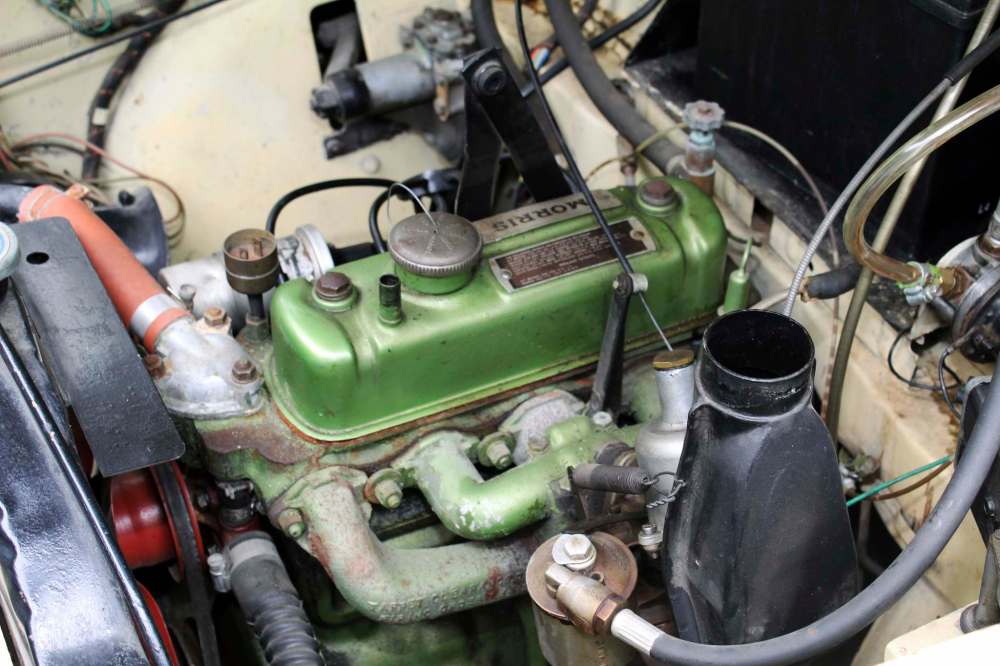
By 1958, the Morris Minor 100 was a common sight on the road in Europe, Asia and North America. A true family-capable vehicle, now boasting 37 horsepower thanks to a modest increase in compression, its top speed was nearing 112 kilometres per hour with a zero-to-96-kilometres-per-hour time of 31 seconds. Selling nearly 150,000 units per year, it was typically purchased by those wanting a well-engineered small car with familiar mechanicals, without the idiosyncrasies of the air-cooled Volkswagen Beetle.

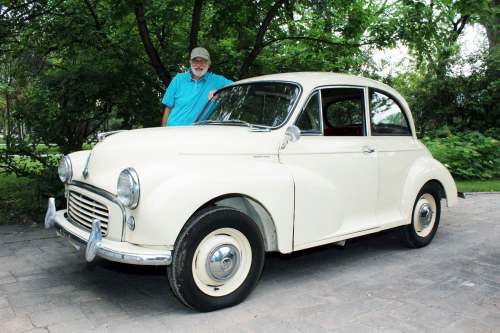
For George Siamandas of Winnipeg, the Morris Minor was the car he first learned to drive. “At age 16, while I was working at the Hollow Mug Cabaret at the International Inn, I learned to drive on a Morris Minor owned by a fellow busboy,” Siamandas says. “As we got off late, past the time the buses ran, he often let me drive the car home.”

The Morris remained a powerful memory for Siamandas, and in 1986, he found one poking out of a lean-to in a River Heights back lane. The young man who owned the car had received it from his grandfather and really wanted to sell it and buy his dream Firebird. Siamandas purchased the Morris with 43,529 original kilometres on the engine, and spent the summer bringing it back to life. A basic tune-up, thorough cleaning and general maintenance got the car back on the road.

Primrose in colour, the two-door Minor had received a repaint in the late 1960s, otherwise it is complete and mostly original. Almost entirely rust-free with acceptable chrome trim and bumpers, it has a very nicely kept red-leather bucket-seat interior. With a four-speed manual transmission, manual choke and pull-start switch on the dash, it’s an extremely bare-bones vehicle in comparison to any newer models. It even has a small access hole in the grille to insert the metal crank handle, to start it in the event of a dead battery.

Over the years, Siamandas has maintained the car and used it sparingly as a summer driver. It now has about 64,373 kilometres on the odometer. “It’s a joy to drive and very easy to work on as everything is simple and accessible,” says Siamandas, who admits his Mazda Miata convertible takes him most places during the summer, so he doesn’t have many occasions to drive the little Morris Minor coupe anymore.

The Morris Minor was a milestone of automotive accomplishment — not only Great Britain, but for the world. It was Britain’s first million-unit seller, making it a true “people’s car,” with more than 1.5 million built before production ceased.
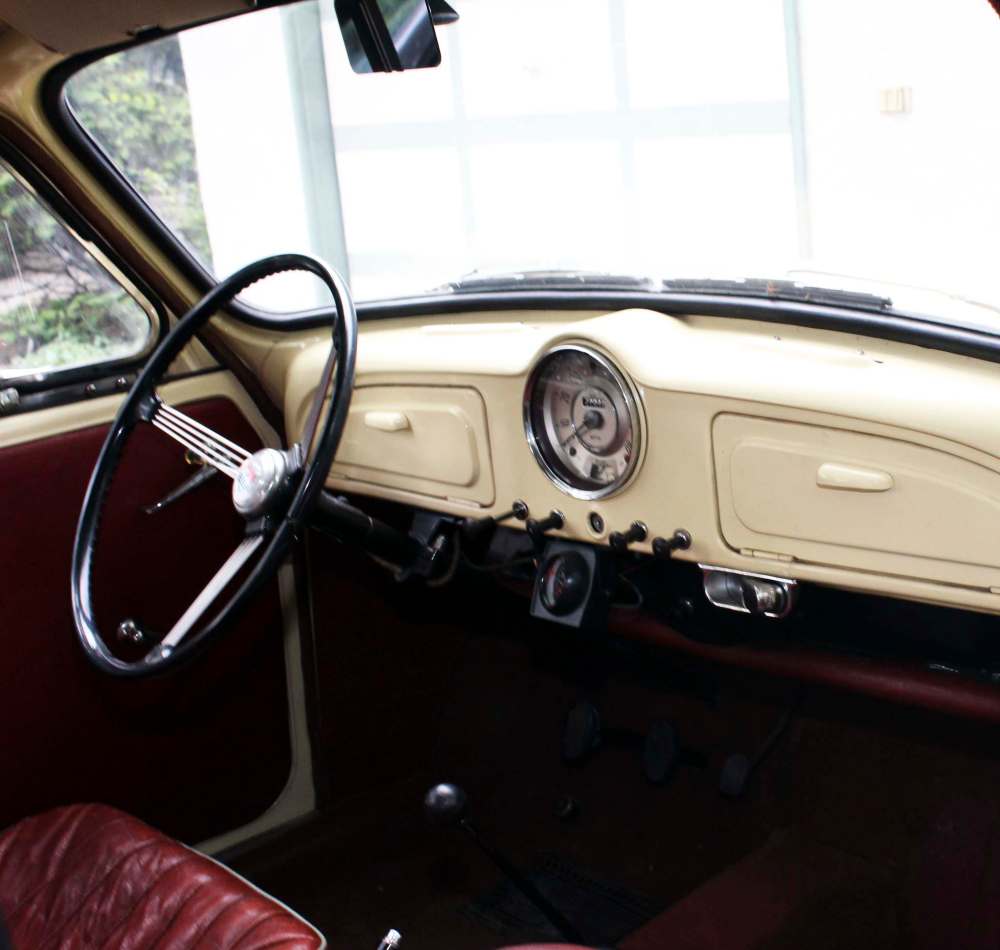
The Minor has a classic feel with red-leather bucket seats and a pull-start switch on the dash.

A final engine upgrade occurred in 1962, when a 49-horsepower A-series 1,098-cubic-centimetre engine became standard. The badging remained 1,000, however, in a bid for familiarity with prospective customers.

With the Morris Minor now enjoying its 70th anniversary since its introduction, it’s ubiquitous at collector car events in Britain, in much the same way 1955 to 57 Chevrolets or early Mustangs are in North America. Though much less common in the U.S. and Canada, there is still a following for these exclusive imports.

57ford@mymts.net

Report Error Submit a Tip

More Stories

Today’s horoscope

Georgia Nicols 4 minute read Preview

Today’s horoscope

Georgia Nicols 4 minute read Yesterday at 2:01 AM CDT

MOON ALERT: Caution. Avoid shopping (except food and gas) and important decisions from 1:15 p.m. until 10 p.m. After that, the moon moves from Aries into Taurus.

ARIES (March 21-April 19)

You have lots of mental energy because the moon is in your sign dancing with your ruler fiery Mars, which pushes you into a leadership role. It makes you feel independent and ready to challenge anyone who challenges you.

TAURUS (April 20-May 20)

Read
Yesterday at 2:01 AM CDT

Cyril Ramaphosa and South African law

Gwynne Dyer 5 minute read 2:01 AM CDT

Perfect justice is not on the menu, but a rough facsimile of justice most of the time is good enough for most purposes.

Government overrides school board in ‘mature minor’ controversy

Maggie Macintosh 5 minute read Preview

Government overrides school board in ‘mature minor’ controversy

Maggie Macintosh 5 minute read Updated: Yesterday at 6:40 PM CDT

The Manitoba government has vetoed the Steinbach school board’s plan to override common law by making parents the ultimate authority on all student health issues.

Since Hanover School Division trustees approved a motion to disregard the category of “mature minors” just over two months ago, there has been widespread debate.

Trustees unanimously voted to stop honouring the mature minor doctrine — in which teenagers 16 and older are automatically assumed to have the maturity to make medical decisions for themselves — at the end of the 2025-26 school year.

“We would just encourage the Hanover School Division to do what they do best, which is providing high-level, quality education for the kids in their community,” Education Minister Tracy Schmidt said in an interview on Tuesday about her July 22 directive to the board to repeal its motion.

Read
Updated: Yesterday at 6:40 PM CDT

Toronto’s alternative crisis response model deemed a success

Scott Billeck 4 minute read Preview

Toronto’s alternative crisis response model deemed a success

Scott Billeck 4 minute read Yesterday at 2:01 AM CDT

A Toronto emergency response program that helped inspire Winnipeg’s proposed alternative crisis response model has already expanded city-wide, just four years after launching as a pilot project.

The Toronto Community Crisis Service, launched in 2022, has become the city’s fourth emergency service, providing a 24-7, community-based response to people experiencing mental health crises. The service has handled nearly 50,000 calls through 911 and 211, dispatched mobile crisis teams to more than 41,000 incidents, made more than 11,600 referrals to health and social services and resolved the majority of eligible 911 calls without police involvement.

Winnipeg Mayor Scott Gillingham last week proposed creating a similar “fourth crisis response pathway” that would allow 911 calls that aren’t violent or criminal in nature to be transferred to community-based crisis teams.

Under the proposal, which has support from both the Winnipeg Police Service and the Winnipeg Fire Paramedic Service, a centralized crisis dispatch and co-ordination hub would receive triaged calls and match them with citywide response teams, staffed in part through existing community organizations, including the Downtown Community Safety Partnership and The Link’s mobile crisis teams. The goal is to divert appropriate calls away from the WPS and WFPS.

Read
Yesterday at 2:01 AM CDT

Britain’s Beetle alternative ‘a joy to drive’

Larry D'ArgisClassic Cruising 4 minute read Preview

Britain’s Beetle alternative ‘a joy to drive’

Larry D'ArgisClassic Cruising 4 minute read Friday, Aug. 10, 2018

The Morris Minor began production in 1948. Built in Britain and designed by Alec Issigonis, the styling was all-new, as was the all-steel, unibody construction incorporating a full-steel floor pan.

Rack-and-pinion steering and torsion bar front suspension gave the Minor what was billed as “Lull-Above” ride, and handling that was well beyond what one could expect from a roomy family car. For power, the 918.6-cubic-centimetre L-head four-cylinder engine, developing 27.5 horsepower at 4,400 rpm was a prewar carry-over, but by 1956, the Minor would see a new engine. The Minor, wearing the 1,000 designation badging featured an A-series 948-cubic-centimetre, overhead-valve four-cylinder engine, would produce 30 horsepower. The car was available in two-door sedan or four-door sedan body styles, as well as the now much-loved and collectible Traveller “woodie” two-door station wagon and two-door convertible.

Although the 1950s is remembered as the decade of the chrome-laden large car era in North America, there were those buyers who were seeking out more austere vehicles for their motoring needs. The import market opened the door for buyers seeking roomy, small sedans, with good handling, ample trunk room and fuel-efficient engines. These cars were a real alternative for families on a budget.

By 1958, the Morris Minor 100 was a common sight on the road in Europe, Asia and North America. A true family-capable vehicle, now boasting 37 horsepower thanks to a modest increase in compression, its top speed was nearing 112 kilometres per hour with a zero-to-96-kilometres-per-hour time of 31 seconds. Selling nearly 150,000 units per year, it was typically purchased by those wanting a well-engineered small car with familiar mechanicals, without the idiosyncrasies of the air-cooled Volkswagen Beetle.

Read
Friday, Aug. 10, 2018

Ticked off by Trump’s tantrums

Scott Forbes 5 minute read Preview

Ticked off by Trump’s tantrums

Scott Forbes 5 minute read Yesterday at 2:01 AM CDT

If Mr. Trump isn’t prepared to step up and better manage his ticks, he’s just blowing smoke.

Read
Yesterday at 2:01 AM CDT