Canada’s cannabis health warning messages get overhaul
New labels also address edibles, topicals
Advertisement
Read this article for free:
or
Already have an account? Log in here »
To continue reading, please subscribe:

Digital Subscription
One year of digital access for only $205*
- Enjoy unlimited reading on winnipegfreepress.com
- Read the E-Edition, our digital replica newspaper
- Access News Break, our award-winning app
- Play interactive puzzles
*First annual payment billed as $205.00 + GST for one year. This annual subscription will automatically renew at $233.00 + GST every 52 weeks (10% off the regular annual price of $259.35). Offer available to new and qualified returning subscribers only. Cancel any time.
To continue reading, please subscribe:
Add Free Press access to your Brandon Sun subscription for only an additional
$1 for the first 4 weeks*
- Enjoy unlimited reading on winnipegfreepress.com
- Read the E-Edition, our digital replica newspaper
- Access News Break, our award-winning app
- Play interactive puzzles
*Your next Brandon Sun subscription payment will increase by $1.00 and you will be charged $17.95 plus GST for four weeks. After four weeks, your payment will increase to $24.95 plus GST every four weeks.
Read unlimited articles for free today:
or
Already have an account? Log in here »
Hey there, time traveller!
This article was published 17/06/2019 (2658 days ago), so information in it may no longer be current.
Federal cannabis regulator Health Canada is shaking up its mandatory health warning messages for legal cannabis products by reducing the total number of messages, removing certain statistical claims about the harms of cannabis, and eliminating warnings about cannabis being addictive.
The eight new warning messages for all cannabis products will take effect on Oct. 17, 2019, when new regulations governing cannabis edibles, topicals and concentrates come into force. Two of the new messages are specifically about edible and drinkable forms of cannabis. A separate new warning message will only be seen on topical cannabis products, warning users not to use them internally or apply them to broken or irritated skin.
Many of the 14 current warning messages for cannabis products repeat the same main message, followed by a secondary sentence with more information: two messages cover the risks of cannabis use while pregnant or breastfeeding, two warn about driving and using machinery, and the messages warning that "Cannabis can be addictive," "Regular use of cannabis can increase the risk of psychosis and schizophrenia," and "Adolescents are at greater risk of harms from cannabis" each have three variants.
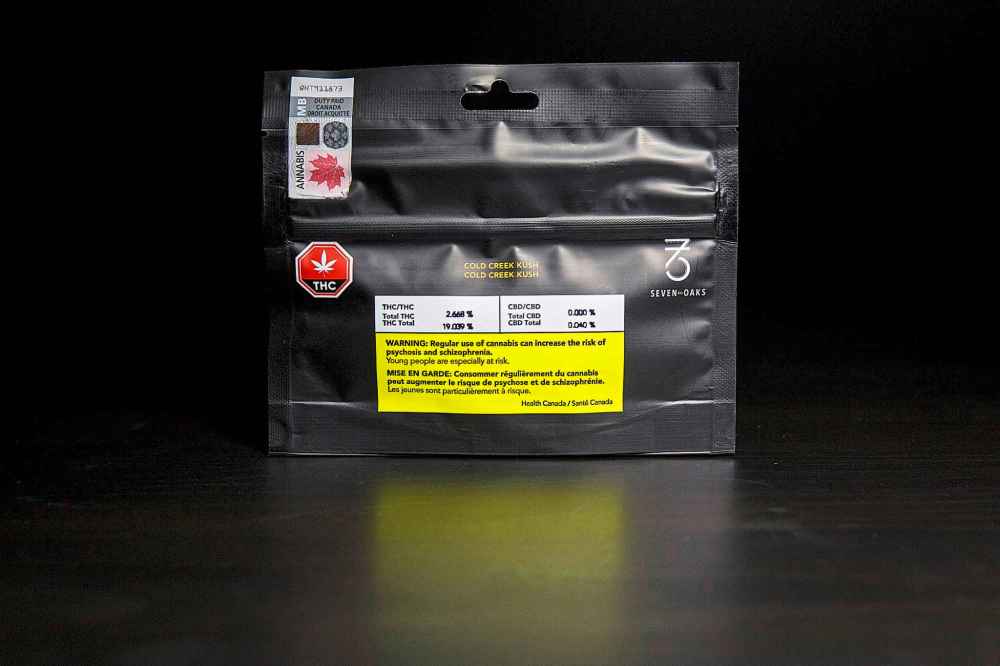
The new messages will do away with those variations on the same warnings, in most cases making the statements more general. For example, the three current messages targeted at adolescents include three different statements with specific warnings related to psychosis and schizophrenia, and the risk of addiction among young users. All three will be replaced with a single warning: "Adolescents and young adults are at greater risk of harms from cannabis. Daily or near-daily use over a prolonged period of time can harm brain development and function."
The three existing warnings about cannabis being "addictive" will be scrapped entirely, although one of the new messages warns that "Daily or near-daily use increase the risk of dependence". In an overview of the new regulations released Friday, Health Canada said its revamped warning messages were "informed by advice from scientific experts, the best available evidence from peer-reviewed scientific publications, the outcomes of public opinion research conducted in May 2018 and February 2019," and public feedback.
Focus group participants were especially skeptical about health warning messages linking cannabis with addiction, according to one of the public opinion research reports commissioned by Health Canada in 2018.
"The statistics in the three secondary messages were not all that persuasive," said the October, 2018 report from Earnscliffe Strategy Group, which tested three variants of "Cannabis is addictive" messages on focus groups. People aged 18 to 24 were especially likely to disbelieve the addiction messages, Earnscliffe found. The consultancy concluded that Canadians who were familiar with cannabis wanted "clearer evidence of harms or risks in the statements to improve their credibility — simply stating facts (statistics) was not all that persuasive or credible."
"I think (the new cannabis warning messages are) condensed and more general, and perhaps more helpful, but I still think there’s some things that will give people pause," said Rebecca Haines-Saah, an assistant professor of community health sciences at the University of Calgary who studies cannabis from a public health perspective.
Haines-Saah highlighted the revised warning message about the potential harms of cannabis smoke, which bucks the trend towards more general messaging by including very specific information. (The original message said, "Harmful chemicals found in tobacco smoke are also found in cannabis smoke," but the revised message specifically references "Toxic and carcinogenic chemicals found in tobacco smoke such as polyaromatic hydrocarbons, aromatic amines, and N-heterocyclics".)
"It would be better if they just said, ‘Smoking anything probably has the potential to be carcinogenic,’" said Haines-Saah.
Updated cannabis health warnings
Smoke
Old message
WARNING: Cannabis smoke is harmful. Harmful chemicals found in tobacco smoke are also found in cannabis smoke.
New message
WARNING: The smoke from cannabis is harmful. Toxic and carcinogenic chemicals found in tobacco smoke such as polyaromatic hydrocarbons, aromatic amines, and N-heterocyclics are also found in cannabis smoke.
Smoke
Old message
WARNING: Cannabis smoke is harmful. Harmful chemicals found in tobacco smoke are also found in cannabis smoke.
New message
WARNING: The smoke from cannabis is harmful. Toxic and carcinogenic chemicals found in tobacco smoke such as polyaromatic hydrocarbons, aromatic amines, and N-heterocyclics are also found in cannabis smoke.
Pregnancy
Old message
WARNING: Do not use if pregnant or breastfeeding. Using cannabis during pregnancy may harm your baby and result in low birth weight.
New message
WARNING: Do not use if pregnant or breastfeeding. Substances found in cannabis are also found in the breast milk of mothers who use cannabis.
Driving
Old messages
WARNING: Do not drive or operate machinery after using cannabis. More than 4,000 Canadians were injured and 75 died from driving after using cannabis (in 2012).
WARNING: Do not drive or operate machinery after using cannabis. After cannabis use, coordination, reaction time and ability to judge distances are impaired.
New message
WARNING: Do not drive or operate heavy equipment after using cannabis. Cannabis can cause drowsiness and impair your ability to concentrate and make quick decisions.
Addiction/Mental health
Old messages
WARNING: Cannabis can be addictive. Up to half of people who use cannabis on a daily basis have work, social or health problems from using cannabis.
WARNING: Cannabis can be addictive. 1 in 11 people who use cannabis will become addicted.
WARNING: Cannabis can be addictive. Up to 1 in 2 people who use cannabis daily will become addicted.
WARNING: Regular use of cannabis can increase the risk of psychosis and schizophrenia. Higher THC content can increase the risk of psychosis and schizophrenia.
WARNING: Regular use of cannabis can increase the risk of psychosis and schizophrenia. Higher THC content can lower the age of onset of schizophrenia
WARNING: Regular use of cannabis can increase the risk of psychosis and schizophrenia. Young people are especially at risk.
New message
WARNING: Frequent and prolonged use of cannabis containing THC can contribute to mental health problems over time. Daily or near-daily use increases the risk of dependence and may bring on or worsen disorders related to anxiety and depression.
Youth cannabis use
Old messages
WARNING: Adolescents are at greater risk of harms from cannabis. Early and regular use increases the risk of psychosis and schizophrenia.
WARNING: Adolescents are at greater risk of harms from cannabis. Using cannabis as a teenager can increase your risk of becoming addicted.
WARNING: Adolescents are at greater risk of harms from cannabis. 1 in 6 people who start using cannabis in adolescence will become addicted.
New message
WARNING: Adolescents and young adults are at greater risk of harms from cannabis. Daily or near-daily use over a prolonged period of time can harm brain development and function.
Other new warnings
WARNING: The higher the THC content of a product, the more likely you are to experience adverse effects and greater levels of impairment. THC can cause anxiety and impair memory and concentration.
WARNING: It can take up to 4 hours to feel the full effects from eating or drinking cannabis. Consuming more within this time period can result in adverse effects that may require medical attention.
WARNING: The effects from eating or drinking cannabis can be long-lasting. The effects can last between 6 and 12 hours following use.
(For topical products) WARNING: Do not swallow or apply internally or to broken, irritated or itching skin. There may be health effects and risks associated with cannabis topicals that are not fully known or understood.
The public health researcher praised the two new warning messages related to edible cannabis products, which warn that their full effects may not be felt for hours and can last a long time.
"That, to me, is more practical harm-reduction information… These are good things people can use," she said.
Overall, Haines-Saah believes Health Canada deserves credit for updating its cannabis warning messages so quickly after legalization.
"They’re to be applauded for that," she said, specifically citing the phase-out of three health warning messages variants that read, "Regular use of cannabis can increase the risk of psychosis and schizophrenia." (A replacement warning message reads, "Frequent and prolonged use of cannabis containing THC can contribute to mental health problems over time.")
"It’s a fraught issue in the research community, and so they probably had a great deal of pressure to have that message," said Haines-Saah.
"But to come out with (a message about) harms to mental health, instead of that specific risk, I think that shows that they’re responsive to what’s currently happening in the research community."
solomon.israel@theleafnews.com
@sol_israel