Existing home sales rose in July, inventory ticked higher

Advertisement

Advertise with us

Sales of previously occupied U.S. homes rose for the second consecutive month in July, though only modestly from a year ago, suggesting the red-hot housing market may be cooling a little.

Read this article for free:


or

Already have an account? Log in here »

To continue reading, please subscribe:

Subscribe and receive a limited-edition Free Press branded hat or tote.

Digital Subscription

One year of digital access for only $205*

  • Enjoy unlimited reading on winnipegfreepress.com
  • Read the E-Edition, our digital replica newspaper
  • Access News Break, our award-winning app
  • Play interactive puzzles

*First annual payment billed as $205.00 + GST for one year. This annual subscription will automatically renew at $233.00 + GST every 52 weeks (10% off the regular annual price of $259.35). Offer available to new and qualified returning subscribers only. Cancel any time.

To continue reading, please subscribe:

Add Free Press access to your Brandon Sun subscription for only an additional

$1 for the first 4 weeks*

  • Enjoy unlimited reading on winnipegfreepress.com
  • Read the E-Edition, our digital replica newspaper
  • Access News Break, our award-winning app
  • Play interactive puzzles
Start now

*Your next Brandon Sun subscription payment will increase by $1.00 and you will be charged $17.95 plus GST for four weeks. After four weeks, your payment will increase to $24.95 plus GST every four weeks.

Hey there, time traveller!
This article was published 23/08/2021 (1855 days ago), so information in it may no longer be current.

Sales of previously occupied U.S. homes rose for the second consecutive month in July, though only modestly from a year ago, suggesting the red-hot housing market may be cooling a little.

Existing homes sales rose 2% last month from June to a seasonally-adjusted annual rate of 5.99 million units, the National Association of Realtors said Monday. That’s greater than the 5.82 million economists were expecting, according to FactSet.

Sales rose only 1.5% from July last year. By comparison, sales in June jumped about 23% from a year earlier, when many states were still in a pandemic lockdown.
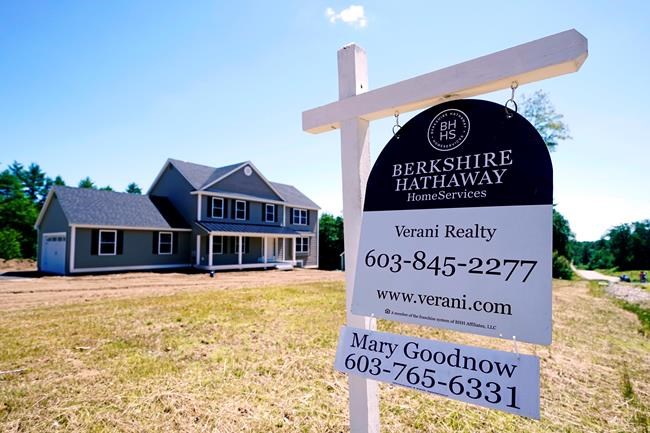
FILE - In this Thursday, June 24, 2021 file photo, a real estate sign is posted in front of a newly constructed single family home in Auburn, N.H. U.S. home prices registered the fastest growth in 17 years in May as a surge in demand for housing outstripped the supply. The S&P CoreLogic Case-Shiller 20-city home price index, released Tuesday, July 27 soared 17% in May from a year earlier on top of a 15% jump in April. (AP Photo/Charles Krupa, File)

“Sales are still running above pre-pandemic conditions, but appear to be settling down,” said Lawrence Yun, the NAR’s chief economist.

The median U.S. home price climbed 17.8% from a year ago to $359,900, near the all-time high it set in June, NAR said. That annual gain was more modest than the 20%-25% year-over-year increases seen earlier this year.

“Clearly, the home price growth is moderating,” Yun said.

Sales of homes above $500,000 rose last month while those below that tier fell, helped skew the median price higher.

Would-be homebuyers who have been trying to navigate the most competitive market in more than a decade had perhaps a wider selection to consider at the end of July, when the inventory of unsold homes stood at 1.32 million. That’s an increase of 7.3% from June, but it’s still down 12% from July last year. At the current sales pace, the unsold inventory amounts to a 2.6-month supply, the NAR said.

With so few homes up for sale, it has become routine for anyone putting a house on the market to receive multiple offers that exceed the asking price, and many sell within days. In July, homes typically remained on the market 17 days before getting snapped up. That’s unchanged from June, but down from 22 days in July 2020.
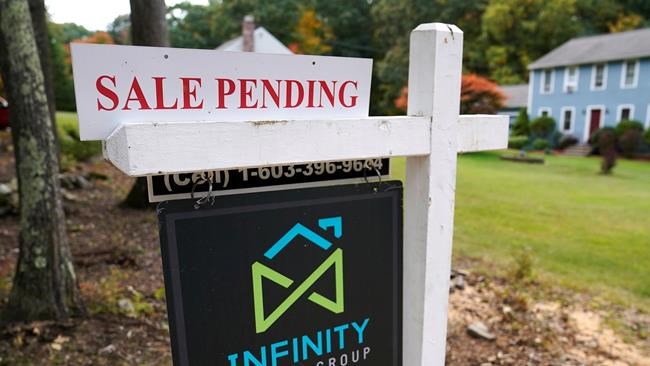
FILE - In this Sept. 29, 2020 file photo, a sale pending sign is displayed outside a residential home for sale in East Derry, N.H. Sales of previously occupied U.S. homes rose in July for the second month in a row, though they only increased modestly from a year ago, suggesting the red-hot housing market may be cooling off a little. Existing homes sales rose 2% last month from June to a seasonally-adjusted annual rate of 5.99 million units, the National Association of Realtors said Monday, Aug. 23, 2021. (AP Photo/Charles Krupa, File)

“I expect we’ll have more inventory in upcoming months,” Yun said.

First-time homebuyers made up 30% of all transactions last month, down from 31% in June and 34% a year ago. These buyers have to contend with fewer homes for sale in the more affordable end of the market and competition from all-cash buyers, often investors. Some 23% of homes sold in July were paid for with cash, unchanged from June and up from 16% in July last year.

Still, first-time buyers continue to benefit from ultra-low mortgage rates. The average interest rate on a 30-year mortgage eased last week to 2.86%, according to Freddie Mac. The benchmark rate, which reached a peak this year of 3.18% in April, stood at 2.99% a year ago.

Report Error Submit a Tip

More Stories

National Black Canadians Summit celebrates culture, combats racism

Gabrielle Piché 4 minute read Preview

National Black Canadians Summit celebrates culture, combats racism

Gabrielle Piché 4 minute read Yesterday at 6:06 PM CDT

Despite the event’s name — the National Black Canadians Summit — Bruce Miller felt he should attend.

He booked a ticket. And so, this weekend, the Indigenous Manitoban joined roughly 1,500 people flocking to the RBC Convention Centre.

It’s a full schedule — addresses from a former Canadian governor general, sessions on Black mental health and anti-Black racism.

The annual event draws politicians, artists and other professionals from across the country.

Read
Yesterday at 6:06 PM CDT

A quick look at where provinces and territories stand on time changes

The Canadian Press 2 minute read Preview

A quick look at where provinces and territories stand on time changes

The Canadian Press 2 minute read Friday, Sep. 18, 2026

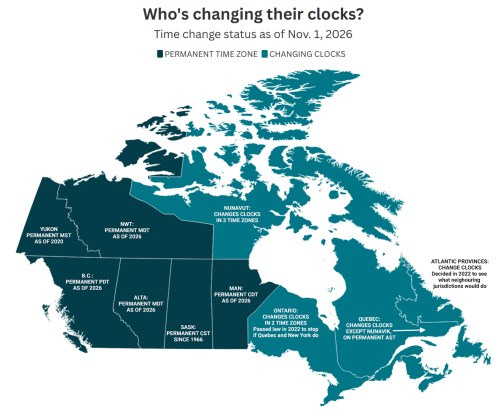
WINNIPEG - Manitoba's government said Thursday the province will be sticking with daylight time year-round, making it the latest jurisdiction to move away from twice-annual time changes. Here's a look at where things stand across Canada:

British Columbia said in March that it was moving to permanent Pacific daylight time. The change also means that parts of northeastern B.C., which have been on mountain standard time year round, are now in alignment with the rest of the province.

Alberta also switched to permanent daylight time this year in what it calls Alberta time. The change means it now has the same time as Saskatchewan year round.

Saskatchewan has been on permanent central standard time since 1966.

Read
Friday, Sep. 18, 2026

Serious crash at West Kildonan intersection known for collisions

Nicole Buffie 3 minute read Preview

Serious crash at West Kildonan intersection known for collisions

Nicole Buffie 3 minute read Updated: 6:09 PM CDT

Residents in West Kildonan say an intersection that was the site of a serious car crash Sunday morning is notoriously dangerous.

Rob Lick heard a loud bang around 7 a.m. and rushed out of his home on Leila to see what the commotion was. He saw two crushed SUVs, a white and black one, in the intersection. Police vehicles arrived shortly after.

“It sounded like when (garbage trucks) drop a big dumpster,” he said. “I heard somebody crying or wailing, they were standing by the vehicle so I don’t know who exactly it was or if someone was injured.”

The sound of sirens followed shortly after when emergency crews came to the scene. The intersection was immediately blocked off.

Read
Updated: 6:09 PM CDT

Klein has burned bridges with PM, Gillingham says

Joyanne Pursaga 3 minute read Preview

Klein has burned bridges with PM, Gillingham says

Joyanne Pursaga 3 minute read Friday, Sep. 18, 2026

One mayoral candidate accused another of writing a column so critical it could compromise his ability to work with the federal government.

Read
Friday, Sep. 18, 2026

Hellebuyck standoff caused by… Nathan MacKinnon?

Mike McIntyre 6 minute read Preview

Hellebuyck standoff caused by… Nathan MacKinnon?

Mike McIntyre 6 minute read Friday, Sep. 18, 2026

Looking for someone to blame in the Connor Hellebuyck fiasco and cast as public enemy No. 1? How about long-time Winnipeg Jets nemesis Nathan MacKinnon?

Allow us to explain as we fire up the time machine and head back to February in Italy.

Oh, what could have been if MacKinnon had been able to score on what appeared to be an open net late in the third period of the men’s gold medal game with Hellebuyck down and seemingly out of position.

Instead, the star forward fired wide, keeping the score deadlocked at 1-1 as the clock ticked down on regulation.

Read
Friday, Sep. 18, 2026

Cabernet Sauvignon star of wine festival

Ben Sigurdson 5 minute read Preview

Cabernet Sauvignon star of wine festival

Ben Sigurdson 5 minute read Yesterday at 3:00 AM CDT

The Winnipeg Wine Festival will celebrate the king of red wine grapes next weekend — the theme of this year’s festival, which takes place Sept. 25 and 26 at the RBC Convention Centre, is Cabernet Sauvignon.

Cab Sauv, as it’s also known, is the world’s most widely planted wine grape of any colour, first coming to prominence in the 1800s in France’s Bordeaux region, where the grape is still popular. Rather than single-variety wines, Bordeaux reds tend to be blends, with those coming from the left bank of the Gironde estuary being Cabernet-dominant, while right-bank wines are Merlot-dominant, with Cabernet Sauvignon playing a supporting role. Cabernet and Merlot work well together and many other countries have followed suit in blending the two.

A team at University of California Davis put Cabernet Sauvignon through a DNA test in 1996 and discovered its parent grapes are Cabernet Franc and Sauvignon Blanc — it’s likely that at some point the two varieties, planted next to each other in some vineyard, crossed and mutated and became the grape we know today. (Someone growing grapes in the 19th century must have had an inkling of what was up, as the grape has been called Cabernet Sauvignon since long before the DNA test.)

Flavour-wise, most Cabernet Sauvignon wines are big and bold, with a core of deep dark berry flavours, some graphite and spice notes and relatively bright acidity. It’s a grape that is well-suited to barrel aging, with most examples seeing at least some time in wood.

Read
Yesterday at 3:00 AM CDT