Heavenly voices
Sacred Harp workshop sheds light on 19th-century worship experience

Advertisement
Read this article for free:
or
Already have an account? Log in here »
To continue reading, please subscribe:

Digital Subscription
One year of digital access for only $205*
- Enjoy unlimited reading on winnipegfreepress.com
- Read the E-Edition, our digital replica newspaper
- Access News Break, our award-winning app
- Play interactive puzzles
*First annual payment billed as $205.00 + GST for one year. This annual subscription will automatically renew at $233.00 + GST every 52 weeks (10% off the regular annual price of $259.35). Offer available to new and qualified returning subscribers only. Cancel any time.
To continue reading, please subscribe:
Add Free Press access to your Brandon Sun subscription for only an additional
$1 for the first 4 weeks*
- Enjoy unlimited reading on winnipegfreepress.com
- Read the E-Edition, our digital replica newspaper
- Access News Break, our award-winning app
- Play interactive puzzles
*Your next Brandon Sun subscription payment will increase by $1.00 and you will be charged $17.95 plus GST for four weeks. After four weeks, your payment will increase to $24.95 plus GST every four weeks.
Read unlimited articles for free today:
or
Already have an account? Log in here »
Hey there, time traveller!
This article was published 18/02/2017 (3459 days ago), so information in it may no longer be current.
Whether you’re a shower singer who can’t read notes or someone who loves to sing in public, consider lending your voice to the chorus just for the fun of it.
“It produces endorphins when you sing together,” says Montreal folk musician and music teacher Dara Weiss, who leads a Sacred Harp singing workshop at Crescent-Fort Rouge United Church, Wednesday at 7 p.m.
“You’re celebrating beauty and something special in the world.”

Originating in the American South, Sacred Harp music is sung in four parts without accompaniment, a style once common in some Protestant churches and now mostly found in community singalongs.
The name refers both to the Original Sacred Harp songbook, first published in 1844, and the characterization of the human voice as a sacred instrument. No actual harps are involved in Sacred Harp music, which is notated in shape notes on a five-line staff, with each shape (triangle, oval, square, and diamond) corresponding to a syllable (so fa la mi).
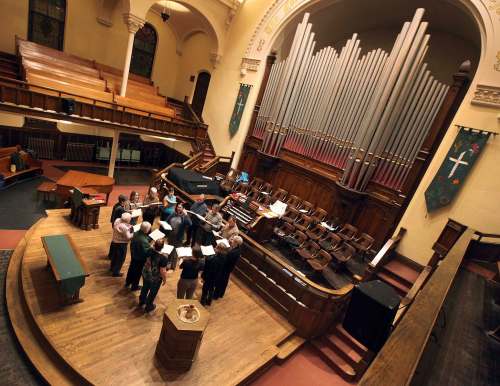
Singers usually sit in a hollow square,; the leader stands in the middle, keeping time as the group voices the syllables during the first run-through of a hymn or anthem, and then singing the words.
“The old way of teaching this is to have weeklong singing schools, where they drilled and drilled and mastered the intervals,” says David Ivey, president of the Sacred Harp Musical Heritage Association, which runs summer singing camps in Alabama and Poland and administers the fasola.org website.
Meant for participation rather than performance, the tunes and harmonies may sound strange and a bit harsh to people more familiar with traditional choral music, says Ivey, 61, who grew up singing Sacred Harp in his home church in Henagar, Ala.
“The music is so different because there’s not one dominant melody part. The four parts are all melodious,” he says in a telephone interview from his home in Huntsville, Ala.
He says singers from across the faith traditions participate in Sacred Harp events, attracted by the harmonies, the gospel tunes and even the texts, many penned by prolific 18th-century hymn writers Charles Wesley and Isaac Watts.
“A lot of us consider this (music) a worship experience,” says Ivey of community singings often opened and closed with prayer.
“Some people who don’t go to church consider (Sacred Harp) a worship experience.”
Many hymns and anthem refer to life after death, and include dark images and lines such as “And am I born to die?”
“I think today people are attracted to this open and stark point of view. It was directed to people living on the frontier and they didn’t know if they would live or die,” says Ivey.
“They were much more in touch with the uncertainty of life than we are.”
The words may be dark, but the sound is loud and joyous, says Weiss, 42, guitarist in the All Day Breakfast String Band and founder of a Sacred Harp group in Montreal.
“People should feel free to sing as loud or soft as they want. They can sing some tunes and listen to the others,” she says of the 21/2-hour introductory workshop, part of the annual Artfest at Crescent-Fort Rouge United.
That vocalization style in Sacred Harp music, heard on the soundtrack of the 2003 movie Cold Mountain, hearkens back to farmers singing Sunday hymns during their daily chores, says Ivey.
“We don’t teach people to sing loud, we teach them to sing full voice,” he says. “We’re singing like people do when they’re working out in the field.”
That style intrigues the music director of Crescent-Fort Rouge United, who looks forward to learning the singing style in Weiss’s workshop.

“There’s a greater sense of participation and that we’re all in it together,” says Michael Cutler.
That’s the point of Sacred Harp, says Weiss, who enjoys the connections she has made with other singers in Montreal and when she travels to larger events in Vermont.
“You don’t perform; it’s there for community,” explains the host of Bluegrass Ramblings on McGill University’s radio station, CKUT.
“You don’t go to a Sacred Harp concert, you go to communicate.”
brenda@suderman.com
The Free Press is committed to covering faith in Manitoba through our Religion in the News project. This reporting continues because readers like you step forward to fund it.
Donate now to support our reporting on religion.
Your donation is eligible for a charitable tax receipt.
BECOME A FAITH JOURNALISM SUPPORTER
Brenda Suderman has been a columnist in the Saturday paper since 2000, first writing about family entertainment, and about faith and religion since 2006.
Our newsroom depends on a growing audience of readers to power our journalism. If you are not a paid reader, please consider becoming a subscriber.
Our newsroom depends on its audience of readers to power our journalism. Thank you for your support.
Dara Weiss leads a Sacred Harp workshop 7 to 9:30 p.m. Wednesday, Feb. 22 at Crescent-Fort Rouge United Church, 525 Wardlaw Ave.
Register at artistshowell@shaw.ca. Cost is pay what you can at the door.
Listen to Sacred Harp singing online on the their YouTube channel https://www.youtube.com/user/stratfield142.
For more information on Sacred Harp, visit http://fasola.org.
The Free Press is committed to covering faith in Manitoba through our Religion in the News project. This reporting continues because readers like you step forward to fund it.
Donate now to support our reporting on religion.
Your donation is eligible for a charitable tax receipt.
BECOME A FAITH JOURNALISM SUPPORTER
Brenda Suderman has been a columnist in the Saturday paper since 2000, first writing about family entertainment, and about faith and religion since 2006.
Our newsroom depends on a growing audience of readers to power our journalism. If you are not a paid reader, please consider becoming a subscriber.
Our newsroom depends on its audience of readers to power our journalism. Thank you for your support.
Advertisement Advertise With Us
Advertisement Advertise With Us
The Free Press acknowledges the financial support it receives from members of the city’s faith community, which makes our coverage of religion possible.