Uncovering fears
Event aims to share what it means to be Muslim and Canadian

Advertisement
Read this article for free:
or
Already have an account? Log in here »
To continue reading, please subscribe:

Digital Subscription
One year of digital access for only $205*
- Enjoy unlimited reading on winnipegfreepress.com
- Read the E-Edition, our digital replica newspaper
- Access News Break, our award-winning app
- Play interactive puzzles
*First annual payment billed as $205.00 + GST for one year. This annual subscription will automatically renew at $233.00 + GST every 52 weeks (10% off the regular annual price of $259.35). Offer available to new and qualified returning subscribers only. Cancel any time.
To continue reading, please subscribe:
Add Free Press access to your Brandon Sun subscription for only an additional
$1 for the first 4 weeks*
- Enjoy unlimited reading on winnipegfreepress.com
- Read the E-Edition, our digital replica newspaper
- Access News Break, our award-winning app
- Play interactive puzzles
*Your next Brandon Sun subscription payment will increase by $1.00 and you will be charged $17.95 plus GST for four weeks. After four weeks, your payment will increase to $24.95 plus GST every four weeks.
Read unlimited articles for free today:
or
Already have an account? Log in here »
Hey there, time traveller!
This article was published 30/06/2017 (3365 days ago), so information in it may no longer be current.
ALTHOUGH she’s still in high school, Maryam Islam already knows what it is like to face discrimination because she wears a head scarf as part of her Muslim beliefs.
“Whenever it’s a group activity or a class discussion, people may question before putting me in a group,” the Grade 10 student at Fort Richmond Collegiate says.
“Whenever I get into a group I try to be nice and kind and to show I’m not an alien.”
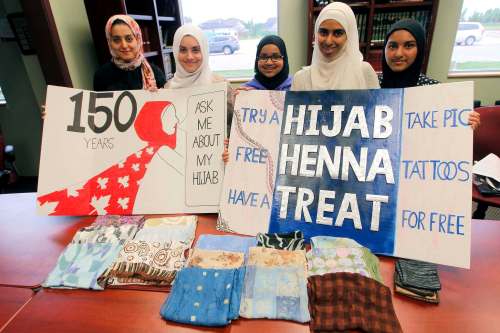
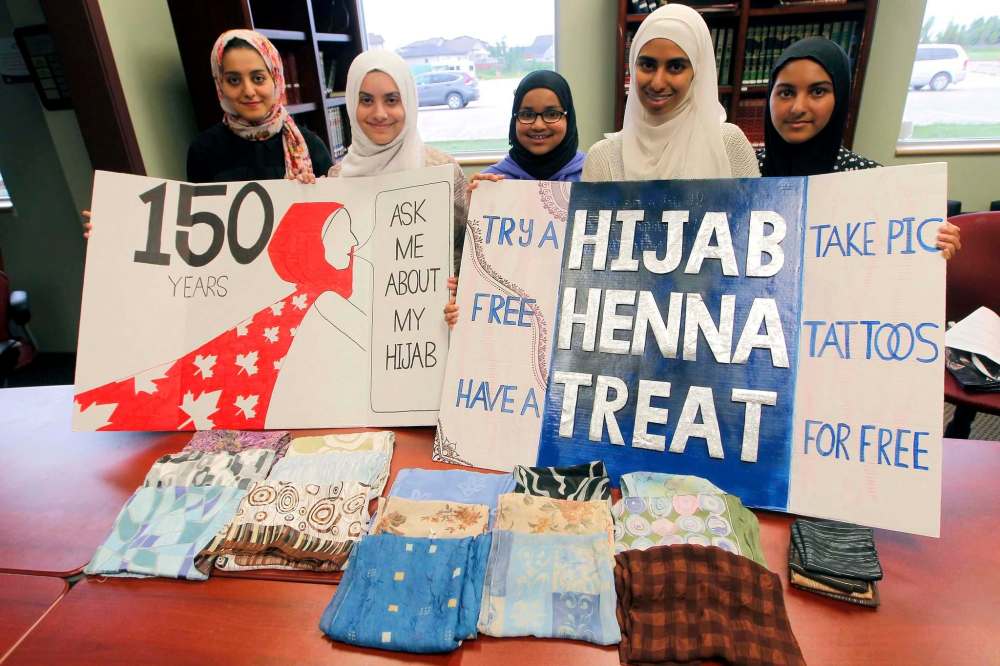
Islam and two dozen other young Muslim women plan to address concerns and questions from Winnipeggers about the hijab at Saturday’s Canada Day celebrations at Assiniboine Park.
“It’s a good opportunity to reach more people,” says university student Yasmine El-Salakawy, leader of the Muslims of the West group, which is running a hijab awareness booth at the park from 5 to 9 p.m.
“If we’re going to celebrate diversity, which people are most proud of in being Canadian, then I feel it hits right at home.”
A hijab is the head scarf covering the hair and neck area worn by Muslim women in public as a sign of modesty. Girls usually begin wearing it once they reach puberty, although some don it earlier, says Maryam’s sister Maria Islam, who put on the hijab at age nine.
“I wasn’t forced to do it and I just wanted to do it because of modesty,” says Maria, who just finished Grade 6.
“I feel people take a second look at me when I walk down the (school) hallway, but it’s not necessarily bad.”
In addition to answering questions about the hijab at the July 1 event, the young women will offer free henna tattoos and assist anyone wanting to try on a head scarf.
“(The hijab) is a way to empower women because it removes the aspect that is objectified and it allows women to be respected for their minds and actions,” says El-Salakawy, a science student at the University of Manitoba.
“The hijab is mandated in the religion. There are verses in the Qur’an about how to cover up. So that’s not debated at all.”
In Winnipeg, the vast majority of newcomer Muslim women from countries such as Somalia, Djibouti, Syria and Iraq wear the hijab, says Yasmin Ali of the Canadian Muslim Women’s Institute.
That wasn’t always the case, recalls Winnipegger Sumera Sahar, who says few Muslim women wore the hijab when she arrived in the city more than three decades ago. She says there are multiple interpretations and viewpoints on the Qur’an passages.
“Some women do not wear the hijab because they don’t believe it’s a matter of Islam or Islamic jurisprudence so they don’t want to buy into the dominant narrative about hijab being part of Islamic practice,” says the St. Norbert resident, who doesn’t wear the head covering.
She says no one should assume Muslim women who do not wear the hijab are more secular or not practising their faith.
“It reduces our experience of being Muslim to a piece of cloth,” says Sahar of viewing the head scarf as an expression of beliefs.

“This is a really complicated issue for any religious community to deal with and there is no one-size-fits-all answer.”
On Canada Day, El-Salakawy and her group of young women hope to provide part of that answer, by sharing their views on how they are both Muslim and Canadian.
“We’re going to be there to talk about hijab and what it means and to raise awareness on the topic.”
brenda@suderman.com
The Free Press is committed to covering faith in Manitoba through our Religion in the News project. This reporting continues because readers like you step forward to fund it.
Donate now to support our reporting on religion.
Your donation is eligible for a charitable tax receipt.
BECOME A FAITH JOURNALISM SUPPORTER
Brenda Suderman has been a columnist in the Saturday paper since 2000, first writing about family entertainment, and about faith and religion since 2006.
Our newsroom depends on a growing audience of readers to power our journalism. If you are not a paid reader, please consider becoming a subscriber.
Our newsroom depends on its audience of readers to power our journalism. Thank you for your support.
The Free Press is committed to covering faith in Manitoba through our Religion in the News project. This reporting continues because readers like you step forward to fund it.
Donate now to support our reporting on religion.
Your donation is eligible for a charitable tax receipt.
BECOME A FAITH JOURNALISM SUPPORTER
Brenda Suderman has been a columnist in the Saturday paper since 2000, first writing about family entertainment, and about faith and religion since 2006.
Our newsroom depends on a growing audience of readers to power our journalism. If you are not a paid reader, please consider becoming a subscriber.
Our newsroom depends on its audience of readers to power our journalism. Thank you for your support.
Advertisement Advertise With Us
Advertisement Advertise With Us
The Free Press acknowledges the financial support it receives from members of the city’s faith community, which makes our coverage of religion possible.