Darts and laurels
Parliament of World's Religions speakers note faith's good, bad aspects

Advertisement
Read this article for free:
or
Already have an account? Log in here »
To continue reading, please subscribe:

Digital Subscription
One year of digital access for only $205*
- Enjoy unlimited reading on winnipegfreepress.com
- Read the E-Edition, our digital replica newspaper
- Access News Break, our award-winning app
- Play interactive puzzles
*First annual payment billed as $205.00 + GST for one year. This annual subscription will automatically renew at $233.00 + GST every 52 weeks (10% off the regular annual price of $259.35). Offer available to new and qualified returning subscribers only. Cancel any time.
To continue reading, please subscribe:
Add Free Press access to your Brandon Sun subscription for only an additional
$1 for the first 4 weeks*
- Enjoy unlimited reading on winnipegfreepress.com
- Read the E-Edition, our digital replica newspaper
- Access News Break, our award-winning app
- Play interactive puzzles
*Your next Brandon Sun subscription payment will increase by $1.00 and you will be charged $17.95 plus GST for four weeks. After four weeks, your payment will increase to $24.95 plus GST every four weeks.
Read unlimited articles for free today:
or
Already have an account? Log in here »
Hey there, time traveller!
This article was published 24/11/2018 (2828 days ago), so information in it may no longer be current.
Organizers of the Parliament of the World’s Religions in Toronto, held Nov. 1-7, promised the event wouldn’t just be a “big pat on the back” for faith groups, in the words of co-chair Karen Hamilton.
They delivered.
The event, which brought together 8,350 people from more than 200 religions under the theme “The promise of inclusion, the power of love,” did not shy away from the negative aspects of religion — things like how some religions are oppressing others around the world, religion’s role in oppressing women and Indigenous groups, and religiously supported violence around the world.
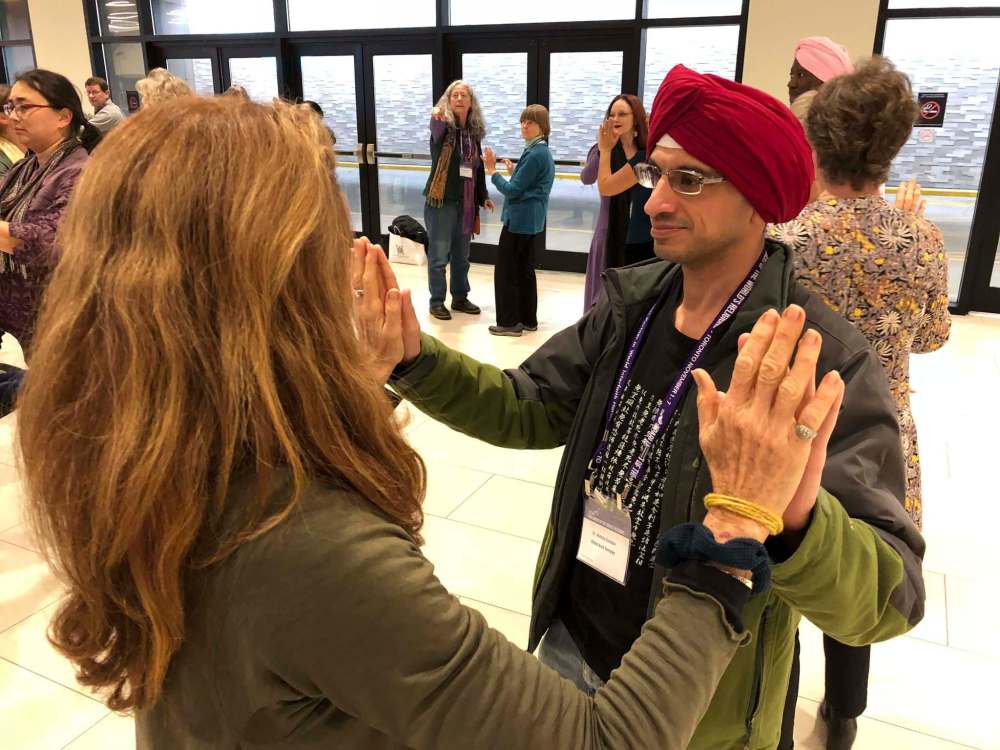
But it also highlighted the positive that religion can do, even as it called people of faith to be more aggressive in addressing the injustices facing the world.
The rise of Christian supremacy in America
Although Donald Trump wasn’t at the parliament, his influence was widely felt.
Speakers from around the world — and especially the U.S. — often reference the situation in that country, expressing disappointment at the hate and anger dividing Americans.
It was felt most forcefully at a workshop titled Faith, Secularism and Democracy.
Billed as a look at the threats to religious freedom and secular democracy in the U.S., presenter Jaideep Singh wasted no time in naming the source of that threat: Christian supremacy.
The co-founder of the Sikh American Legal Defense and Education Fund, Singh said the rise of Christian supremacy is a worrisome development in that country — and equally worrisome is how the president has encouraged and enabled it.
Trump, he said, has “triggered fears of discrimination among Christians.”
Singh cited a poll showing how American evangelicals feel more discriminated against than Muslims and other minority religions.
But as a member of a religious minority group, Singh said he knows that’s not true.
What is happening, he said, is Christians feel threatened because religious minorities are asking for the same rights they enjoy — to practise their faith.
Christians should also be able to practise their faith, Singh said, but they shouldn’t “impose their extremist strictures on all Americans.”
This includes things like insisting on only having Christian prayers in legislatures and schools, the elevation of Christian holidays over other religious events, the use of only Christian scriptures in public life or making it hard for religious minorities to build sacred buildings.
Things like that make religious minorities feel like they “don’t belong,” that they “are not on same level with other Americans.”
The result, he said, is “slowing the national shift towards national pluralism… held up by those seeking to preserve their supremacy.”
In addition to the president, Singh blamed “numerous Christian supremacist politicians” and “unprincipled white Christian religious leaders and media figures” who are polarizing Americans by playing to their fears of immigrants and minorities.
“There is a fear and loathing of Islam found in Christian pulpits in the nation, and on Christian radio and TV,” that “threatens the religious freedom of non-Christian communities of colour,” he said.
Singh also placed blame on the U.S. mainstream media for its “fixation upon Muslim terrorism” instead of on “white hate.”
Co-presenter Michael Reid Trice, assistant dean of ecumenical and interreligious dialogue at the School of Theology and Ministry at Seattle University, noted that although diversity in the U.S. “is a fact, pluralism is not.”
Pluralism, he said, “is aspirational,” a “garden to be cultivated.”
It’s not just Trump’s fault, he said.
“We want to blame a leader, but the truth is we did this to ourselves over decades. Our current fever is not explained by the rise of right-wing leaders. Rather, the condition of the soil was right as we disagreed too ardently, and painted opponents as adversaries.”
Positive role of religion in society
While not shying away from the problems caused by religion, the parliament also noted the role religion plays in making for a better world.
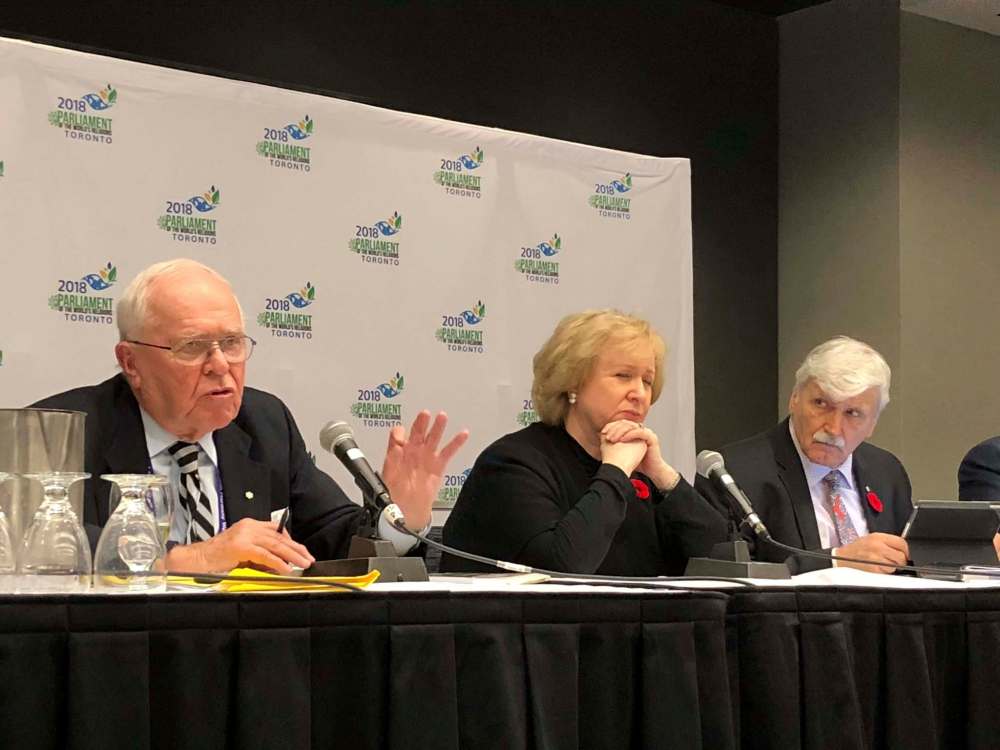
This was emphasized during a press conference featuring Canadian leaders, including retired lieutenant-general Roméo Dallaire, former senator Douglas Roche and former prime minister Kim Campbell.
“Our choice is clear,” Campbell said. “Peace begins with the Golden Rule. Religions and political institutions should treat each other like they want to be treated.”
Secular leaders “don’t want to engage religion,” she added, “but religion has to be part of the discussion.”
Dallaire, who commanded United Nations peacekeeping troops in Rwanda during that country’s genocide, added that the issues facing the world today require people to “bring our human values into action… religions have a duty and capacity to inspire those values.”
He went on to warn of the “grave danger of secularism” where nobody wants to favour religion out of fear of offending someone.
The problem with that, he said, is we “are not providing any foundation” for people today. A vacuum has been created, “but we haven’t filled the vacuum.”
Roche, noted for his work to abolish nuclear weapons, added that “violence takes many forms, and the abuse and distortion of religion by extremists stimulates violence. But all religions have a core message of peace, love and service towards others which form the basis for a culture of peace.”
The values of all faiths “can lead us to policies that protect the environment, eliminate nuclear weapons and promote human rights and the rule of law,” he said.
He went on to say that the issues facing the world today “are deeply moral — migration, sustainable development, nuclear war, the environment,” and that faith can help provide guidance.
A gathering like the parliament “has a global ethic that is badly needed. The voice of religion is badly needed,” he said.
Religion as a Power for Change
In his concluding address, Larry Greenfield, the event’s executive director, said this was not a time for people of faith to seek only their “own salvation,” but to seek the “continued life of the whole world.”
“Every single one of us is not self-created or self-sustained,” he said. “All of us together are dependent on something other than ourselves.”
People need to “take responsibility in return” for other human beings, for all the Earth’s creatures “and for the Earth itself,” he added.
Humans, he said, have the capacity to “not just to destroy ourselves, but to eliminate everything that has life on this globe — unless we change our ways of being in the world… religions have a fundamental role in making that change happen.”
But to do that, he said, “the religions of the world have to change themselves at the most fundamental and radical level” by reversing how they have let beliefs, doctrines and theology decide what actions they should take.
In many cases, those things “have led to practices and behaviours and actions that are destroying the Earth,” he said.

Now is the time for action to determine beliefs, doctrines and theologies so they “can be mutually supportive in saving the Earth,” he said.
At the same time, he said, religions need to collaborate more to address things like climate change, “drawing on their own teachings of justice and compassion.”
This could include recovering the “power of civil disobedience and non-violent action… for the common good and for the good of the Earth.”
No date or place for the next parliament was announced.
jdl562000@yahoo.com
The Free Press is committed to covering faith in Manitoba through our Religion in the News project. This reporting continues because readers like you step forward to fund it.
Donate now to support our reporting on religion.
Your donation is eligible for a charitable tax receipt.
BECOME A FAITH JOURNALISM SUPPORTER
Our newsroom depends on a growing audience of readers to power our journalism. If you are not a paid reader, please consider becoming a subscriber.
Our newsroom depends on its audience of readers to power our journalism. Thank you for your support.
The Free Press is committed to covering faith in Manitoba through our Religion in the News project. This reporting continues because readers like you step forward to fund it.
Donate now to support our reporting on religion.
Your donation is eligible for a charitable tax receipt.
BECOME A FAITH JOURNALISM SUPPORTER
Our newsroom depends on a growing audience of readers to power our journalism. If you are not a paid reader, please consider becoming a subscriber.
Our newsroom depends on its audience of readers to power our journalism. Thank you for your support.
Advertisement Advertise With Us
Advertisement Advertise With Us
The Free Press acknowledges the financial support it receives from members of the city’s faith community, which makes our coverage of religion possible.