Alumni grieve for Jesuit-run university seized by Nicaraguan government that transformed their lives
Advertisement
Read this article for free:
or
Already have an account? Log in here »
To continue reading, please subscribe:

Digital Subscription
One year of digital access for only $205*
- Enjoy unlimited reading on winnipegfreepress.com
- Read the E-Edition, our digital replica newspaper
- Access News Break, our award-winning app
- Play interactive puzzles
*First annual payment billed as $205.00 + GST for one year. This annual subscription will automatically renew at $233.00 + GST every 52 weeks (10% off the regular annual price of $259.35). Offer available to new and qualified returning subscribers only. Cancel any time.
To continue reading, please subscribe:
Add Free Press access to your Brandon Sun subscription for only an additional
$1 for the first 4 weeks*
- Enjoy unlimited reading on winnipegfreepress.com
- Read the E-Edition, our digital replica newspaper
- Access News Break, our award-winning app
- Play interactive puzzles
*Your next Brandon Sun subscription payment will increase by $1.00 and you will be charged $17.95 plus GST for four weeks. After four weeks, your payment will increase to $24.95 plus GST every four weeks.
Read unlimited articles for free today:
or
Already have an account? Log in here »
Hey there, time traveller!
This article was published 29/08/2023 (1133 days ago), so information in it may no longer be current.
MÉXICO CITY (AP) — Long before it was confiscated by President Daniel Ortega’s government in mid-August, the Jesuit-run University of Central America in Nicaragua was a special place for the thousands whose minds and lives it transformed.
“The university was the only center of independent thought left in the country,” said Juan Diego Barberena, a lawyer who fled to Costa Rica. He studied at the institution, known as UCA, between 2014 and 2017.
Ortega’s government described the university as a “center of terrorism” and seized its property, buildings and bank accounts on August 16. A week later, the Jesuit religious order was declared illegal and all of its assets were confiscated. A new institution would replace UCA, though further details are still unclear.
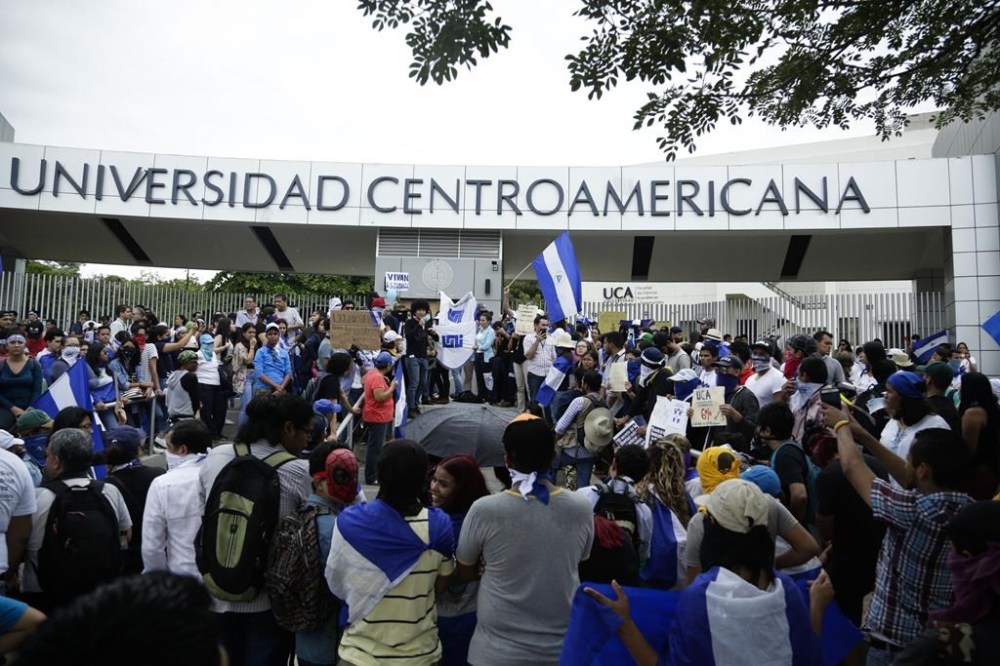
“This is a government policy that systematically violates human rights and appears to be aimed at consolidating a totalitarian state,” the Society of Jesus of Central America said in a statement.
Since December 2021, at least 26 Nicaraguan universities have been closed in a similar manner.
“UCA’s closure responds to the position it took during protests in 2018: to be on the side of the people who were suffering repression and demanding substantial changes,” Barberena said.
Founded by Jesuits in 1960, UCA had historically rejected authoritarianism and offered support for students committed to fighting for deep social transformations.
“The Revolution (1979-1990) cannot be explained without the universities, UCA included,” said Daisy Zamora, a poet and former vice minister of culture who currently lives in the United States. She became a student at UCA in 1967.
Zamora recalls that, even after receiving her primary education in a religious school, UCA expanded her social vocation and political awareness. Eager to fight for her country and overthrow Anastasio Somoza’s dictatorship, she and fellow classmates joined a student branch of the Sandinista National Liberation Front, which ended the Somoza dynasty in 1979 and established a revolutionary government.
“The Jesuits were very open to students expressing themselves politically,” Zamora said. “UCA was a hotbed where resistance actions against the dictatorship were being developed. It was like a small republic where students exercised democracy.”
Four decades later, in 2018, UCA became a hub for protests against Ortega, and its rector participated in peace talks that eventually failed. The recent confiscation of the university, which enrolled more than 8,000 students, follows a series of increasingly authoritarian actions by the government against the Catholic Church and opposition figures.
A human rights organization, Nicaragua Nunca Más, estimates that more than 50 religious leaders have fled in the last five years. In 2022, two congregations of nuns were expelled, and in February, an outspoken critic of Ortega’s government, Bishop Rolando Álvarez, was sentenced to 26 years in prison. A month later, the Vatican closed its embassy after Nicaragua proposed suspending diplomatic relations.
“When I found out about the closure of UCA, I started crying,” said María Gómez, a journalist who fled to Spain. She graduated with a communications degree in 2017.
She first heard about UCA at age 11 and becoming a student was her lifelong dream. When she got in with a full scholarship, she was overcome with joy. “I couldn’t pay the tuition despite the fact that it was cheap, about 2 or 3 dollars, but for a family with limited resources, that was a lot of money.”
In 2018, she joined protests in which peasants and former students demanded government action to stop the burning of an environmental reserve.
“We felt safe because the teachers didn’t interfere, but they gave us freedom to create banners, to gather, and even protected us,” Gomez said. “When the police began to attack the demonstrators, they opened the gates of UCA for us.”
“Some of my professors — who were Jesuits — approached refugees in the cathedral and other universities to pray, to bless them,” she added. “And they told us: You are the future of this country. Do not be discouraged.”
UCA’s influence on youth went beyond its classrooms. Ernesto Medina, a past student and former rector at the National Autonomous University of Nicaragua in the city of León, said that colleagues from UCA changed the way he thought about his own Christianity more than 50 years ago.
“I had social concerns, but they were the traditional ones that Catholic schools instilled in us,” said Medina, who now lives in Germany. “We would go to a poor neighborhood to distribute food, clothes, to talk to people. But the comrades from Managua seriously questioned the dictatorship and the need for a deep social transformation.”
According to Medina, the 1970s were decisive for his country. The military stopped attempts to develop guerrilla groups inspired by the Cuban Revolution in the mountains. Therefore, the FSLN penetrated urban areas.
“UCA played a crucial role back then, because a generation of boys were influenced by the Jesuits of the time,” Medina said. “What mobilized the majority of the Nicaraguan population was a combination of Christian ideas that were highly committed to the people and revolutionary ideas that ended up prevailing.”
For retired military member Roberto Samcam, who served as major in the Sandinista Popular Army and became an engineer at UCA in the 1970s, the university is woven into the fabric of Nicaraguan society.
Ortega himself spent a few months as a student at UCA before devoting himself to the revolution. And in an event that now seems ironic, the university granted him an honorary doctorate for his “contribution to peace and democracy” after accepting an electoral defeat in 1990. He came back to power in 2007 and has governed Nicaragua ever since.

“What he’s stealing is more than a campus, more than university degrees,” Samcam said.
Other former students agree. Barberena fears for the fate of the Institute of History of Nicaragua and Central America, which was housed by UCA and is considered the main documentation and memory center in the country. Gómez worries the press clippings that documented the revolution, which she read endlessly during her spare time at UCA, might be lost.
“For me, it was the only university that taught students how to become critical and respect each other,” Gómez said. “And by losing that, we lose everything.”
——
Associated Press religion coverage receives support through the AP’s collaboration with The Conversation US, with funding from Lilly Endowment Inc. The AP is solely responsible for this content.
The Free Press acknowledges the financial support it receives from members of the city’s faith community, which makes our coverage of religion possible.