Passover Haggadah reflects Jewish diversity
Originally written in Hebrew with some Aramaic, Haggadah sets out 15 steps for Seder to follow
Advertisement
Read this article for free:
or
Already have an account? Log in here »
To continue reading, please subscribe:

Digital Subscription
One year of digital access for only $205*
- Enjoy unlimited reading on winnipegfreepress.com
- Read the E-Edition, our digital replica newspaper
- Access News Break, our award-winning app
- Play interactive puzzles
*First annual payment billed as $205.00 + GST for one year. This annual subscription will automatically renew at $233.00 + GST every 52 weeks (10% off the regular annual price of $259.35). Offer available to new and qualified returning subscribers only. Cancel any time.
To continue reading, please subscribe:
Add Free Press access to your Brandon Sun subscription for only an additional
$1 for the first 4 weeks*
- Enjoy unlimited reading on winnipegfreepress.com
- Read the E-Edition, our digital replica newspaper
- Access News Break, our award-winning app
- Play interactive puzzles
*Your next Brandon Sun subscription payment will increase by $1.00 and you will be charged $17.95 plus GST for four weeks. After four weeks, your payment will increase to $24.95 plus GST every four weeks.
Read unlimited articles for free today:
or
Already have an account? Log in here »
Hey there, time traveller!
This article was published 12/04/2025 (536 days ago), so information in it may no longer be current.
In the 600 years since the first printed Haggadah rolled off the newly invented printing press, thousands of versions of the Haggadah have been published. The Haggadah, which translates as ‘the telling,’ is the central text or user manual of the Passover Seder. The Seder is the ritual meal that heralds the start of the eight day Passover holiday when Jewish people recall their deliverance from slavery in Egypt in the 13th century BCE.
This year, Passover begins on the evening of Saturday, April 12. Also known as Pesach, Passover is generally considered the most widely celebrated Jewish holiday.
Originally written in Hebrew with some Aramaic, the Haggadah sets out 15 steps for the Seder to follow. The steps, which include readings, rabbinical commentaries, the recitation of blessings, the asking of questions, songs and the consumption of symbolic foods, were compiled during the Talmudic or Rabbinic era. That era began after the destruction of the Second Jewish Temple in Jerusalem in 70 CE.
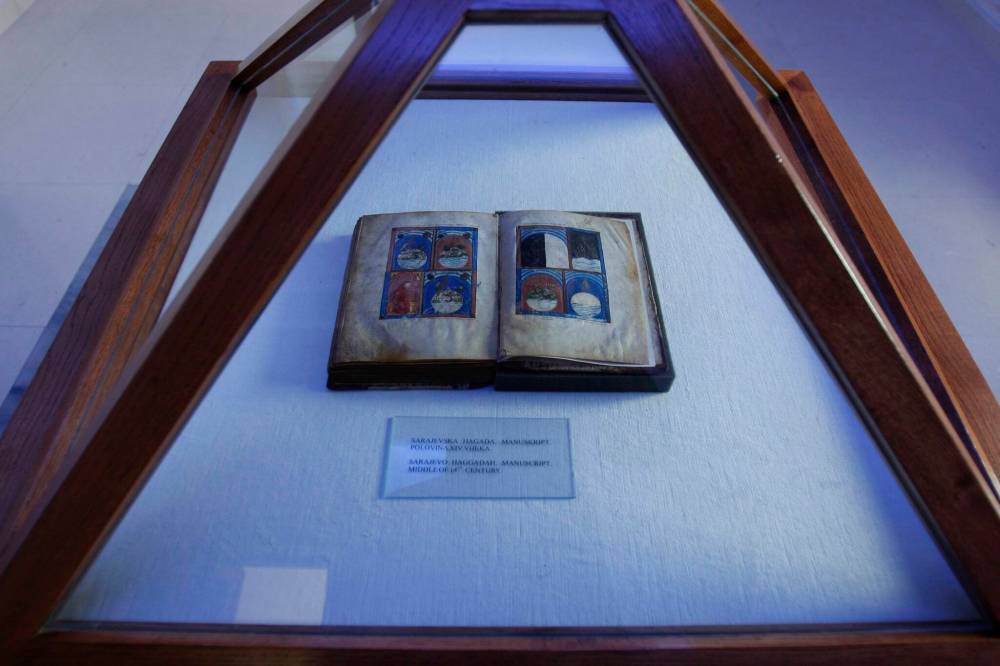
Amel Emric / The Associated Press files
The original book of Sarajevo Haggadah, displayed at the National Museum of Bosnia and Herzegovina in Sarajevo, Bosnia and Herzegovina.
“The Passover Seder was created 2,000 years ago by the same rabbis who essentially created a new version of Judaism,” Rabbi Michael Strassfeld explained in 2023 in an article on the online platform Evolve: Groundbreaking Jewish Conversations. “Faced with the destruction of the Temple and the exile of the Jewish people, they created a Judaism that was portable, enabling Jews to carry it wherever the winds of misfortune would take them.”
While every Haggadah incorporates the 15 steps, not all Haggadot — the plural of Haggadah — are the same. Jews are a diverse people and the wide variety of Haggadot in use reflects their differences in ethnicity, culture, geography, interests, politics, religious affiliation and schools of thoughts.
Mizrachi Jews, who are Jews originally from the Middle East and North Africa, are likely to use different Haggadot than Ashkenazi Jews, who trace their roots to Eastern Europe. Likewise, Jews who are religiously observant tend to use different Haggadot than Jews who identify as Reform or Reconstructionist.
The most famous Haggadah in the world is the Sarajevo Haggadah, an illuminated medieval manuscript written on parchment and preserved under glass in the National Museum of Bosnia and Herzegovina. The most widely used Haggadah in North America for much of the 20th century was the Maxwell House Haggadah, first published as a marketing promotion for the coffee manufacturer back in 1932.

In recent decades, it has become increasingly common for Jewish groups and Seder leaders to create their own Haggadot by borrowing the essential elements of their traditional Haggadot and connecting them to current trends, issues and events. The themes of these alternative Haggadot range from the absurd to the inspiring. There are Haggadot focused on the climate crisis, social justice, feminism, LGBTTQ+ inclusion, the plight of refugees and the pursuit of peace and justice in Israel and Palestine. But there are also Haggadot and Haggadot supplements that have been created specifically for fans of Wicked, Star Wars and Shakespeare.
The creative compilation of alternative Haggadot has been simplified by online, interactive portals such as Recustom.com, which invites users to both upload for sharing and download for their own use multi-authored poems, commentaries, and a host of other Haggadah content on a wide range of themes.
At my family’s Seder tonight we will be relying primarily on a child-friendly Haggadah that integrates translations, transliterations and cartoonish illustrations with the core Hebrew narrative. We will supplement that Haggadah with some critical, contemporary readings — including one that acknowledges the Israeli hostages still being held in Gaza and one that reminds us that nobody is free until everybody is free; from oppression, hunger, homelessness and violence, no matter who they are or where they are in the world.
As Rabbi Sharon Brous, co-founder of the Los Angeles based progressive Jewish community Ikar, wrote in her organization’s Haggadah supplement, “… we do not begin to tell our story, let alone eat our meal, without recognizing that for others, even in our place and in our time, enslavement is no metaphor or abstraction. And for those who have been blessed to traverse the darkness and make our way toward the light, the only responsible thing, the only human thing to do is open our doors and invite in those who are still now where we once were.”
swchisvin@gmail.com
The Free Press is committed to covering faith in Manitoba through our Religion in the News project. This reporting continues because readers like you step forward to fund it.
Donate now to support our reporting on religion.
Your donation is eligible for a charitable tax receipt.
BECOME A FAITH JOURNALISM SUPPORTER
The Free Press acknowledges the financial support it receives from members of the city’s faith community, which makes our coverage of religion possible.