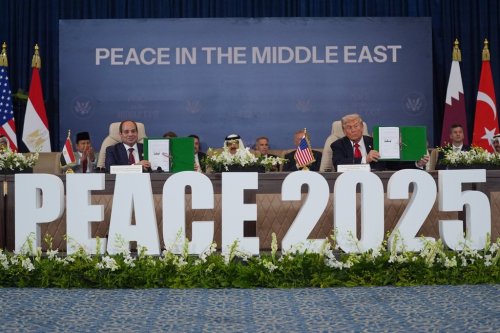
This is why the story of Abraham is coming up in the push for Middle East peace
Advertisement
Read this article for free:
or
Already have an account? Log in here »
To continue reading, please subscribe:

Digital Subscription
One year of digital access for only $205*
- Enjoy unlimited reading on winnipegfreepress.com
- Read the E-Edition, our digital replica newspaper
- Access News Break, our award-winning app
- Play interactive puzzles
*First annual payment billed as $205.00 + GST for one year. This annual subscription will automatically renew at $233.00 + GST every 52 weeks (10% off the regular annual price of $259.35). Offer available to new and qualified returning subscribers only. Cancel any time.
To continue reading, please subscribe:
Add Free Press access to your Brandon Sun subscription for only an additional
$1 for the first 4 weeks*
- Enjoy unlimited reading on winnipegfreepress.com
- Read the E-Edition, our digital replica newspaper
- Access News Break, our award-winning app
- Play interactive puzzles
*Your next Brandon Sun subscription payment will increase by $1.00 and you will be charged $17.95 plus GST for four weeks. After four weeks, your payment will increase to $24.95 plus GST every four weeks.
Read unlimited articles for free today:
or
Already have an account? Log in here »
Hey there, time traveller!
This article was published 13/10/2025 (366 days ago), so information in it may no longer be current.
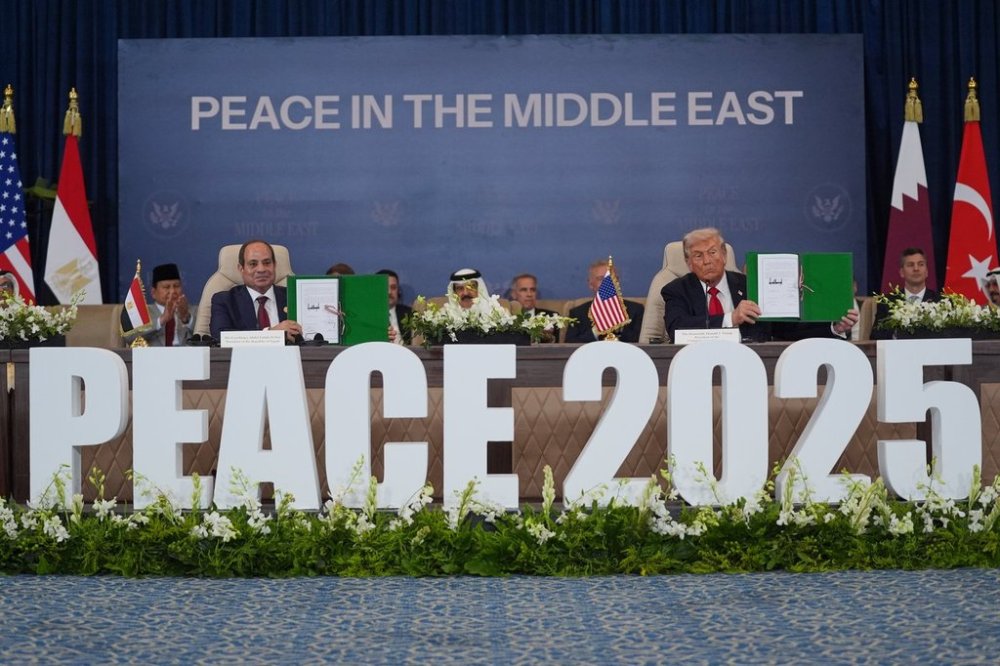
President Donald Trump repeatedly touted the “Abraham Accords” in his Middle East trip on Monday, seeking to build on 2020 agreements that expanded the number of Arab states with diplomatic ties with Israel.
The term is filled with religious and cultural meaning, citing a biblical patriarch revered as a founding figure in three major religions whose adherents encompass more than half the world’s population — Christianity, Islam and Judaism. Anyone trying to build a bridge between faiths is liable to invoke Abraham — known to Muslims as Ibrahim — as someone they hold in common.
But this legacy can also be a source of division because some faith groups portray themselves as his true heirs.
“Everybody has tried to claim Abraham as their own, but in fact Abraham belongs to everybody,” said Bruce Feiler, author of “Abraham: A Journey to the Heart of Three Faiths.”
“Even in the last two years, we have seen this battle play out in a way that has played out for 4,000 years,” he said. “Everyone is trying to say, ‘This is my story, my point of view is the only point of view that matters.'”
But, he said, “the story belongs to all of us, the land will need to be shared, and the legacy will need to be a shared legacy for all of us.”
The Abraham Accords as a template
The Abraham Accords were a series of diplomatic and commercial agreements forged with U.S. influence between Israel and the United Arab Emirates, Bahrain, Sudan and Morocco in 2020, during Trump’s first term. A permanent agreement in Gaza could help pave the path for talks with other majority-Muslim lands.
From the Bible to the headlines
Abraham first appears in the Book of Genesis in the Hebrew Bible, described as a childless elderly man who God promised would be the father of a great nation. God sends Abraham on a journey that leads to the area of present-day Israel and the Palestinian lands.
Abraham first has a son, Ishmael, with an enslaved woman, Hagar. Then Abraham’s wife, Sarah, who is beyond childbearing years, miraculously conceives and bears Isaac. Hagar and Ishmael are banished, although Ishmael returns after Abraham’s death to help Isaac bury their father.
In a pivotal biblical story — retold each Rosh Hashana, marking the Jewish new year — God orders Abraham to sacrifice Isaac. Abraham agrees, binds Isaac to an altar and is stopped before killing his son by an angel who says Abraham has passed a test of faith.
Isaac and his son Jacob become ancestors of the Jews, according to Genesis.
Christianity embraces Abraham as an exemplar of faith — willing to believe and obey God.
Islamic and Jewish traditions depict a young Abraham as smashing his father’s idols as he embraced the worship of one, almighty God.
Muslims, however, place Ismail (Arabic for Ishmael) rather than Isaac at the center of the binding story. They honor Ismail as a righteous prophet who, according to tradition, is an ancestor of the prophet Muhammad. Muslims believe the rock upon which Abraham offered his son is within the Dome of the Rock, the gold-domed shrine in Jerusalem.
Abraham is a dividing figure — and a unifying one
Each of the three monotheistic religions — Christianity, Judaism and Islam — have claimed to be the true heirs of Abraham at different points in a history that included crusades, terror attacks and other violence.
At the same time, because all three faiths revere Abraham, he is invoked for efforts such as the diplomatic accords brokered by the majority-Christian United States between the Jewish state of Israel and majority-Muslim Arab states.
“We see in Islam a religion that traces its origins back to God’s call on Abraham,” then-President George W. Bush said at an iftar (fast-breaking) dinner with Muslims soon after the 9/11 attacks, seeking to differentiate mainstream Muslims from terrorists claiming to act in the name of Islam. “We share your belief in God’s justice, and your insistence on man’s moral responsibility.”
The term “Abrahamic faiths” is also used to promote dialogue between religions.
The United Arab Emirates is home to an Abrahamic Family House, which includes a church, mosque and synagogue.
In the United States, many involved in inter-religious dialogue see the term as more inclusive than “Judeo-Christian,” which was often used in the 20th century. While “Abrahamic” doesn’t encompass all faiths, it reflects an effort to broaden the tent.
Such efforts come amid sharpening religious divisions on other fronts. A surge in antisemitism has accompanied the current Middle East war. Anti-Muslim sentiment has risen as New York appears poised to elect its first Muslim mayor.
With words about Abraham, context is key
During his speech to the Israeli Knesset on Monday, Trump emphasized the specifically Jewish tradition around the patriarch. He offered thanks to the “God of Abraham, Isaac and Jacob” — a central Jewish formulation. He was applauded when he said he preferred calling the diplomatic agreements the “Avraham Accords,” using the Hebrew pronunciation.
At the same time, he has praised Arab and Muslim leaders whose countries engaged in the agreements, some of whom gathered at a summit in Egypt Monday.
It may seem head-spinning that this is the same Trump who was first elected after responding to a 2015 terror attack by calling for a “total and complete shutdown of Muslims entering the United States.” His current administration has launched a crackdown on foreign students and others who have advocated for Palestinians.
But it’s less perplexing if one pays attention “to the last 4,000 years, when everyone has lived within the tension of the story” of Abraham, Feiler said.

The story of Abraham, his two sons and their two mothers is one of “tensions, of inviting people in and pushing people out,” Feiler said.
It’s a timeless story of relations and rivalries between family members, neighbors and others, he said.
“We want it all for ourselves, but we keep being reminded that we can only live alongside the other.”
___
Associated Press religion coverage receives support through the AP’s collaboration with The Conversation US, with funding from Lilly Endowment Inc. The AP is solely responsible for this content.
Related Articles
‘Unimaginable what they’ve endured': Winnipeg Jewish leaders hopeful as surviving Israeli hostages released
Advertisement Advertise With Us
Advertisement Advertise With Us
The Free Press acknowledges the financial support it receives from members of the city’s faith community, which makes our coverage of religion possible.