How France is balancing its strict secularism with excitement for Pope Leo XIV’s visit

Advertisement

Advertise with us

PARIS (AP) — A four-day visit by Pope Leo XIV to France, which starts on Friday, will feature large public gatherings, popemobile parades and an open-air Mass in Paris that will present the country with a balancing act under its strict approach to secularism, known as laïcité.

Read this article for free:


or

Already have an account? Log in here »

To continue reading, please subscribe:

Subscribe and receive a limited-edition Free Press branded hat or tote.

Digital Subscription

One year of digital access for only $205*

  • Enjoy unlimited reading on winnipegfreepress.com
  • Read the E-Edition, our digital replica newspaper
  • Access News Break, our award-winning app
  • Play interactive puzzles

*First annual payment billed as $205.00 + GST for one year. This annual subscription will automatically renew at $233.00 + GST every 52 weeks (10% off the regular annual price of $259.35). Offer available to new and qualified returning subscribers only. Cancel any time.

To continue reading, please subscribe:

Add Free Press access to your Brandon Sun subscription for only an additional

$1 for the first 4 weeks*

  • Enjoy unlimited reading on winnipegfreepress.com
  • Read the E-Edition, our digital replica newspaper
  • Access News Break, our award-winning app
  • Play interactive puzzles
Start now

*Your next Brandon Sun subscription payment will increase by $1.00 and you will be charged $17.95 plus GST for four weeks. After four weeks, your payment will increase to $24.95 plus GST every four weeks.

PARIS (AP) — A four-day visit by Pope Leo XIV to France, which starts on Friday, will feature large public gatherings, popemobile parades and an open-air Mass in Paris that will present the country with a balancing act under its strict approach to secularism, known as laïcité.

“France is an indivisible, secular, democratic and social Republic,” the country’s Constitution states.

Secularism guarantees the freedom to believe or not to believe, as well as the freedom to practice a religion as long as it does not disturb public order. It also requires the state to remain neutral toward all religions.
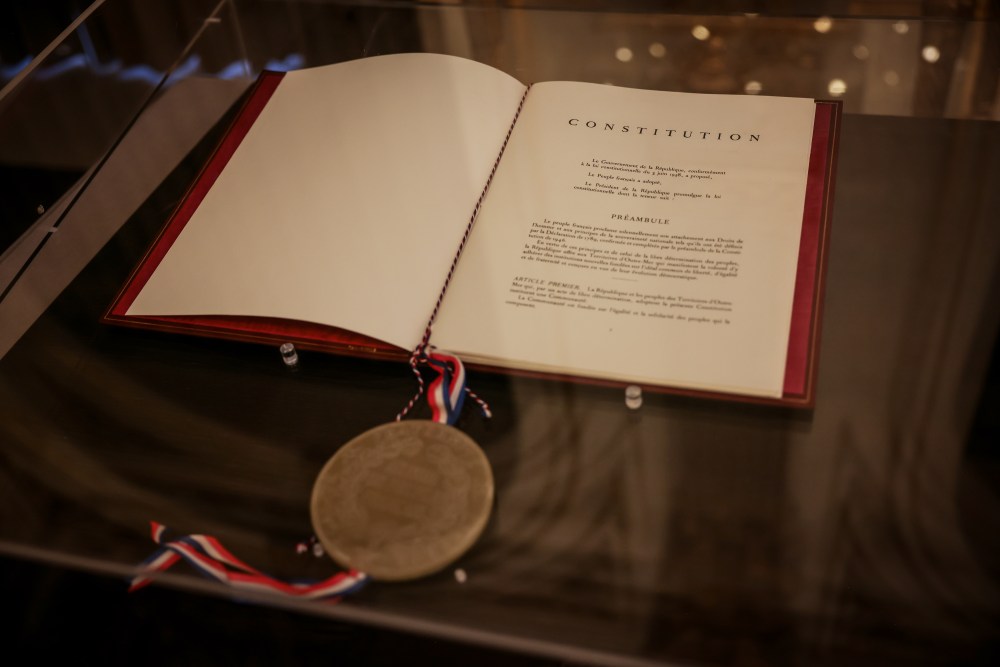
The text of the French Constitution is on display at the Elysee Palace in Paris on Saturday, Sept. 19, 2026. (AP Photo/Thomas Padilla)

Here is a look at France’s distinctive model of secularism, known as laïcité (pronounced lah-ee-see-TAY).

A republic based on separation of church and state

Key rules have been defined by a historic 1905 law, primarily intended to distance the state from the then-powerful influence of the Catholic Church.

The law guarantees freedom of conscience and the free exercise of religion while requiring the state to remain neutral.

Churches built before 1905, including world-renowned cathedrals treasured by tourists, are the property of municipalities or the state, which maintain the buildings while allowing religious communities to use them for worship.

Most places of worship built after 1905, including most mosques, are financed and maintained by religious organizations.

A national survey carried out in 2019 and 2020 found that Catholicism was France’s largest religious affiliation, representing 29% of the population, followed by Islam at 10%. About half of respondents said they had no religious affiliation.

Pope to meet with Macron like other foreign leaders

During his time in France, Leo will visit Paris, Saint-Denis, Lourdes and Metz. He will be received by President Emmanuel Macron in the pope’s capacity as head of Vatican City, making Friday’s meeting at the Élysée Palace an encounter between two heads of state.

Laïcité does not require the government to reject contact with religious institutions.

In an unusual sight for the French capital, a Paris bishop, Monsignor Emmanuel Tois, on Friday morning blessed the media center set up for the pope’s visit, which faces the presidential palace.

Macron met Leo at the Vatican in April to discuss relations with the Holy See, international affairs, peace, and interreligious dialogue, according to his office.

During Pope Francis’ visit to Marseille in 2023, Macron attended the Mass but did not participate in worship. Responding to criticism that his attendance breached France’s secular principles, Macron said he would be present as president out of respect and courtesy, not as a practicing worshipper.

An open-air Mass and other public events are planned

The 1905 law explicitly mentions religious ceremonies, processions and other outdoor manifestations as subject to the ordinary rules governing public order. Security for such events, however, is provided and financed by the state.

Other religions also regularly receive permission to use public spaces. Still, some observers argue that holding Saturday’s Mass at Place de la Concorde and along the Champs-Élysées, near the National Assembly and the presidential palace, could be seen as a continuation of Catholicism’s privileged cultural position.

The area is usually used for the Bastille Day parade, state visits by foreign leaders and celebrations by soccer fans.

Transforming it into a venue for a religious event expected to attract hundreds of thousands of worshippers gives the Catholic Church exceptional visibility.

In 2008, Pope Benedict XVI celebrated Mass before about 260,000 people at Les Invalides in central Paris.

Rules are questioned in schools and on sports fields

A 2004 law bars conspicuous religious symbols in French public schools. The ban covers Muslim headscarves, Jewish kippahs, oversized Christian crosses and other clothing that visibly signals a religious affiliation. Discreet symbols, such as small crosses, Stars of David or Hand of Fatima necklaces, are allowed.

The law does not apply to private schools or university students.

French officials and many educators say secularism in public schools and other institutions protects less observant and nonreligious people from pressure while leaving everyone free to worship in private. Critics, however, argue that the policy primarily targets Muslim girls who wear headscarves.

In sports, the rules are complex and vary according to the athlete’s representative role and the governing federation.

French authorities prohibit national-team athletes from displaying religious symbols while competing in an official capacity, including at the 2024 Paris Olympics.

In 2023, France’s highest administrative court said the country’s soccer federation could impose a ban on headscarves in competitions even though the measure can limit freedom of expression.

International federations may also permit clothing that the corresponding French federation prohibits domestically.

Report Error Submit a Tip

The Free Press acknowledges the financial support it receives from members of the city’s faith community, which makes our coverage of religion possible.
More Stories

How France is balancing its strict secularism with excitement for Pope Leo XIV’s visit

Sylvie Corbet, The Associated Press 5 minute read Preview

How France is balancing its strict secularism with excitement for Pope Leo XIV’s visit

Sylvie Corbet, The Associated Press 5 minute read Friday, Sep. 25, 2026

PARIS (AP) — A four-day visit by Pope Leo XIV to France, which starts on Friday, will feature large public gatherings, popemobile parades and an open-air Mass in Paris that will present the country with a balancing act under its strict approach to secularism, known as laïcité.

“France is an indivisible, secular, democratic and social Republic,” the country’s Constitution states.

Secularism guarantees the freedom to believe or not to believe, as well as the freedom to practice a religion as long as it does not disturb public order. It also requires the state to remain neutral toward all religions.

Here is a look at France’s distinctive model of secularism, known as laïcité (pronounced lah-ee-see-TAY).

Read
Friday, Sep. 25, 2026

’Disgusting’ posters being investigated by police

Morgan Modjeski 4 minute read Yesterday at 2:22 PM CDT

The Winnipeg Police Service major crimes unit is investigating what some have labelled offensive and hateful posters on full-display at a Winnipeg home.

One of the people irked by the display is Gracie Garrett. She’s has lived on Ashburn Street in Winnipeg’s Minto neighbourhood for almost ten years. She’s never felt unsafe in the neighbourhood before, but now, a set of posters plastered on a nearby house are making her feel uneasy.

The five signs, posted facing the street prominently on a front window, contain a slur, refer to Nazis as “heroes” and call Muslims, Christians and other groups “evil.”

Learning of the signs Friday, Garrett said she’ll be reporting the posters to police, as she worries they incite and promote violence.

Bombers get ‘whooped’ in Montreal

Taylor Allen 5 minute read Preview

Bombers get ‘whooped’ in Montreal

Taylor Allen 5 minute read Yesterday at 11:32 PM CDT

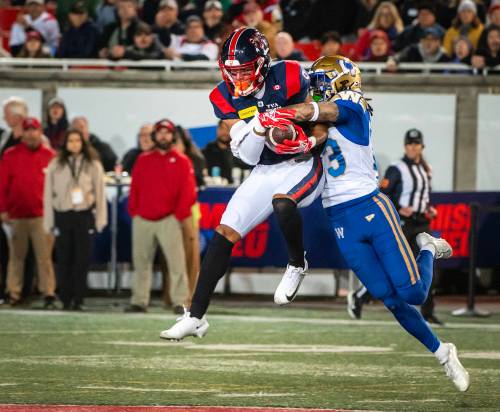
MONTREAL — It’s hard to fathom that the Winnipeg Blue Bombers smacked these Montreal Alouettes five weeks ago.

The team that pulled off that 44-28 upset at Princess Auto Stadium was nowhere to be found in La Belle Province on Saturday night.

You can, however, now find them in the basement of the West Division at 7-8 after getting completely outmatched and outclassed by the Als in a 37-10 beatdown.

“This was bad,” left tackle Stanley Bryant told the Free Press postgame. “They basically had their way all around. They whooped our ass.”

Read
Yesterday at 11:32 PM CDT

Winnipeggers witness unveiling of Japanese Canadian monument in B.C.

Morgan Modjeski 6 minute read Preview

Winnipeggers witness unveiling of Japanese Canadian monument in B.C.

Morgan Modjeski 6 minute read Yesterday at 8:39 PM CDT

As Miki Stewart gathered with her family at the Japanese Cultural Association of Manitoba on Saturday afternoon, she was thinking of her parents, Yoshimaru and Yoshi Abe.

Both Stewart, 80, and her sister Yumi Falk, 81, alongside an older brother, were born in the Tashme internment camp in British Columbia. They were among more than 2,600 Japanese Canadians who were forcefully removed and interred at the camp following the bombing of Pearl Harbour and Canada’s declaration of war on Japan in 1941.

“They didn’t talk much about how they suffered,” Stewart said of her parents. “But they did.”

She was amongst a group of more than 150 people who gathered at the association’s McPhillips headquarters on Saturday afternoon to watch the unveiling of the Japanese Canadian Monument in Victoria B.C.

Read
Yesterday at 8:39 PM CDT

May be whiff of truth to ex’s odour ardour

Maureen Scurfield 5 minute read Yesterday at 2:01 AM CDT

DEAR MISS LONELYHEARTS: I ran into an old boyfriend I used to curl on a team with, and we went for drinks. We’ve been almost eight years apart, and I couldn’t remember why we broke up, as we always had such a great time together.

It wasn’t until the second date — this time on a weekend — that it came back to me, with a jolt. Pee-yew! I remembered he doesn’t use deodorant on weekends. Why? He enjoys his own body odour. I recalled that a bit too late, and it was just as awful as ever! I went home early.

Tonight, he called and I refused him another date. I said, “Think back. You remember why we broke up?” Then he said, “Oh yeah, you hated my no-deodorant weekend policy. Well, guess what? Some women don’t mind!” I said I really doubted that, and that ended the conversation. Miss L., wouldn’t any women find stinky underarms offensive?

— Sensitive Nose, Fort Richmond

Moving drama at MTYP gives voice to boy who changed law

Holly Harris 4 minute read Preview

Moving drama at MTYP gives voice to boy who changed law

Holly Harris 4 minute read Yesterday at 2:37 PM CDT

The heroic true tale of Norway House Cree Nation-born Jordan River Anderson came home Friday night, as Manitoba Theatre for Young People presented Yvette Nolan’s Jordan.

The touring production, a collaboration with Geordie Theatre, runs weekends through Oct. 11, with additional stops in Toronto, Vancouver and Ottawa’s National Arts Centre.

Having several of Anderson’s family members witness the local première underscored the evening with poignancy. Elder and Pine Creek First Nation member Barbara Nepinak added her own dignified presence and prayers following MTYP artistic director Pablo Felices-Luna’s welcoming remarks.

The season-opener also marks the Winnipeg-raised playwright’s homecoming; the Algonquin playwright, director, dramaturg, actor and educator was a fixture in our local theatre community for many years before going on to serve as artistic director for Native Earth Performing Arts from 2003 to ‘11, among other contributions.

Read
Yesterday at 2:37 PM CDT