As Pope’s apology echoes, U.S. Indigenous boarding-school probe follows Canada’s lead
Advertisement
Read this article for free:
or
Already have an account? Log in here »
To continue reading, please subscribe:
Digital Subscription
One year of digital access for only $1.44 a week*
- Enjoy unlimited reading on winnipegfreepress.com
- Read the E-Edition, our digital replica newspaper
- Access News Break, our award-winning app
- Play interactive puzzles
*Billed as $5.77 plus GST every four weeks. After 52 weeks, price increases to the regular rate of $19.95 plus GST every four weeks. Offer available to new and qualified returning subscribers only. Cancel any time.
To continue reading, please subscribe:
Add Free Press access to your Brandon Sun subscription for only an additional
$1 for the first 4 weeks*
- Enjoy unlimited reading on winnipegfreepress.com
- Read the E-Edition, our digital replica newspaper
- Access News Break, our award-winning app
- Play interactive puzzles
*Your next Brandon Sun subscription payment will increase by $1.00 and you will be charged $17.95 plus GST for four weeks. After four weeks, your payment will increase to $24.95 plus GST every four weeks.
Read unlimited articles for free today:
or
Already have an account? Log in here »
Hey there, time traveller!
This article was published 10/04/2022 (1651 days ago), so information in it may no longer be current.
WASHINGTON – On the heels of a historic moment of healing for Indigenous Peoples in Canada, their counterparts in the United States are anxiously anticipating a federal report on residential schools — commissioned by one of their own — that’s fuelling hope for the start of a similar reckoning.
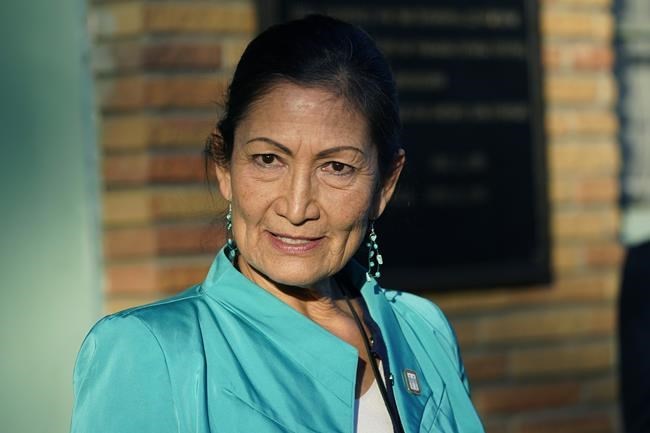
Deb Haaland ordered the Indian Boarding School Initiative last June, shortly after becoming the first Indigenous secretary of the interior in U.S. history, and just days after a B.C. First Nation announced the grim discovery of human remains at a former residential school.
The results of that probe, which is expected to detail the scope and depth of the program in the U.S., are due any day now. When it lands, striking words from Pope Francis — “I want to say to you with all my heart: I am very sorry” — will still be reverberating.
Indigenous leaders in Canada had long sought the pontiff’s personal apology as a gesture of reconciliation for the generations of harm done to children who were forced to attend schools run across the country by the Roman Catholic Church for more than a century.
After his meetings with Indigenous delegates at the Vatican earlier this month, Pope Francis also promised to follow up with a personal visit to Canada.
That cathartic moment and the imminent release of Haaland’s report have combined to put church leaders on notice in the U.S., where they are preparing for what they hope will be a period of reconciliation of their own.
“While the Holy Father was specifically addressing the history in Canada last week, the U.S. bishops are similarly committed to bringing real and honest dialogue on the boarding school period in the United States,” said Chieko Noguchi of the U.S. Conference of Catholic Bishops.
Noguchi said the conference has been encouraging dioceses and state Catholic conferences across the country to reach out to Indigenous communities to initiate conversations in anticipation of the report.
“We acknowledged that we must approach the history that is being brought to light with sensitivity and humility. We hope these are steps on that path towards healing and heightened awareness so that this history is never repeated.”
Haaland’s investigation sought to identify all of the schools that were part of the program, with a particular emphasis on “any records relating to cemeteries or potential burial sites which may later be used to assist in locating unidentified human remains.”
The department will also liaise with Indigenous communities across the U.S., including in Alaska and Hawaii, on how best to handle any such remains.
It’s not just a matter of policy but also personal for Haaland, a member of the Laguna Pueblo tribe in New Mexico.
“My great-grandfather was taken to Carlisle Indian School in Pennsylvania,” she wrote in a moving column in the Washington Post last year. “Its founder coined the phrase, ‘Kill the Indian, and save the man’; which genuinely reflects the influences that framed these policies at the time.”
It’s a chilling echo of words frequently attributed to Canada’s first prime minister, Sir John A. Macdonald — “take the Indian out of the child” — in his 19th century defence of the Canadian residential school system.
In November of last year, Haaland’s investigation prompted Oklahoma City Archbishop Paul Coakley and James Wall, bishop of Gallup, N.M., to put their fellow bishops on notice about a coming “Kairos” — an ancient Greek word to describe an opportune moment.
“A Kairos moment is both a crisis and an opportunity,” the bishops wrote in their letter, a copy of which was obtained by The Canadian Press.
“Honestly confronting the history of the church in the United States in relation to Indigenous Peoples will present challenges, but it also is an opportunity to reach out and connect, to have honest dialogue about our shared histories, and discern how best to draw closer and go forward together.”
The report, scheduled for release in April, is expected to serve as a jumping-off point for a host of reconciliation efforts, Department of the Interior spokesman Tyler Cherry said in a statement.
“The analysis that has been undertaken is expected to form the basis for future efforts intended to honour Tribal Nations and the families of the Indigenous children who may be interred at boarding school sites,” Cherry said.
The report will also “provide a foundation for ongoing research, site visits, and stakeholder engagement to address the intergenerational impact of these assimilationist policies.”
What’s unlikely, however, is an odyssey similar to the one in Canada that culminated earlier this month in the Pope’s long-sought apology, said Joseph Gone, a decorated psychologist and anthropology professor at Harvard who specializes in Indigenous mental health.
Not only is Indigenous history dramatically different in the two countries, so too has been the scope and scale of the saga of residential schools — known in the U.S. as boarding schools, Gone said in an interview. And while Indigenous issues have long been a driving force in Canadian racial politics, those same issues have largely been overshadowed in the U.S. by what he called the “Black-white” dynamic.
In Canada, an estimated 150,000 Indigenous children are believed to have attended one of about 150 residential schools that operated between the 1880s and when the last one closed in 1996.
For several decades, “Indigenous Peoples have identified the residential schooling as a main or primary indicator of their colonial subjugation in Canada,” Gone said.
“American Indian, Alaskan native and native Hawaiian folks are often completely invisible in the United States in a way that is just not the case in Canada, so our issues do not get the same kind of attention.”

Indeed, any American awareness of traumas like residential schools or missing and murdered Indigenous women and girls is largely a result of the long, arduous conversations and controversies that have been evolving north of the border since at least the 1990s, he said.
As a result, Gone expects the report to “fuel attention and consternation and address, in terms of native peoples here in United States, articulating this history, talking about its significance in a way to try get the floor, take the mic and make our presence known in a way that will matter.
“But I don’t think it will result in any kind of big truth and reconciliation of the kind seen in Canada.”
This report by The Canadian Press was first published April 10, 2022.
Note to readers: This is a corrected story. An earlier version had an incorrect spelling for Archbishop Paul Coakley’s last name.
The Free Press acknowledges the financial support it receives from members of the city’s faith community, which makes our coverage of religion possible.