Newfoundland iceberg tours draw more visitors as climate warms: tour operator

Advertisement

Advertise with us

TRINITY, N.L. - Instead of May flowers, late spring in Newfoundland and Labrador is known for the towering icebergs sent drifting down the province's coasts.

Read this article for free:


or

Already have an account? Log in here »

To continue reading, please subscribe:

Subscribe and receive a limited-edition Free Press branded hat or tote.

Digital Subscription

One year of digital access for only $205*

  • Enjoy unlimited reading on winnipegfreepress.com
  • Read the E-Edition, our digital replica newspaper
  • Access News Break, our award-winning app
  • Play interactive puzzles

*First annual payment billed as $205.00 + GST for one year. This annual subscription will automatically renew at $233.00 + GST every 52 weeks (10% off the regular annual price of $259.35). Offer available to new and qualified returning subscribers only. Cancel any time.

To continue reading, please subscribe:

Add Free Press access to your Brandon Sun subscription for only an additional

$1 for the first 4 weeks*

  • Enjoy unlimited reading on winnipegfreepress.com
  • Read the E-Edition, our digital replica newspaper
  • Access News Break, our award-winning app
  • Play interactive puzzles
Start now

*Your next Brandon Sun subscription payment will increase by $1.00 and you will be charged $17.95 plus GST for four weeks. After four weeks, your payment will increase to $24.95 plus GST every four weeks.

Hey there, time traveller!
This article was published 16/06/2019 (2652 days ago), so information in it may no longer be current.

TRINITY, N.L. – Instead of May flowers, late spring in Newfoundland and Labrador is known for the towering icebergs sent drifting down the province’s coasts.

After separating — or “calving” — from glaciers in Greenland, these 10,000-year-old hunks of ice, with eye-catching colourations and textures, may soon melt down to nothing off the island’s shores.

For many residents and tourists, the photogenic phenomenon is also a stark visual reminder of the planet’s changing climate and rapidly melting glaciers.
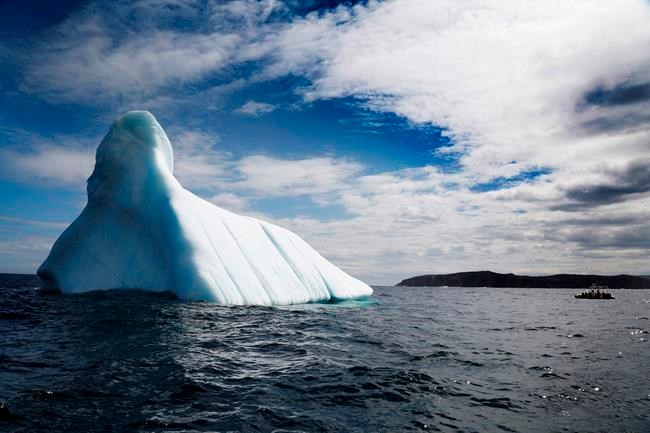
Trinity Eco-Tours take tourists up close to an iceberg in Bonavista Bay, Newfoundland and Labrador on Monday, June 11, 2019.THE CANADIAN PRESS/Paul Daly

Bob Bartlett, owner and operator of Trinity Eco-Tours, says he’s detected an increase in iceberg tourism over the last few years as people rush to see the glacial giants up close before they are lost to climate change.

“There’s been an increase in tourism based on the fact that people think icebergs are going away with global warming,” Barlett said from a dock in Trinity after an afternoon tour.

“There’s a perception, I think, that with global warming there will be no more icebergs.”

Doug Leonard, a senior ice forecaster the Meteorological Service of Canada, said the annual number of icebergs visible from land depends on many factors independent from climate change, such as wind patterns. But increased calving from glaciers, where the icebergs begin their trek, is linked to the warming climate.

On a recent visit to St. John’s, federal Environment Minister Catherine McKenna said while icebergs may be an attractive tourism boon, more multi-year ice coming south is a “very dangerous” sign for ocean industries.

A statement from McKenna’s department cited research from the Journal of Geophysical Research Centre that points to increased warming in the Canadian Arctic, sending “more thick multi-year sea ice” southward during the annual melt season.

The International Ice Patrol has assessed 2019 as an “extreme year” for icebergs on the east coast, in the top 10 per cent of years tracked, the department said.

As of June 11, 1,494 icebergs had drifted south into transatlantic shipping lanes south of 48 degrees north, compared to a yearly average of 713, classifying 2019 as the tenth most severe year on record since 1900.

For Bartlett’s customers, these numbers and long ocean journeys are brought into focus from Trinity Eco-Tours’ small boats, as people look up at a tall mass of white and blue with streams of water running down its sides.

“It is a phenomenon and people are sincerely interested. I’ve had people cry on tour over these icebergs,” Bartlett said of the “immersive experience” people seek from far and wide.

“This is live, it’s happening now. And in a couple or three weeks, that iceberg may be done and finished.”

Some tourists even come to escape the heat themselves.

Jim and Laura East were vacationing in Trinity from their home just south of Daytona Beach in Florida, saying they chose a cold vacation spot for a break from the hot temperatures back home.

“The only ice we see is in our drinks,” Jim said cheerfully before boarding the vessel.

On Bartlett’s tours, the up-close sight of a ‘berg brings smiles to people’s faces, but still, chatter on board naturally turns to rising sea levels, and the iceberg’s impressive lifespan that’s nearing its end.

Once one iceberg disappears, the chase to find the next one begins, Bartlett said, but there’s still a melancholy aspect to seeing a hunk of ancient glacier at the end of its travels.

“We have this gigantic, mammoth iceberg that is actually in its last, dying stages as we watch it. So it’s a bit of a sad moment, as well.”

Report Error Submit a Tip

More Stories

A quick look at where provinces and territories stand on time changes

The Canadian Press 2 minute read Preview

A quick look at where provinces and territories stand on time changes

The Canadian Press 2 minute read Updated: Yesterday at 6:28 AM CDT

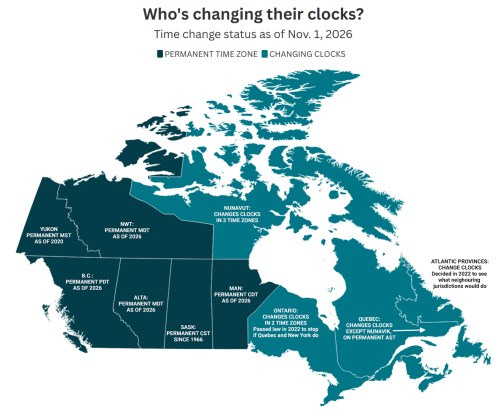
WINNIPEG - Manitoba's government said Thursday the province will be sticking with daylight time year-round, making it the latest jurisdiction to move away from twice-annual time changes. Here's a look at where things stand across Canada:

British Columbia said in March that it was moving to permanent Pacific daylight time. The change also means that parts of northeastern B.C., which have been on mountain standard time year round, are now in alignment with the rest of the province.

Alberta also switched to permanent daylight time this year in what it calls Alberta time. The change means it now has the same time as Saskatchewan year round.

Saskatchewan has been on permanent central standard time since 1966.

Read
Updated: Yesterday at 6:28 AM CDT

United Way, other charities fight for dollars as donor base shrinks

Scott Billeck 7 minute read Preview

United Way, other charities fight for dollars as donor base shrinks

Scott Billeck 7 minute read Yesterday at 2:00 AM CDT

Winnipeg’s charitable sector is being squeezed from both sides: demand for help is growing while the pool of donors to meet that need is shrinking.

The imbalance is increasingly being carried by a relatively small group of deep-pocketed donors. Last year, 600 people — about three per cent of United Way Winnipeg’s individual donors — accounted for roughly $8 million, or 55 per cent of individual donations.

The fundraising pitch isn’t getting any easier.

Homelessness and public drug use have become increasingly visible, household budgets remain strained and the problems charities are trying to address can seem so entrenched that donors may reasonably wonder what difference another contribution can make.

Read
Yesterday at 2:00 AM CDT

Gillingham in lead with decided voters

Nicole Buffie 6 minute read Preview

Gillingham in lead with decided voters

Nicole Buffie 6 minute read Yesterday at 6:55 PM CDT

A cloud of uncertainty is hanging over Winnipeg as October’s municipal election nears.

Three months after a poll showed more than 40 per cent of Winnipeggers wanted to see someone other than current mayor Scott Gillingham elected, a new Abacus Data poll indicates more than half of Winnipeg voters are undecided heading into next month’s civic election.

Of decided voters, 55 per cent favour Gillingham compared to 23 per cent for former councillor and provincial cabinet minister Kevin Klein and 11 per cent for funeral director Mike Vogiatzakis.

Of all respondents, just over 50 per cent said they were unsure while 13 per cent said they will not vote.

Read
Yesterday at 6:55 PM CDT

His blissful kiss is well worth the risk

Maureen Scurfield 4 minute read Yesterday at 2:00 AM CDT

DEAR MISS LONELYHEARTS: The best kisser I ever met knocked me off balance. My little joke was, “That’s why we have to go home now and lie down in a hurry!” We’ve been seeing each other for almost six months. This man can convince me to do almost anything — so much fun!

But, now he’s been transferred out of province for bigger money at a new company.

He’s leaving soon and he could have asked me to move with him, as his trucking partner, but he didn’t! Other women will soon have their hands on him, believe me!

I’m already 27 and I don’t want to date any more guys — just him. Now what can I do? I feel sadder every day.

Iceberg tours draw visitors as Arctic melts

Holly McKenzie-Sutter, The Canadian Press 4 minute read Preview

Iceberg tours draw visitors as Arctic melts

Holly McKenzie-Sutter, The Canadian Press 4 minute read Sunday, Jun. 16, 2019

TRINITY, N.L. - Instead of May flowers, late spring in Newfoundland and Labrador is known for the towering icebergs sent drifting down the province's coasts.

After separating — or "calving" — from glaciers in Greenland, these 10,000-year-old hunks of ice, with eye-catching colourations and textures, may soon melt down to nothing off the island's shores.

For many residents and tourists, the photogenic phenomenon is also a stark visual reminder of the planet's changing climate and rapidly melting glaciers.

Bob Bartlett, owner and operator of Trinity Eco-Tours, says he's detected an increase in iceberg tourism over the last few years as people rush to see the glacial giants up close before they are lost to climate change.

Read
Sunday, Jun. 16, 2019

Day 1 of Jets training camp in the books with pairings essentially cemented

Ken Wiebe 7 minute read Preview

Day 1 of Jets training camp in the books with pairings essentially cemented

Ken Wiebe 7 minute read Thursday, Sep. 17, 2026

Nearly six minutes into his question-and-answer session, Scott Arniel took a welcome detour from the news of the day.

After exhausting the discussion around the goalie who wasn’t in training camp, the head coach of the Winnipeg Jets finally got a query about the line combinations and defensive pairings that were unveiled in training camp.

And unlike past years, when exhibition games were more frequent and the training camp wasn’t this condensed, Arniel conceded these groupings were intentional and were likely staying together for some time.

The expansion to an 84-game regular season brings with it a reduction to four pre-season games and a much shorter training camp, which could limit the amount of experimentation that Arniel can do during the next two weeks.

Read
Thursday, Sep. 17, 2026