A timeline on rail disruptions by anti pipeline protesters across Canada
Advertisement
Read this article for free:
or
Already have an account? Log in here »
To continue reading, please subscribe:
Digital Subscription
One year of digital access for only $1.44 a week*
- Enjoy unlimited reading on winnipegfreepress.com
- Read the E-Edition, our digital replica newspaper
- Access News Break, our award-winning app
- Play interactive puzzles
*Billed as $5.77 plus GST every four weeks. After 52 weeks, price increases to the regular rate of $19.95 plus GST every four weeks. Offer available to new and qualified returning subscribers only. Cancel any time.
To continue reading, please subscribe:
Add Free Press access to your Brandon Sun subscription for only an additional
$1 for the first 4 weeks*
- Enjoy unlimited reading on winnipegfreepress.com
- Read the E-Edition, our digital replica newspaper
- Access News Break, our award-winning app
- Play interactive puzzles
*Your next Brandon Sun subscription payment will increase by $1.00 and you will be charged $17.95 plus GST for four weeks. After four weeks, your payment will increase to $24.95 plus GST every four weeks.
Read unlimited articles for free today:
or
Already have an account? Log in here »
Hey there, time traveller!
This article was published 27/02/2020 (2424 days ago), so information in it may no longer be current.
RCMP began enforcing an injunction earlier this month that prevents interference with construction of a $6.6-billion natural gas pipeline in northern British Columbia.
Here is a timeline of the dispute, which led to rail disruptions by people showing solidarity with the hereditary Wet’suwet’en chiefs opposing the Coastal GasLink project:
Dec. 31, 2019 — The B.C. Supreme Court grants Coastal GasLink an injunction calling for the removal of any obstructions including cabins and gates on any roads, bridges or work sites the company has been authorized to use.
Jan. 1, 2020 — The Wet’suwet’en First Nation serves Coastal GasLink with an eviction notice, telling the company workers are “currently trespassing” on their unceded territory.
Jan. 27 — The British Columbia government appoints former New Democrat MP Nathan Cullen as a provincial liaison with Wet’suwet’en hereditary chiefs in the LNG pipeline dispute.
Jan. 30 — The hereditary chiefs of the Wet’suwet’en agree to seven days of meetings with the province.
Feb. 5 — The talks that were intended to de-escalate the dispute fail after just two days.
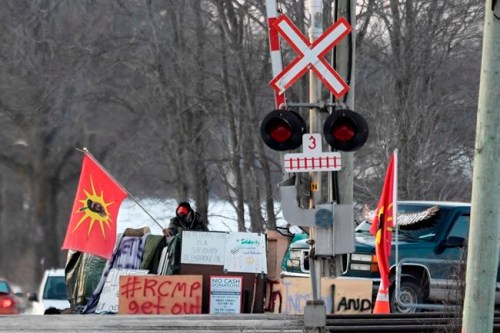
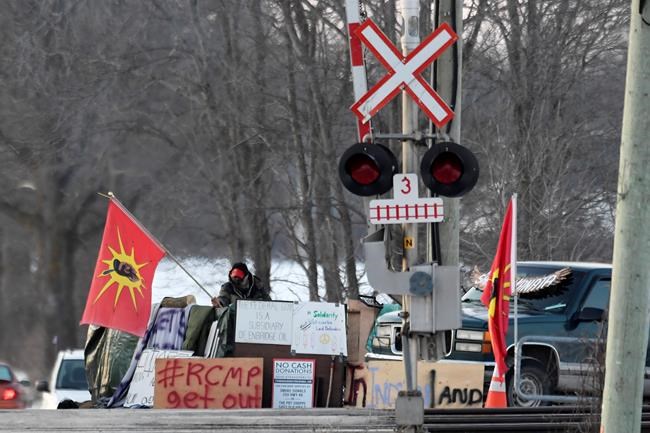
Feb. 6 — The RCMP move in to Wet’suwet’en territory to enforce the court injunction that would have allowed construction work to resume. A handful of pipeline opponents are arrested. Hours later, outside of Belleville, Ont., east of Toronto, protesters start holding up railway traffic in solidarity with the Wet’suwet’en hereditary chiefs.
Feb. 7 — Via Rail halts service along one of its busiest routes because of the Belleville-area blockade. All travel between Toronto, Ottawa and Montreal is cancelled. Canadian National Railway obtains a court injunction to end a demonstration by members of the Tyendinaga Mohawk Territory near Belleville. Protesters also begin disruptions at ports in Vancouver and Delta, B.C.
Feb. 8 — Protesters in Toronto disrupt Canadian Pacific Railway traffic moving through the downtown area. Kahnawake Mohawk community members south of Montreal erect a blockade on a CP rail line.
Feb. 10 — Demonstrators in the Montreal area disrupt commuter train service on the Exo Candiac line. A shuttle bus service is in effect for affected rail stations.
Feb. 11 — CN stops transport between Prince George, B.C., and Prince Rupert, B.C., because of a blockade near Hazelton, B.C. The company says it has halted more than 150 freight trains since blockades started on Feb. 6.
Feb. 12 — The Manitoba government says it may seek a court injunction to end a blockade on a rail line west of Winnipeg, but CN obtains its own court order. Two hereditary Wet’suwet’en chiefs start a constitutional challenge of fossil fuel projects, as Prime Minister Justin Trudeau calls for demonstrators across the country to observe the rule of law.
Feb. 13 — CN shuts down its operations in Eastern Canada. The railway says blockades have ended in Manitoba and may come down soon in British Columbia, but the orders of a court in Ontario have yet to be enforced and continue to be ignored.
Feb. 14 — A rail blockade that halted train traffic to and from the Port of Prince Rupert is lifted as First Nations leaders agree to meet with federal and provincial politicians.
Feb. 15 — Federal Indigenous Services Minister Marc Miller travels to meet with protesters in Tyendinaga Mohawk Territory near the site of the Belleville blockade. He says “modest progress” was made during nine hours of talks, but declines to share details on what was discussed.
Feb. 16 — Trudeau cancels his planned trip to Barbados, less than 24 hours before his scheduled departure, so he can handle the protests in Canada. Meanwhile, protesters briefly shut down a busy Ontario border crossing.
Feb. 17 — Trudeau convenes the Incident Response Group, an emergency committee that meets in the event of a national crisis.
Feb. 18 — An emergency debate is held in the House of Commons, where the Opposition Conservatives advocate for forceful action and the governing Liberals push for ongoing dialog with backing from other political parties. Meanwhile, CN issues temporary layoff notices for 450 employees, citing the ongoing protests as the reason.
Feb. 19 — Protesters erect a blockade along a stretch of CN rail line in Edmonton, but are soon faced with counter-protesters who begin forcibly dismantling the barricade. The blockade is taken down later in the day. Via Rail announces nearly 1,000 temporary layoffs in light of ongoing service suspensions across much of Canada. The rail provider also cancels plans to resume a route between Ottawa and Quebec City as a new blockade is erected near Montreal.
Feb. 20 — Federal Public Safety Minister Bill Blair says the RCMP has offered to move its officers from Wet’suwet’en territory to a nearby town. He says this concession meets a key condition from the hereditary chiefs and calls for all rail blockades to be dismantled. Wet’suwet’en hereditary chiefs travel to Quebec and Ontario to thank supporters who have maintained the blockades.
Feb. 21 — Prime Minister Justin Trudeau says the barricades must come down and the injunctions to clear the rail lines must be enforced, calling the situation “unacceptable and untenable.” He points the finger at Indigenous leadership, who he says have not been receptive to his government’s attempts at negotiation. Protesters who’d been blockading a CN Rail line near Montreal clear out shortly after riot police arrive on scene ready to enforce an injunction to clear the tracks.
Feb. 22 — Anti-pipeline demonstrations spring up, including a protest along the railway tracks in Saskatoon. Saskatchewan Premier Scott Moe says a train was allowed to pass through the protest area as scheduled, warning that the protest must remain lawful and that transport routes cannot be disrupted by illegal blockades.

Feb. 23 —Ontario Provincial Police give protesters until midnight Sunday to clear the blockade near Belleville on Tyendinaga Mohawk Territory or face an investigation and possible criminal charges.
Feb. 24 — Ontario Provincial Police move to enforce injunction aimed at clearing the Belleville-area rail blockade. Police make several arrests and officers line up in front of the remaining protesters at the encampment. A small group of protesters are served with an injunction by CN Rail to leave the tracks. In B.C., 14 people are arrested at a blockade near New Hazelton. Three other hereditary chiefs are also taken into custody as RCMP remove a demonstration on the CN Rail main line in northern B.C. About 300 people gather at the front steps of the B.C. legislature, despite a court injunction prohibiting protests blocking entrances to the building.
Feb. 25 — Metrolinx, operator of the GO Transit network in Ontario, suspends on multiple routes as a series of protests spring up in and around Toronto. Three people are arrested at a demonstration in Toronto’s west end. A protest at a GO station in Hamilton causes numerous cancellations and delays during the morning commute. A court injunction is served to protesters, who leave the blockade site peacefully in the evening. In Vancouver, police arrest several demonstrators at a major intersection leading to the city’s port, just hours after warning them the protest was violating a court injunction. Canadian Pacific Railway obtains an injunction to end a blockade in the Mohawk community of Kahnawake, south of Montreal.
Feb. 26 — A hereditary house chief with the Wet’suwet’en Nation says the federal and provincial governments have cancelled planned talks. Hours later, he says the meeting is back on and scheduled to start the following day. Chief Na’Moks says the cancellation was due to a “miscommunication.” A rail blockade on the Kahnawake Mohawk territory south of Montreal is reinforced with concrete barriers and loads of rock. Quebec Premier Francois Legault suggests provincial police are not dismantling it because those on the reserve are armed, potentially with assault rifles. Kenneth Deer, the secretary of the Mohawk Nation at Kahnawake, says the accusation is “highly irresponsible and ludicrous.” Protesters block a major highway on Vancouver Island before the evening rush hour.
This report by The Canadian Press was first published Feb. 13, 2020.
Related Articles
Pipeline talks with chiefs wrap for day in B.C.
Advertisement Advertise With Us
Advertisement Advertise With Us