Delay after alarm puts California spill response in question

Advertisement

Advertise with us

Amplify Energy’s emergency response plan for a major oil spill like the one it’s now dealing with in coastal Southern California depended heavily on a quick shutdown of the San Pedro Bay Pipeline if its sensors picked up a sudden loss of pressure. That’s not what happened, investigators revealed Tuesday.

Read this article for free:


or

Already have an account? Log in here »

To continue reading, please subscribe:

Subscribe and receive a limited-edition Free Press branded hat or tote.

Digital Subscription

One year of digital access for only $205*

  • Enjoy unlimited reading on winnipegfreepress.com
  • Read the E-Edition, our digital replica newspaper
  • Access News Break, our award-winning app
  • Play interactive puzzles

*First annual payment billed as $205.00 + GST for one year. This annual subscription will automatically renew at $233.00 + GST every 52 weeks (10% off the regular annual price of $259.35). Offer available to new and qualified returning subscribers only. Cancel any time.

To continue reading, please subscribe:

Add Free Press access to your Brandon Sun subscription for only an additional

$1 for the first 4 weeks*

  • Enjoy unlimited reading on winnipegfreepress.com
  • Read the E-Edition, our digital replica newspaper
  • Access News Break, our award-winning app
  • Play interactive puzzles
Start now

*Your next Brandon Sun subscription payment will increase by $1.00 and you will be charged $17.95 plus GST for four weeks. After four weeks, your payment will increase to $24.95 plus GST every four weeks.

Hey there, time traveller!
This article was published 05/10/2021 (1793 days ago), so information in it may no longer be current.

Amplify Energy’s emergency response plan for a major oil spill like the one it’s now dealing with in coastal Southern California depended heavily on a quick shutdown of the San Pedro Bay Pipeline if its sensors picked up a sudden loss of pressure. That’s not what happened, investigators revealed Tuesday.

After an alarm went off in a company control room at 2:30 a.m. Saturday — signaling a rupture that would spill tens of thousands of gallons of crude into the Pacific Ocean — the company waited more than three hours to shut down the pipeline, at 6:01 a.m., according to preliminary findings of an investigation into the spill.

The Houston-based company took another three hours to notify the U.S. Coast Guard’s National Response Center for oil spills, investigators said, further slowing the response to an accident for which Amplify workers spent years preparing.
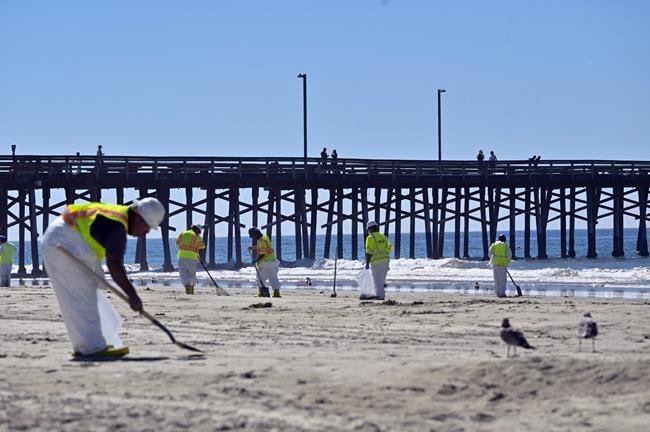
Workers clean oil from the sand, south of the pier, in Newport Beach, Calif., Tuesday, Oct. 5, 2021. A leak in an oil pipeline caused a spill off the coast of Southern California, sending about 126,000 gallons of oil into the ocean, some ending up on beaches in Orange County. (Jeff Gritchen/The Orange County Register via AP)

“How come it took so long? That’s a fair question,” said Richard Kuprewicz, a pipeline consultant and private accident investigator from Redmond, Washington. “If you have any doubt, your action should be to shut down and close. … Something’s not quite right here.”

Pipeline control room alarms don’t always mean a leak and can be tripped by numerous factors — from a faulty signal from a sensor along the line, to a pump that goes offline and causes a sudden pressure change, according to Kuprewicz and other industry experts. But the alarms also are supposed to trigger immediate follow-up actions to quickly ascertain if anything is wrong.

It’s uncertain why that process dragged out hours in San Pedro Bay, potentially worsening a spill that left some birds coated with oil and has stirred worries about broader environmental impacts.

The cause of the pipeline break just offshore from Los Angeles remains under investigation. Early findings point to a ship anchor possibly catching the line and dragging it across the seafloor, tearing a gash in the half-inch-thick (12.7 millimeter) steel pipe.

The timeline of the company’s response appears to contradict statements from Amplify’s CEO, Martyn Willshire, who told reporters on Monday that the company first became aware of the spill after receiving a report from a boat of a sheen in the water.

Willshire acknowledged the company’s equipment was supposed to help detect spills, then said, “we did not have any notice that there was a leak” prior to the sheen report.

In documents released Tuesday detailing the company’s actions, federal transportation officials did not comment on the time lag in shutting down the line or reveal any potential explanation that the Amplify executives may have offered.

Company representatives did not respond to emailed questions about the delay between the alarm and the shutdown.

Problems with faulty leak detection procedures have plagued the industry for years, including during a massive 2010 oil spill that polluted 40 miles (64 kilometers) of Michigan’s Kalamazoo River. In that case, an Enbridge Inc. pipeline leaked at least 843,000 gallons (3.2 million liters) of crude over 17 hours, even as alarms kept going off in a company control room.

The company later settled pollution violations in the case for $176 million.

The accident spurred calls for more stringent leak detection rules and the installation of more automatic or remote-control shut-off valves that can quickly halt the flow of oil in a leak.

A dearth of such valves was also cited in another 2010 pipeline accident — a natural gas transmission line explosion in San Bruno, California, that left eight dead and dozens injured after the line continued burning like a massive blowtorch for almost 90 minutes before the line was shut down manually.
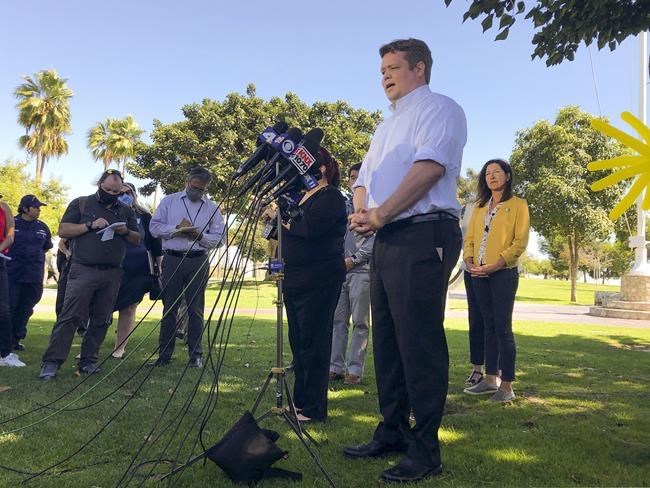
Amplify Energy Corp. CEO Martyn Willsher discusses the Huntington Beach oil spill during a news conference in Long Beach, Calif., Tuesday, Oct. 5, 2021. Willsher said company divers were inspecting the area of the suspected leak reported Saturday. Willsher said an anchor from a cargo ship striking the pipeline is
Amplify Energy Corp. CEO Martyn Willsher discusses the Huntington Beach oil spill during a news conference in Long Beach, Calif., Tuesday, Oct. 5, 2021. Willsher said company divers were inspecting the area of the suspected leak reported Saturday. Willsher said an anchor from a cargo ship striking the pipeline is "one of the distinct possibilities" behind the leak. The Coast Guard received the first report of a possible oil spill more than 12 hours before the company reported a major leak in its pipeline and a cleanup effort was launched, records show. (AP Photo/Stefanie Dazio)

Federal officials began crafting new leak detection and valve rules under former President Barack Obama, but they were never finalized.

A new rule proposed last year under former President Donald Trump and now awaiting final approval would mandate more valves only for new or replaced oil pipelines, not the thousands of miles that are already in use. The change came after oil industry lobbying groups including the American Petroleum Institute said retrofitting lines with valves would cost up to $1.5 million per device.

The pending rule does not set standards for leak detections, giving companies significant leeway in how sensitive to leaks their equipment needs to be, said Bill Caram with the Pipeline Safety Trust, a Bellingham, Washington-based group that advocates for safer pipelines.

“It makes us worry for our country’s aging energy infrastructure,” Caram said. “We fear this could become a bigger and bigger issue.”

John Stoody with the Association of Oil Pipe Lines said companies and industry groups are working hard to improve leak detection technologies. Fine-tuning equipment is part of that, to make sure companies can detect even small leaks but not have to respond to false alarms.

“If you’re riddled with false alarms, people have a harder time reacting,” Stoody said.

___

Follow Matthew Brown on Twitter: @MatthewBrownAP

Report Error Submit a Tip

More Stories

At last, some good news on homelessness

Editorial 4 minute read Preview

At last, some good news on homelessness

Editorial 4 minute read Yesterday at 2:00 AM CDT

There is no shortage of reasons to be frustrated about homelessness in Winnipeg. But the latest numbers provide something that has been increasingly difficult to find — evidence that at least some things are getting better.

Read
Yesterday at 2:00 AM CDT

Reimagining education in Manitoba

Jim Silver 4 minute read 2:00 AM CDT

There has been much talk lately about how Manitoba can strengthen its economy and improve its general well-being. Adding a third component to our education system, one that would be equal in funding and recognition to K-12 and post-secondary education, would do just that.

That third component, adult basic education, already exists, but with inadequate funding and little recognition.

Adult basic education includes adult learning centres that offer mature high school diplomas to those who have not previously completed high school, and adult literacy programs that bring adults up to high school entry level.

Adult basic education works well. Since 2003, some 25,000 Manitobans have earned their mature high school diplomas. Enough graduates move off employment and income assistance, saving the provincial government money, and into full-time employment, increasing the government’s tax revenue, so that over a 10-year period the government makes more than it spends on adult basic education. The system pays for itself.

Letters, Sept. 2

7 minute read Preview

Letters, Sept. 2

7 minute read 3:00 AM CDT

I read Maggie Macintosh’s story with frustration at our city’s continued lack of action on pedestrian safety. I was particularly angered by the fact the “WSD board was unsuccessful last year in making an appeal to city council to permanently reduce speeds around its elementary school buildings.”

Read
3:00 AM CDT

Winnipeg teacher disciplined for ‘liking’ student’s post

Maggie Macintosh 5 minute read Preview

Winnipeg teacher disciplined for ‘liking’ student’s post

Maggie Macintosh 5 minute read Monday, Aug. 31, 2026

A Winnipeg teacher has been reprimanded for accidentally clicking ‘like’ on a student’s year-old social media post during a late-night scroll.

A recent investigation by Manitoba’s independent teacher commissioner found Jordan Nelson, a hockey coach in the Pembina Trails School Division, engaged in professional misconduct by viewing online profiles of students who were following a team account he was managing on behalf of his school.

“Using information associated with the school’s hockey team account to access and review a student’s social media account, without any legitimate educational or workplace purpose, was inappropriate and inconsistent with the professional boundaries expected of a teacher,” commissioner Noni Classen wrote.

A five-page report, better known as a consent resolution agreement, details agreed-upon facts about an October 2025 incident and subsequent disciplinary action.

Read
Monday, Aug. 31, 2026

Church-run event shows risks, difficult choices faced by those fleeing persecution

Josiah Neufeld 6 minute read Preview

Church-run event shows risks, difficult choices faced by those fleeing persecution

Josiah Neufeld 6 minute read 6:00 AM CDT

I recently went on a fictional journey when I participated in “Explore the Refugee Highway,” a choose-your-own-adventure-style game that was set up in Kildonan Park on Aug. 29 to give Winnipeggers a taste of the terror, risks, challenges and occasional breakthroughs faced by refugees.

Read
6:00 AM CDT

Chefs gather in St. Boniface to see whose version of jollof is best

Eva Wasney 4 minute read Preview

Chefs gather in St. Boniface to see whose version of jollof is best

Eva Wasney 4 minute read Yesterday at 5:30 PM CDT

Chef Alex Bockarie is bringing an age-old African culinary battle to Winnipeg.

On Saturday, five local chefs hailing from Senegal, Liberia, Sierra Leone, Ghana and Nigeria will go head-to-head to determine who makes the best jollof — a rice dish simmered in a savoury tomato-based stew.

“Jollof rice originated from Senegal but it has spread throughout West Africa and every country has its own method of cooking it,” Bockarie says. “It’s a long-standing fight; even among the communities here in Winnipeg, everybody’s always saying that Sierra Leone’s (jollof) is the best, Ghana’s is the best, Nigeria’s is the best.

“It’s a friendly competition; friendly, but very serious too.”

Read
Yesterday at 5:30 PM CDT