Canada’s electric vehicle charging ambitions falling short, industry group says

Advertisement

Advertise with us

OTTAWA - The federal government is promising to spend close to $880 million over the next four years to build about 65,000 new charging stations for electric or fuel cell-powered passenger vehicles.

Read this article for free:


or

Already have an account? Log in here »

To continue reading, please subscribe:

Subscribe and receive a limited-edition Free Press branded hat or tote.

Digital Subscription

One year of digital access for only $205*

  • Enjoy unlimited reading on winnipegfreepress.com
  • Read the E-Edition, our digital replica newspaper
  • Access News Break, our award-winning app
  • Play interactive puzzles

*First annual payment billed as $205.00 + GST for one year. This annual subscription will automatically renew at $233.00 + GST every 52 weeks (10% off the regular annual price of $259.35). Offer available to new and qualified returning subscribers only. Cancel any time.

To continue reading, please subscribe:

Add Free Press access to your Brandon Sun subscription for only an additional

$1 for the first 4 weeks*

  • Enjoy unlimited reading on winnipegfreepress.com
  • Read the E-Edition, our digital replica newspaper
  • Access News Break, our award-winning app
  • Play interactive puzzles
Start now

*Your next Brandon Sun subscription payment will increase by $1.00 and you will be charged $17.95 plus GST for four weeks. After four weeks, your payment will increase to $24.95 plus GST every four weeks.

Hey there, time traveller!
This article was published 20/12/2021 (1707 days ago), so information in it may no longer be current.

OTTAWA – The federal government is promising to spend close to $880 million over the next four years to build about 65,000 new charging stations for electric or fuel cell-powered passenger vehicles.

But an industry group representing some of Canada’s biggest automakers says Canada needs to be building millions of stations.

Brian Kingston, president of the Canadian Vehicle Manufacturers Association, said a national electric-charging network needs years of careful planning to ensure the charging stations are available when and where people need them.
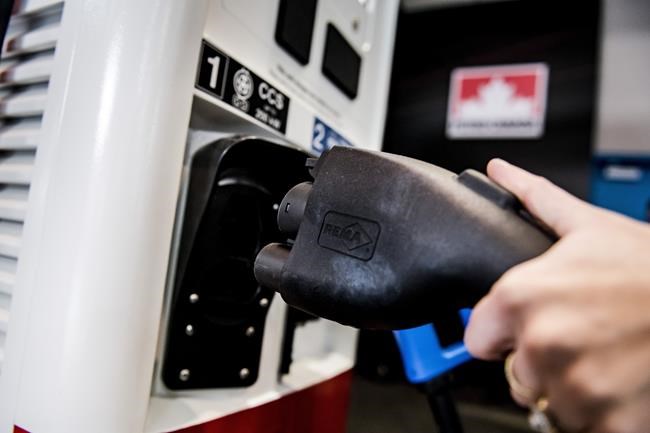
Petro-Canada's electric vehicle charging station is photographed while on display at the Canadian International Auto Show in Toronto on February 14, 2019. THE CANADIAN PRESS/Christopher Katsarov

“We haven’t done the planning and we haven’t put the investment into a charging network,” he said.

Canada is mandating EV sales — 50 per cent of new cars sold in 2030 and 100 per cent in 2035 — but nobody is taking the lead to make sure people know what that means for how much electricity, or how many charging stations, will be needed, he added.

The association represents three of Canada’s biggest automakers — Ford, GM and the new multinational Stellantis, formed earlier this year in a merger that now represents brands such as Dodge, Jeep and Chrysler.

Kingston said automakers are committed to the transition to electric — the three companies the association represents are investing US$100 billion in electrification over the next few years, with plans to bring 120 new EV models to the market.

But he said new models and more supply would solve only one piece of the electric transition, because if the charging networks don’t keep pace, people aren’t going to make the switch.

Or, even worse, they’re going to switch back, he said.

A study published in Nature Energy journal last spring said as many as one in five zero-emission vehicle owners went back to gas power because of inconvenient charging access.

“So I just use that as a caution to government that, you know, we better start planning this like tomorrow,” he said.

He argues Canada hasn’t done the planning and instead has a fractured response with very low ambitions compared to the rest of the world.

Canada currently has about 15,000 public or semi-private chargers available, and at least another 2,000 are in various stages of construction with public funding. Natural Resources Canada has another $180 million in the existing budget to build 17,000 or so more in the next three years.

The Liberals promised to spend another $700 million by 2026 to build an additional 50,000 new ones.

Kingston said to keep pace with Europe’s goal of having one public charger for every 10 EVs, Canada will need almost four million chargers by 2050. To get to California’s goal of one for every seven vehicles, that’s closer to six million needed in Canada.

An analysis done for Natural Resources Canada recently suggested Canada will need, on average, one charger for every 20 EVs by 2025 and, after more EVs roll on to streets, the ratio would fall to about one in every 49 vehicles by 2050.

“It’s obvious that we don’t have an ambitious enough plan to build charging infrastructure,” Kingston said, adding overbuilding is needed at first to encourage EV adoption.

The Natural Resources analysis also notes that longer term, it’s more likely that public chargers will need to be high-speed, capable of recharging a car in less than an hour.

The International Energy Agency said this year Canada has about 0.06 publicly available chargers for every EV on the road, ranking about 20th in the world, neck and neck with the United States as a whole.

In November, an Ernst and Young analysis of the EV readiness of the world’s 10 biggest auto markets said Canada was in the bottom three, largely because of low demand and a lacklustre charging system. China is on top, followed by Sweden and Germany.

Wilf Steimle, president of the Electric Vehicle Society, said charging is one of the biggest concerns raised by people thinking about making the switch.

“What owners care about is, by the time I’ve gone to the bathroom, and grab another cup of coffee, is my car ready to go, because I don’t want to stand there waiting for it for half an hour or so,” he said.

This report by The Canadian Press was first published Dec. 20, 2021.

Report Error Submit a Tip

More Stories

‘We got attacked’: Carney says retaliatory tariffs on U.S. to take effect next month

Catherine Morrison and David Baxter, The Canadian Press 7 minute read Preview

‘We got attacked’: Carney says retaliatory tariffs on U.S. to take effect next month

Catherine Morrison and David Baxter, The Canadian Press 7 minute read Updated: Yesterday at 3:46 PM CDT

OTTAWA - Prime Minister Mark Carney says retaliatory tariffs will hit the U.S. starting next month after Canada walked away from what he called a "bad deal."

The U.S. introduced new 50 per cent tariffs on billions of dollars in Canadian exports on Saturday after trade talks failed.

"We got attacked," Carney told reporters on Parliament Hill Saturday when asked about the escalating trade war.

Carney suspended talks with the United States late Friday and summoned his negotiators back to Ottawa.

Read
Updated: Yesterday at 3:46 PM CDT

Unresolved issues leave little space for you

Maureen Scurfield 5 minute read Yesterday at 2:00 AM CDT

DEAR MISS LONELYHEARTS: My boyfriend — who is newly divorced — has two great children from his marriage. Although he and I have been together since Christmas, it’s obvious he loves his kids much more than he loves me! For instance, he lavishes affection on the kids when they’re over and completely leaves me out. I’m just the cook and dish-washer for the night.

When I brought this up recently, he said, “My girlfriends don’t last, because if I’m openly affectionate with them, the kids tell their mother we’re making out in front of them! They want all my affection and attention when I’m with them.” Then he added, “Stick around, and the kids will probably loosen up.”

Stick around? The explanation and his “advice” totally turned me off. What do you think?

— Not Second-Best to Anyone, St. Vital

‘Strong sense of unity’

By Melissa Martin 6 minute read Preview

‘Strong sense of unity’

By Melissa Martin 6 minute read Yesterday at 5:14 PM CDT

Manitoba government and business leaders are rallying behind Prime Minister Mark Carney’s plan to fight back, after a sudden collapse of trade talks between the U.S. and Canada sparked a new salvo of U.S. tariffs on some Canadian goods.

On Saturday, after Carney vowed to respond with retaliatory tariffs, Manitoba premier Wab Kinew said his government stood “100 per cent” behind the prime minister’s plan to respond to what Kinew called U.S. president Donald Trump’s “unjustified and immoral” tariffs.

“History will not be kind to Donald Trump, so we should never appease him,” Kinew said. “We should fight back, which is what Canada is doing today.”

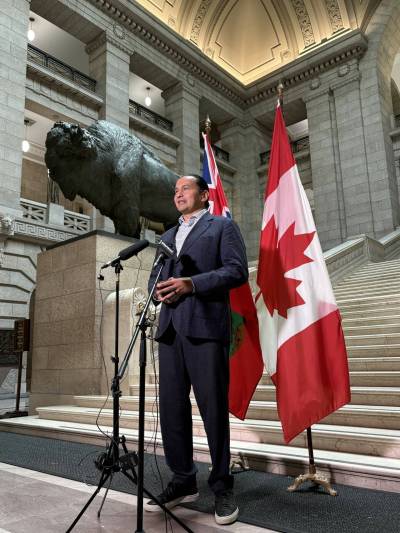
Kinew met reporters for a brief news conference at the legislature on Saturday afternoon, about an hour after finishing a call with Carney and the other premiers. There was a “really strong sense of unity” on that call, Kinew said, and emphasized that he backs the federal decision to “walk away from what would have been a bad deal.”

Read
Yesterday at 5:14 PM CDT

Wooed by wood, Cedarella founder takes pride in handcrafted designs

David Sanderson 7 minute read Preview

Wooed by wood, Cedarella founder takes pride in handcrafted designs

David Sanderson 7 minute read Yesterday at 6:00 AM CDT

Marina Bulan is the founder of Cedarella, a two-year-old venture that turns out eye-catching wood products such as jewelry, kitchen decor, children’s toys and, most recently, metre-high outdoor planters that double as home street-number indicators.

Ahead of immigrating to Winnipeg a decade ago from their native Russia, Bulan and her partner thought it would be prudent to conduct some research on their soon-to-be new home, a city they knew next to nothing about.

Imagine their surprise as they were viewing the 2007 surrealist film My Winnipeg, which comically blends historical facts about our burg with what Winnipeg-born writer/director Guy Maddin has termed “mystical hypothesizing.”

(For instance, there is no proof that, as reported in the award-winning flick, Winnipeg is the sleepwalking capital of the world, and that residents keep keys to their former abodes on their person in the event they turn up there during a bout of somnambulism.)

Read
Yesterday at 6:00 AM CDT

Residents fear mailbox crime sprees

Morgan Modjeski 4 minute read Preview

Residents fear mailbox crime sprees

Morgan Modjeski 4 minute read Yesterday at 2:01 AM CDT

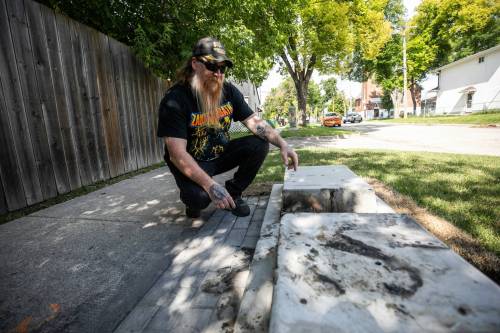
Some North End residents are concerned new community mailboxes will become a target for vandalism and crime after the base of one was recently lit ablaze — before it was even installed.

The community mailboxes started to show up on Andrews Street within the last two weeks. Some have been installed, while at other locations, only the concrete foundation is in place.

“They just dumped them on the boulevard,” said Stephen Giesbrecht, who lives beside one of the boxes in the St. John’s neighbourhood. “They dumped them on the corner and then they were gone.”

One of the concrete slabs has already played host to a fire and some of the hardware needed to install the mailbox melted.

Read
Yesterday at 2:01 AM CDT

Plenty of alternatives to U.S. wines on the shelves

Ben Sigurdson 5 minute read Preview

Plenty of alternatives to U.S. wines on the shelves

Ben Sigurdson 5 minute read Yesterday at 6:00 AM CDT

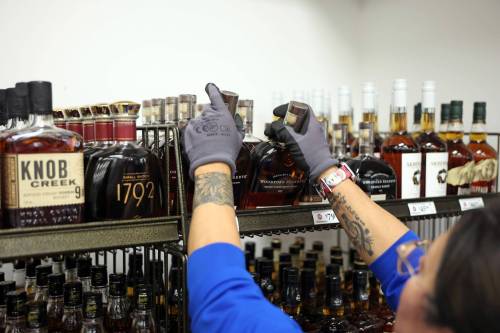
In February 2025, Manitoba (and most other provinces) pulled American liquor from store shelves as part of the ongoing trade dispute with the United States.

Then in December, the province followed a similar course to others and put American booze that was already on hand back on shelves, selling off inventory that had been wasting away in warehouses for months, and directing proceeds from those sales to charities.

Lineups sprung up at numerous stores as consumers snapped up bestselling American products — think Maker’s Mark, Jack Daniel’s, Apothic Red and the like. After that initial rush, what was left has been languishing on shelves ever since, with many products eventually being drastically discounted for a quick sale, lest they become too long in the tooth.

I decided early on not to write about/review U.S. products in this space until things were well and truly sorted. But a few months back, I found myself in the mood for a big, oaky red wine and — in a moment of weakness, or nostalgia, or maybe just curiosity — I picked up a $30-ish California Cabernet Sauvignon.

Read
Yesterday at 6:00 AM CDT