Biden administration moves to expand solar power on US land
Advertisement
Read this article for free:
or
Already have an account? Log in here »
To continue reading, please subscribe:

Digital Subscription
One year of digital access for only $205*
- Enjoy unlimited reading on winnipegfreepress.com
- Read the E-Edition, our digital replica newspaper
- Access News Break, our award-winning app
- Play interactive puzzles
*First annual payment billed as $205.00 + GST for one year. This annual subscription will automatically renew at $233.00 + GST every 52 weeks (10% off the regular annual price of $259.35). Offer available to new and qualified returning subscribers only. Cancel any time.
To continue reading, please subscribe:
Add Free Press access to your Brandon Sun subscription for only an additional
$1 for the first 4 weeks*
- Enjoy unlimited reading on winnipegfreepress.com
- Read the E-Edition, our digital replica newspaper
- Access News Break, our award-winning app
- Play interactive puzzles
*Your next Brandon Sun subscription payment will increase by $1.00 and you will be charged $17.95 plus GST for four weeks. After four weeks, your payment will increase to $24.95 plus GST every four weeks.
Read unlimited articles for free today:
or
Already have an account? Log in here »
Hey there, time traveller!
This article was published 21/12/2021 (1733 days ago), so information in it may no longer be current.
BILLINGS, Mont. (AP) — U.S. officials announced approval Tuesday of two large-scale solar projects in California and moved to open up public lands in other Western states to potential solar power development, as part of the Biden administration’s effort to counter climate change by shifting from fossil fuels.
The Interior Department approved the Arica and Victory Pass solar projects on federal land in Riverside County east of Los Angeles. Combined they would generate up to 465 megawatts of electricity, or enough to power about 132,000 homes, according to San Francisco-based developer Clearway Energy. Approval of a third solar farm planned for 500 megawatts is expected in coming days, officials said.
The Interior Department also Tuesday issued a call to nominate land for development within “solar energy zones” in Colorado, Nevada and New Mexico that combined cover about 140 square miles (360 square kilometers).
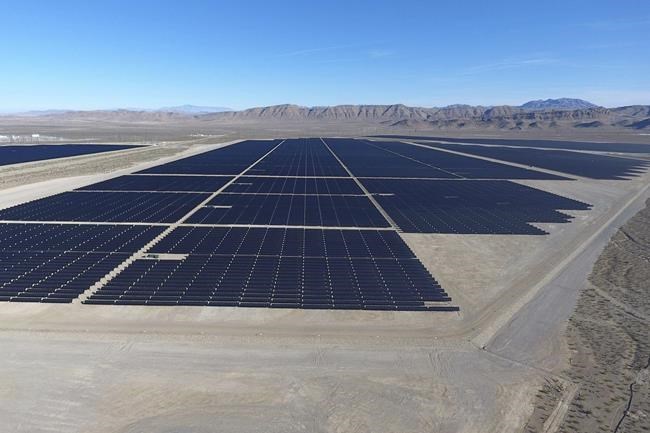
The invitation to developers comes as officials under Democratic President Joe Biden promote renewable wind and solar power on public lands and offshore to reduce greenhouse gas emissions that are warming the planet. That’s a pronounced change from Republican President Donald Trump’s emphasis on coal mining and oil and gas drilling.
Biden suffered a huge blow to his climate agenda this week, as opposition from West Virginia Democrat Sen. Joe Manchin tanked the administration’s centerpiece climate and social services legislation. The administration also has been forced to resume oil and natural gas lease sales in the Gulf of Mexico and numerous western states, after a federal judge sided with Republican-led states that sued when Biden suspended the sales.
During a Tuesday conference call with reporters, Interior Secretary Deb Haaland did not directly address a question about the faltering climate bill and instead pointed to clean energy provisions in the bipartisan infrastructure bill signed into law last month.
“We fully intend to meet our clean energy goals,” Haaland said. She said the Trump administration stalled clean energy by shuttering renewable energy offices at the Bureau of Land Management and undermining long-term agreements, such as a conservation plan tied to solar development in the California desert.
“We are rebuilding that capacity,” Haaland said.
But without the climate bill, tax incentives to build large-scale solar will drop to 10% of a developer’s total capital costs by 2024, instead of rising to 30%, said Xiaojing Sun, head solar researcher at industry consulting firm Wood Mackenzie.
Incentives for residential-scale solar would go away completely by 2024, she said.
“It will significantly slow down the growth of solar,” Sun said.
However, she added that streamlining access to federal land could help the industry, as large solar farms on non-federal lands face growing local opposition and cumbersome zoning laws.
The Bureau of Land Management oversees almost a quarter-billion acres of land, primarily in Western states. Agency director Tracy-Stone Manning said boosting renewable energy is now one of its top priorities.
Forty large-scale solar proposals in the West are under consideration, she said.
The agency in early December issued a draft plan to reduce rents and other fees paid by companies authorized to build wind and solar projects on public lands. Officials were unable to provide an estimate of how much money that could save developers.
In Nevada, where the federal government owns and manages more than 80% of the state’s land, large-scale solar projects have faced opposition from environmentalists concerned about harm to plants and animals in the sun- and windswept deserts.
Developers abandoned plans for what would have been the country’s largest solar panel installation earlier this year north of Las Vegas amid concerns from local residents. Environmentalists are fighting another solar project near the Nevada-California border that they claim could harm birds and desert tortoises.
Stone-Manning said solar projects on public lands are being sited to take environmental concerns into account.
The solar development zones were first proposed under the Obama administration, which in 2012 adopted plans to bring utility-scale solar energy projects to public lands in Arizona, California, Colorado, Nevada, New Mexico and Utah. Officials have identified almost 1,400 square miles (3,500 square kilometers) of public land for potential leasing for solar power.
If all that land were developed, the bureau says it could support more than 100 gigawatts of solar power, or enough for 29 million homes.
That’s almost equal to all U.S. solar capacity now in place.
The power generation capacity of solar farms operating on federal lands is a small fraction of that amount — just over 3 gigawatts, federal data shows.

In November the land bureau awarded solar leases for land in Utah’s Milford Flats solar zone. Solar leases are expected to be finalized by the end of the month for about land at several sites in Arizona.
Solar power on public and private lands accounted for about 3% of total U.S. electricity production in 2020. After construction costs fell during the past decade, that figure is expected to grow sharply, to more than 20% by 2050, the U.S. Energy Information Administration projects.
Developers warn costs have been rising due to constraints on supplies of steel, semiconductor chips and other materials.
___
Associated Press writer Sam Metz in Carson City, Nevada, contributed to this report.