Coast Guard retiring key ocean science vessel, replacement delayed yet again

Advertisement

Advertise with us

OTTAWA - The federal government is being forced to retire one of the Canadian Coast Guard’s important science vessels, dealing a blow to the country’s ocean research capabilities for at least the next few years.

Read this article for free:


or

Already have an account? Log in here »

To continue reading, please subscribe:

Subscribe and receive a limited-edition Free Press branded hat or tote.

Digital Subscription

One year of digital access for only $205*

  • Enjoy unlimited reading on winnipegfreepress.com
  • Read the E-Edition, our digital replica newspaper
  • Access News Break, our award-winning app
  • Play interactive puzzles

*First annual payment billed as $205.00 + GST for one year. This annual subscription will automatically renew at $233.00 + GST every 52 weeks (10% off the regular annual price of $259.35). Offer available to new and qualified returning subscribers only. Cancel any time.

To continue reading, please subscribe:

Add Free Press access to your Brandon Sun subscription for only an additional

$1 for the first 4 weeks*

  • Enjoy unlimited reading on winnipegfreepress.com
  • Read the E-Edition, our digital replica newspaper
  • Access News Break, our award-winning app
  • Play interactive puzzles
Start now

*Your next Brandon Sun subscription payment will increase by $1.00 and you will be charged $17.95 plus GST for four weeks. After four weeks, your payment will increase to $24.95 plus GST every four weeks.

Hey there, time traveller!
This article was published 19/01/2022 (1671 days ago), so information in it may no longer be current.

OTTAWA – The federal government is being forced to retire one of the Canadian Coast Guard’s important science vessels, dealing a blow to the country’s ocean research capabilities for at least the next few years.

The Canadian Coast Guard announced Wednesday that age had finally caught up to the 59-year-old CCGS Hudson, and the ocean research science vessel is being decommissioned even though a replacement will not be ready until at least 2025.

The difficult decision came after one of the ship’s motors broke last November and officials determined it was too expensive to both repair it and upgrade other outdated parts of the vessel to meet new regulations.
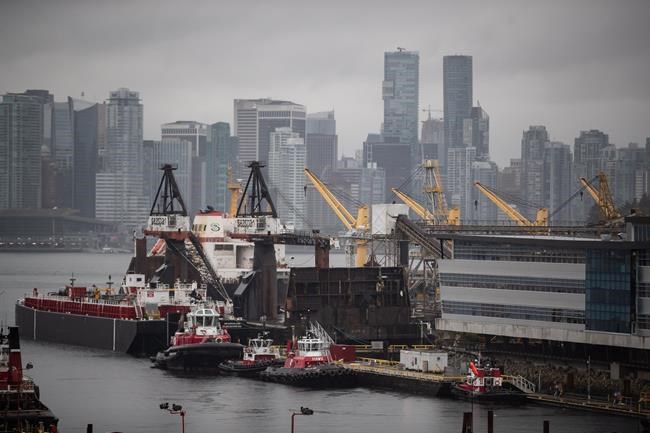
Vessels are seen docked at Seaspan Shipyards in North Vancouver, B.C., Friday, Oct. 9, 2020. The federal government says it is being forced to retire one of the country's most important science vessels, even as work on its replacement has hit yet another snag. THE CANADIAN PRESS/Darryl Dyck

The breakdown was the latest in a series of problems for the coast guard’s oldest serving ship, which had undergone millions of dollars in repairs and retrofits in recent years in a desperate attempt to keep it in the water.

Those investments were made necessary after several delays in the delivery of a replacement offshore oceanographic science vessel from Seaspan Shipyards in Vancouver, which was originally supposed to finish the new vessel in 2017.

Aside from the delays, the new vessel has been the subject of numerous cost overruns. The Canadian Press reported in the summer that the original $108-million budget had ballooned to nearly $1 billion.

The Canadian Coast Guard is now scrambling to find alternatives to conduct what it has previously described as “vital” research of Canada’s oceans, which has become even more important due to concerns about climate change.

“The Canadian Coast Guard is working closely with Fisheries and Oceans Canada to evaluate the near- and long-terms impacts on programming and developing a plan to mitigate these impacts,” the agency said in a statement.

“Discussions are focused on which parts of the science program can be completed by other Canadian Coast Guard vessels, by chartered vessels, or through the use of other technology.”

University of Calgary shipbuilding expert Timothy Choi said the loss of the Hudson before its replacement is ready will leave a gap, though it’s too early to tell how significant the damage will be.

“For sure, our offshore research capacity outside the Arctic will be hindered, though that depends on what alternative solutions they’re able to find in the interim,” he said.

The Hudson is only the latest federal ship to have been retired before a replacement is ready thanks to delays across much of the government’s federal shipbuilding strategy.

The Royal Canadian Navy has been operating without any destroyers since 2017, with the first replacement not expected until at least 2032. Those new vessels will also replace the navy’s 12 Halifax-class frigates.

The navy has also been forced to lease a converted civilian ship for the past few years as a support vessel since retiring its own vessels in 2014. Seaspan is currently working on two permanent replacements, which have experienced their own delays.

Seaspan had recently promised to deliver the first new support ship in 2023, and the second in 2025 after finishing the Hudson’s replacement. However, that already tenuous schedule now appears up in the air.

“Seaspan is doing a delicate dance,” said Jeff Collins, an expert on military procurement at the University of Prince Edward Island.

“Any slippage on their part further delays replacement and risks driving up costs, especially in this inflationary period … Schedule is king with the (federal shipbuilding strategy), and especially for Seaspan.”

This report by The Canadian Press was first published Jan. 19, 2022.

Report Error Submit a Tip

More Stories

RCMP searching for missing woman from Split Lake

1 minute read Saturday, Aug. 15, 2026

Thompson RCMP are asking for help from the public to find a 37-year-old woman who has not been heard from since late July.

Melanie Beardy, from Split Lake First Nation, was last in contact on July 26, said an RCMP news release Saturday. Beardy, who was in Thompson, was reported missing last Sunday and RCMP said both police and her family are worried for her well-being.

Attempts to find Beardy have been unsuccessful, said RCMP.

She’s described as 5’4 with a large build and long, black hair usually worn in a ponytail, said Mounties. She has a tattoo on her chest that reads: “Elvis,” and has a tattoo of a dreamcatcher on her left forearm.

Opera group hits pub to stage shows for sophisticated palates

Conrad Sweatman 3 minute read Preview

Opera group hits pub to stage shows for sophisticated palates

Conrad Sweatman 3 minute read 2:00 AM CDT

Opera’s famous drinking songs — La Traviata’s Brindisi, Don Giovanni’s Fin ch’han dal vino, Carmen’s Votre Toast — tend to flow with references to women and wine, not beer.

But that hasn’t stopped Winnipeggers from sipping 1919s or Generics at local bar and brewery Little Brown Jug over the past few years to the strains of Verdi, Puccini and Mozart.

Currently in its eighth season, Opera by the Pint has its next LBJ event Wednesday at 7 p.m. (The artists also perform at the Public Brewhouse and Gallery in Steinbach at 7 p.m. on Thursday.)

This week’s program focuses on musical hits, while also featuring traditional Filipino ballads and Mexican art songs.

Read
2:00 AM CDT

‘You vote with your bike’: cyclists celebrate freedoms, call for increased safety

Maggie Macintosh 5 minute read Preview

‘You vote with your bike’: cyclists celebrate freedoms, call for increased safety

Maggie Macintosh 5 minute read Updated: Yesterday at 4:20 PM CDT

Patty Wiens got dressed up in her sparkly, hot pink cowboy boots to pedal and talk politics with more than 100 other people on Sunday.

The founder of Winnipeg’s Fancy Women Bike Ride called on attendees of the 2026 event to ask candidates in the upcoming civic election — a half-dozen of whom were in attendance — about their active transportation platforms.

“We’re here today, in an election year, to remind you that you vote with your bike,” Wiens told a crowd of nearly 120 cyclists gathered on the legislature grounds for the group ride.

“When (city council) candidates come to your door and ask what’s important to you, you’re going to say, ‘I want to ride my bike safely in the city. What are you going to do about it?’”

Read
Updated: Yesterday at 4:20 PM CDT

Men’s recovery home dedicated to ‘homeless hero’ Faron Hall’s memory

Scott Billeck 14 minute read Preview

Men’s recovery home dedicated to ‘homeless hero’ Faron Hall’s memory

Scott Billeck 14 minute read Friday, Aug. 14, 2026

Faron Hall never got the chance to begin recovery. Once heralded as Winnipeg’s “homeless hero” after twice plunging into the Red River to save strangers from drowning, Hall told St. Boniface Street Links executive director Marion Willis shortly before his death in 2014 that he wanted help for his alcoholism.

Read
Friday, Aug. 14, 2026

Take advantage of hydroelectric potential

Jerry Storie 5 minute read Preview

Take advantage of hydroelectric potential

Jerry Storie 5 minute read 2:00 AM CDT

Manitoba Hydro tells us that we are going to need significant new electricity generation over the coming decades.

Hydro, like every other utility in the world has recognized this fact. Around the world, new generating capacity is being built. Countries that have access to hydroelectric potential are building dams and planning for the future. Other countries, without the natural advantage rivers provide, are building nuclear energy capacity. And yes, in almost all those countries solar and wind generating capacity are being developed as quickly as possible.

All that additional energy capacity is needed to fuel our endless need for technology, data storage and a thousand other things. Quickly moving to electric vehicles from combustion engines will also drive up demand.

Although it is tempting to think that ever larger and better battery storage will help, it will only help in how energy is distributed. The introduction of more and better battery storage is not likely to limit the total demand for energy. The enthusiasm for battery storage is understandable, but it is certainly possible that battery storage will effectively increase our use of energy, simply because it can be so reliably accessed from our battery storage systems.

Read
2:00 AM CDT

A better approach, but not yet enough

Editorial 4 minute read Preview

A better approach, but not yet enough

Editorial 4 minute read 2:00 AM CDT

In late June, when the Winnipeg Police Service launched a 10-day ‘crackdown’ on open drug use and illegal drug sales in areas in and around downtown, it did so without consulting or informing community outreach and social services agencies working in the targeted areas.

Inevitably, the WPS action drew criticism from several front-line agencies, which issued a collective statement just two days after the police operation began, pointing out that heavy-handed policing would drive vulnerable people away from the help they desperately need.

“Every day we work to build trust with people who have experienced trauma, discrimination, and barriers to care,” Kate Sjoberg, executive director of Resource Assistance for Youth, said at the time. “Actions that create fear around accessing services can undo months or years of relationship-building and place people at greater risk of preventable harm.”

At the time, WPS Chief Gene Bowers held up his hand and said, “That’s on me.”

Read
2:00 AM CDT