Heat wave scorches India’s wheat crop, snags export plans

Advertisement

Advertise with us

NEW DELHI (AP) — An unusually early, record-shattering heat wave in India has reduced wheat yields, raising questions about how the country will balance its domestic needs with ambitions to increase exports and make up for shortfalls due to Russia's war in Ukraine.

Read this article for free:


or

Already have an account? Log in here »

To continue reading, please subscribe:

Subscribe and receive a limited-edition Free Press branded hat or tote.

Digital Subscription

One year of digital access for only $205*

  • Enjoy unlimited reading on winnipegfreepress.com
  • Read the E-Edition, our digital replica newspaper
  • Access News Break, our award-winning app
  • Play interactive puzzles

*First annual payment billed as $205.00 + GST for one year. This annual subscription will automatically renew at $233.00 + GST every 52 weeks (10% off the regular annual price of $259.35). Offer available to new and qualified returning subscribers only. Cancel any time.

To continue reading, please subscribe:

Add Free Press access to your Brandon Sun subscription for only an additional

$1 for the first 4 weeks*

  • Enjoy unlimited reading on winnipegfreepress.com
  • Read the E-Edition, our digital replica newspaper
  • Access News Break, our award-winning app
  • Play interactive puzzles
Start now

*Your next Brandon Sun subscription payment will increase by $1.00 and you will be charged $17.95 plus GST for four weeks. After four weeks, your payment will increase to $24.95 plus GST every four weeks.

Hey there, time traveller!
This article was published 28/04/2022 (1606 days ago), so information in it may no longer be current.

NEW DELHI (AP) — An unusually early, record-shattering heat wave in India has reduced wheat yields, raising questions about how the country will balance its domestic needs with ambitions to increase exports and make up for shortfalls due to Russia’s war in Ukraine.

Gigantic landfills in India’s capital New Delhi have caught fire in recent weeks. Schools in eastern Indian state Odisha have been shut for a week and in neighboring West Bengal, schools are stocking up on oral rehydration salts for kids. On Tuesday, Rajgarh, a city of over 1.5 million people in central India, was the country’s hottest, with daytime temperatures peaking at 46.5 degrees Celsius (114.08 Fahrenheit). Temperatures breached the 45 C (113 F) mark in nine other cities.

But it was the heat in March — the hottest in India since records first started being kept in 1901 — that stunted crops. Wheat is very sensitive to heat, especially during the final stage when its kernels mature and ripen. Indian farmers time their planting so that this stage coincides with India’s usually cooler spring.
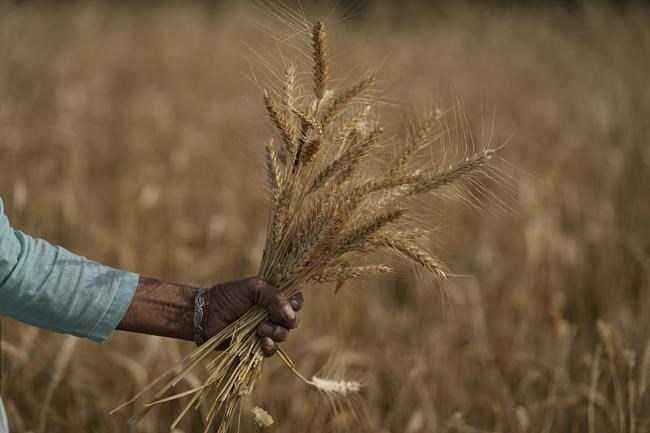
A woman harvests wheat on the outskirts of Jammu, India, Thursday, April 28, 2022. An unusually early, record-shattering heat wave in India has reduced wheat yields, raising questions about how the country will balance its domestic needs with ambitions to increase exports and make up for shortfalls due to Russia's war in Ukraine. (AP Photo/Channi Anand)

Climate change has made India’s heat wave hotter, said Friederike Otto, a climate scientist at the Imperial College of London. She said that before human activities increased global temperatures, heat waves like this year’s would have struck India once in about half a century.

“But now it is a much more common event — we can expect such high temperatures about once in every four years,” she said.

India’s vulnerability to extreme heat increased 15% from 1990 to 2019, according to a 2021 report by the medical journal The Lancet. It is among the top five countries where vulnerable people, like the old and the poor, have the highest exposure to heat. It and Brazil have the the highest heat-related mortality in the world, the report said.

Farm workers like Baldev Singh are among the most vulnerable. Singh, a farmer in Sangrur in northern India’s Punjab state, watched his crop shrivel before his eyes as an usually cool spring quickly shifted to unrelenting heat. He lost about a fifth of his yield. Others lost more.

“I am afraid the worst is yet to come,” Singh said.

Punjab is India’s “grain bowl” and the government has encouraged cultivation of wheat and rice here since the 1960s. It is typically the biggest contributor to India’s national reserves and the government had hoped to buy about a third of this year’s stock from the region. But government assessments predict lower yields this year, and Devinder Sharma, an agriculture policy expert in northern Chandigarh city. said he expected to get 25% less.

The story is the same in other major wheat-producing states like Uttar Pradesh and Madhya Pradesh.

Overall, India purchased over 43 million metric tons (47.3 million U.S. tons) of wheat in 2021. Sharma estimates it will instead get 20% to nearly 50% less.

Even though it is the world’s second-largest producer of wheat, India exports only a small fraction of its harvest. It had been looking to capitalize on the global disruption to wheat supplies from Russia’s war in Ukraine and find new markets for its wheat in Europe, Africa, and Asia.

That looks uncertain given the tricky balance the government must maintain between demand and supply. It needs about 25 million tons (27.5 million U.S. tons) of wheat for the vast food welfare program that usually feeds more than 80 million people.

Before the pandemic, India had vast stocks that far exceeded its domestic needs — a buffer against the risk of famine.
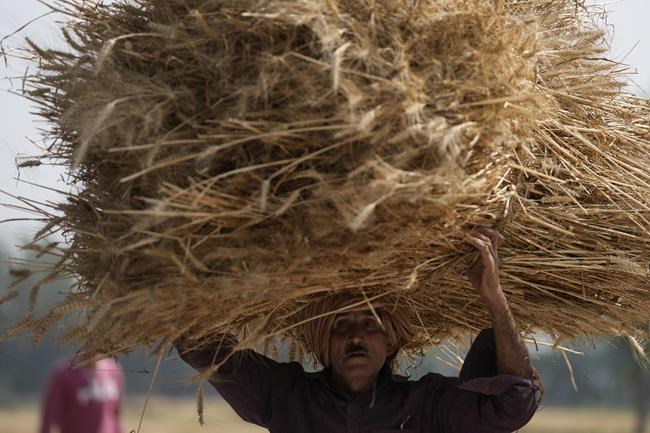
A farmer carries wheat crop after harvested on the outskirts of Jammu, India, Thursday, April 28, 2022. An unusually early, record-shattering heat wave in India has reduced wheat yields, raising questions about how the country will balance its domestic needs with ambitions to increase exports and make up for shortfalls due to Russia's war in Ukraine. (AP Photo/Channi Anand)

Those reserves have been strained, Sharma said, by distribution of free grain during the pandemic to about 800 million people — vulnerable groups like migrant workers. The program was extended until September but it’s unclear if it will continue beyond then.

“We are no longer with that kind of a surplus . . . with exports now picking up, there would be a lot of pressure on the domestic availability of wheat,” Sharma said.

India’s federal agriculture and commerce ministries didn’t respond to questions sent to them via email.

Beyond India, other countries are also grappling with poor harvests that hinder their ability to help offset the potential shortfall of supplies from Russia and Ukraine, normally the world’s largest and fifth-largest exporters of wheat.

China’s agriculture minister, Tang Renjian, said last month that the winter wheat harvest was likely to be poor, hindered by flooding and by delays in planting.

___

The Associated Press Health and Science Department receives support from the Howard Hughes Medical Institute’s Department of Science Education. The AP is solely responsible for all content.

Report Error Submit a Tip

More Stories

Desperate Poilievre wants Canadians to believe the sky is falling when it’s just cloudy outside

Tom Brodbeck 5 minute read Preview

Desperate Poilievre wants Canadians to believe the sky is falling when it’s just cloudy outside

Tom Brodbeck 5 minute read Friday, Sep. 18, 2026

Pierre Poilievre has a problem.

Canadians just don’t seem to be paying much attention to him anymore.

So, naturally, the Conservative Opposition leader has decided to turn up the volume.

At a recent party caucus retreat in Penticton, B.C., Poilievre delivered the familiar message: Canada is in trouble, Canadians are hurting and the Liberal government is making everything worse.

Read
Friday, Sep. 18, 2026

Former Bombers linebacker Gauthier enjoying career as electrician

Taylor Allen 6 minute read Preview

Former Bombers linebacker Gauthier enjoying career as electrician

Taylor Allen 6 minute read Friday, Sep. 18, 2026

Most professional football players don’t ride off into the sunset on their own terms.

Shayne Gauthier was well aware of that, but it didn’t make it sting any less when the Winnipeg Blue Bombers informed the veteran linebacker that they weren’t bringing him back for 2026.

“I was really hoping to play one more (season) because it would have been my 10th season, so, I’d say it didn’t really end the way I wanted,” Gauthier recently told the Free Press.

“It left a little sour taste in my mouth, but that’s part of pro sports. If everybody got the ending that they wanted, then it wouldn’t really work.”

Read
Friday, Sep. 18, 2026

A quick look at where provinces and territories stand on time changes

The Canadian Press 2 minute read Preview

A quick look at where provinces and territories stand on time changes

The Canadian Press 2 minute read Friday, Sep. 18, 2026

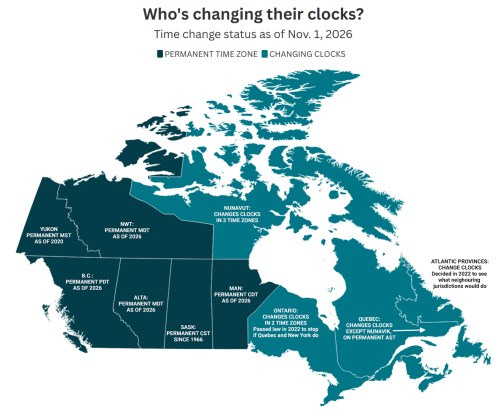
WINNIPEG - Manitoba's government said Thursday the province will be sticking with daylight time year-round, making it the latest jurisdiction to move away from twice-annual time changes. Here's a look at where things stand across Canada:

British Columbia said in March that it was moving to permanent Pacific daylight time. The change also means that parts of northeastern B.C., which have been on mountain standard time year round, are now in alignment with the rest of the province.

Alberta also switched to permanent daylight time this year in what it calls Alberta time. The change means it now has the same time as Saskatchewan year round.

Saskatchewan has been on permanent central standard time since 1966.

Read
Friday, Sep. 18, 2026

American Hostage stars recall warmth of Winnipeggers during brutal winter

Randall King 7 minute read Preview

American Hostage stars recall warmth of Winnipeggers during brutal winter

Randall King 7 minute read Friday, Sep. 18, 2026

TORONTO — When you stream the eight-part series American Hostage, a sense of familiarity may strike.

That’s because the show was shot in Winnipeg — especially in the Exchange District — from November of last year to the beginning of February, with Winnipeg portraying Indianapolis circa 1977.

The whole world seemed to be watching that midwest American city that year as a hostage crisis unfolded involving one Tony Kiritsis, an angry man who goes ballistic when a mortgage brokerage was poised to foreclose on property he had dreamed of developing into a shopping centre.

Kiritsis kidnapped his mortgage broker, Richard Hall, wiring a shotgun to the back of his head, and demanded a public airing of his grievances, with the reluctant help of popular radio broadcaster Fred Heckman.

Read
Friday, Sep. 18, 2026

Not falling back means time loop remains unclosed

Jen Zoratti 4 minute read Yesterday at 2:01 AM CDT

I demand restitution. Where’s my hour?

In the traditional fall-back, spring-forward time change set up — you know, ol’ trusty that’s been effect for lo these 63 years — we lost an hour in the spring that we got back in the fall.

That was the social contract: you commit to feeling like you’re on cold medication for a week in March because you know a glorious extra hour of sleep will be returned to you in November. (Unless, of course, you have little kids, but look: we all make our choices.)

Well, that transaction, flawed as it was, isn’t happening this year. That hour you sacrificed to the sun gods in the spring? Gone. Not coming back. We’ve sprung forward and we shan’t be falling back — not in November, and (possibly) not ever. The scale shall remain unbalanced and the loop shall remain unclosed as Manitoba has adopted permanent daylight time.

Klein has burned bridges with PM, Gillingham says

Joyanne Pursaga 3 minute read Preview

Klein has burned bridges with PM, Gillingham says

Joyanne Pursaga 3 minute read Friday, Sep. 18, 2026

One mayoral candidate accused another of writing a column so critical it could compromise his ability to work with the federal government.

Read
Friday, Sep. 18, 2026