UN talks on a treaty to end global plastic pollution open in Paris

Advertisement

Advertise with us

PARIS (AP) — A United Nations committee met in Paris Monday to work on what is intended to be a landmark treaty to bring an end to global plastic pollution, but there is little agreement yet on what the outcome should be.

Read this article for free:


or

Already have an account? Log in here »

To continue reading, please subscribe:

Subscribe and receive a limited-edition Free Press branded hat or tote.

Digital Subscription

One year of digital access for only $205*

  • Enjoy unlimited reading on winnipegfreepress.com
  • Read the E-Edition, our digital replica newspaper
  • Access News Break, our award-winning app
  • Play interactive puzzles

*First annual payment billed as $205.00 + GST for one year. This annual subscription will automatically renew at $233.00 + GST every 52 weeks (10% off the regular annual price of $259.35). Offer available to new and qualified returning subscribers only. Cancel any time.

To continue reading, please subscribe:

Add Free Press access to your Brandon Sun subscription for only an additional

$1 for the first 4 weeks*

  • Enjoy unlimited reading on winnipegfreepress.com
  • Read the E-Edition, our digital replica newspaper
  • Access News Break, our award-winning app
  • Play interactive puzzles
Start now

*Your next Brandon Sun subscription payment will increase by $1.00 and you will be charged $17.95 plus GST for four weeks. After four weeks, your payment will increase to $24.95 plus GST every four weeks.

Hey there, time traveller!
This article was published 29/05/2023 (1220 days ago), so information in it may no longer be current.

PARIS (AP) — A United Nations committee met in Paris Monday to work on what is intended to be a landmark treaty to bring an end to global plastic pollution, but there is little agreement yet on what the outcome should be.

The Intergovernmental Negotiating Committee for Plastics is charged with developing the first international, legally binding treaty on plastic pollution, including in the marine environment. This is the second of five meetings due to take place to complete the negotiations by the end of 2024.

At the first meeting, held six months ago in Uruguay, some countries pressed for global mandates, some for national solutions and others for both.
FILE -
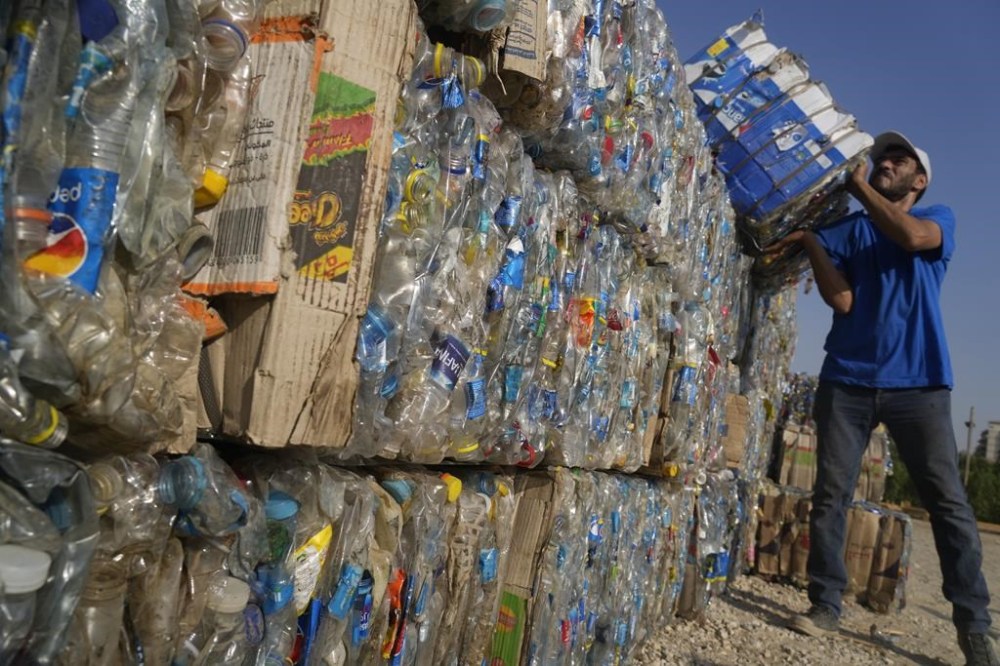
FILE - "Verynile" initiative worker carries compressed plastic bottles which were collected by volunteers and fishermen from the Nile to build a Plastic Pyramid ahead of World Cleanup Day in Cairo, Egypt, Thursday, Sept. 15, 2022 The pyramid aiming to raise awareness on plastic pollution in the Nile. Negotiators from around the world gather at UNESCO in Paris on Monday, May 29, 2023, for a second round of talks aiming toward a global treaty on fighting plastic pollution in 2024. (AP Photo/Amr Nabil,File)

Because it’s an extremely short timeline for treaty negotiations, experts say that in this second session it’s critical that decisions are made about the objectives and scope of the text — such as what kind of plastics it will focus on. But that is easier said than done. Over 2,000 participants, including governments and observers, from nearly 200 countries have descended on the meeting hosted at the Paris-based U.N. cultural agency, UNESCO.

One fundamental issue being considered Monday is the system of voting on decisions for each nation, which has already produced lively debate and delays in the plenary sessions that are due to end Friday.

Humanity produces more than 430 million tons of plastic annually, two-thirds of which are short-lived products that soon become waste, filling the ocean and, often, working their way into the human food chain, the United Nations Environment Program said in April. Plastic waste produced globally is set to almost triple by 2060, with about half ending up in landfill and under a fifth recycled, according to the Organization for Economic Cooperation and Development.

The treaty could focus on human health and the environment, as desired by the self-named “high ambition coalition” of countries, led by Norway and Rwanda, with limits on plastic production and restrictions on some of the chemicals used in plastics. The coalition is committed to an international, legally binding instrument to end plastic pollution by 2040. It says that this is necessary to protect human health and the environment while helping to restore biodiversity and curb climate change.

Alternatively, the treaty could have a more limited scope to address plastic waste and scale up recycling, as some of the plastic-producing and oil and gas exporters want. Most plastic is made from fossil fuels. Countries supporting this plan include the United States, Saudi Arabia and China. The U.S. delegation in Uruguay said national plans would allow governments to prioritize the most important sources and types of plastic pollution. Many plastics and chemical companies want this approach, too, with a plastic waste treaty that prioritizes recycling.

The International Council of Chemical Associations, the World Plastics Council, the American Chemistry Council and other companies that make, use and recycle plastics say they want an agreement that eliminates plastic pollution while “retaining the societal benefits of plastics.” They’re calling themselves the “global partners for plastics circularity.” They say that modern plastic materials are used around the world to create essential and often life-saving products, many of which are critical to a lower-carbon, more sustainable future.

Joshua Baca, vice president of plastics at the American Chemistry Council, said countries are so different “a one-size fits all approach won’t be effective, equitable, or implementable. Instead, the agreement should require national action plans as that will most effectively eliminate plastic pollution specific to a country’s situation.”

The International Pollutants Elimination Network, or IPEN, wants a treaty that restricts chemicals used to make plastic that are harmful to human health and the environment.

“To focus on plastic waste in this treaty would be a failure because you have to look at plastic production to solve the crisis — including the extraction of fossil fuels and the toxic chemical additives,” said Dr. Tadesse Amera, the network’s co-chair.
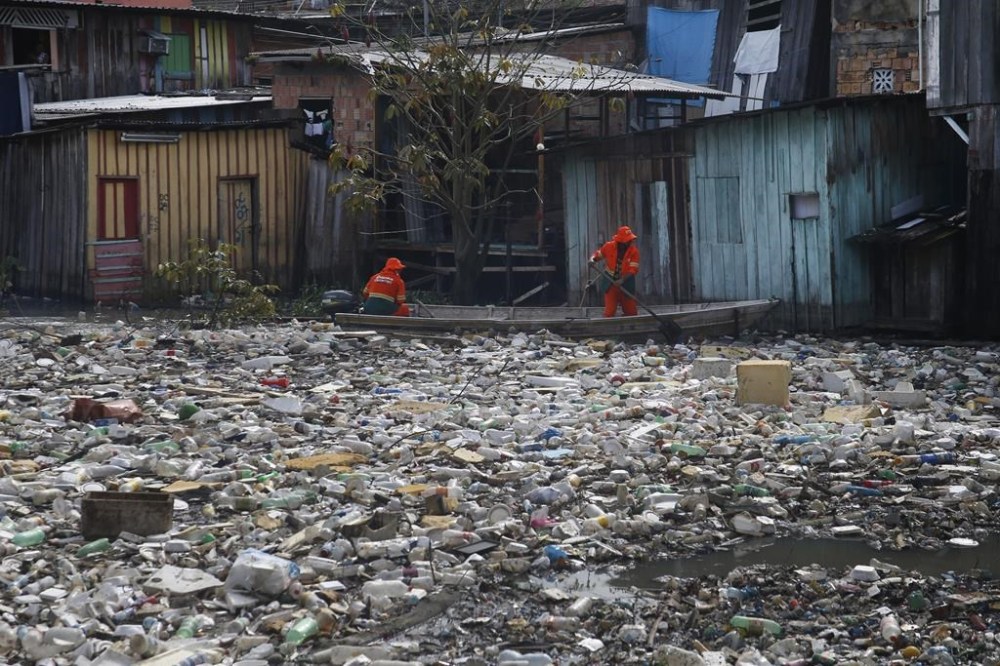
FILE - City workers remove garbage floating on the Negro River, which has a rising water level due to rain, in Manaus, Amazonas state, Brazil, Monday, June 6, 2022. Negotiators from around the world gather at UNESCO in Paris on Monday, May 29, 2023 for a second round of talks aiming toward a global treaty on fighting plastic pollution in 2024. (AP Photo/Edmar Barros, File)

IPEN’s international coordinator, Björn Beeler, said countries need to make a plan by the end of this week to write up an initial draft of the treaty text so it can be negotiated at the third meeting.

“If there’s no text to negotiate, you’re just continuing to share ideas,” he said. “Then because of the timeline, we could be looking at an early failure.”

___

McDermott reported from Providence, Rhode Island.

___

Associated Press climate and environmental coverage receives support from several private foundations. See more about AP’s climate initiative here. The AP is solely responsible for all content.

Report Error Submit a Tip

More Stories

Obsessed stalker who shot, killed young woman at bus stop in 1993 dies behind bars at age 74

Erik Pindera 3 minute read Preview

Obsessed stalker who shot, killed young woman at bus stop in 1993 dies behind bars at age 74

Erik Pindera 3 minute read Yesterday at 5:53 PM CDT

A Winnipeg man who stalked a woman for several years before shooting her dead in the street in 1993 has died in Stony Mountain prison.

On Monday, 74-year-old Ronald Edd Bell died of apparent natural causes at the federal prison just north of Winnipeg, the Correctional Service of Canada said.

Bell had been in prison since May 30, 1994, when he was given a life sentence with no chance of parole for 18 years for killing Terry-Lyn Babb, 25, on Jan. 21, 1993.

Bell walked up behind an unsuspecting Babb, who was waiting at a bus stop at Sherbrook Street and Wolseley Avenue, and shot her in the head with a pistol in front of horrified witnesses, says the Free Press report of his sentencing hearing.

Read
Yesterday at 5:53 PM CDT

Now-independent ex-Tory leader skips legislature’s first question period in four months

Chris Kitching 5 minute read Preview

Now-independent ex-Tory leader skips legislature’s first question period in four months

Chris Kitching 5 minute read Yesterday at 6:03 PM CDT

Crime rates, the cost of living and the state of health care were on the agenda Tuesday when the legislature’s fall sitting began a day after Obby Khan’s abrupt resignation from the Tory caucus.

Read
Yesterday at 6:03 PM CDT

Acquisition of former residential school grounds will help educate future generations: premier

Connor McDowell and Morgan Modjeski 6 minute read Preview

Acquisition of former residential school grounds will help educate future generations: premier

Connor McDowell and Morgan Modjeski 6 minute read Yesterday at 8:31 PM CDT

Premier Wab Kinew says a former Brandon-area campground acquired by the province will help educate future generations about the horrors of residential schools.

“We live in an era where people are trying to deny what happened in residential schools,” Kinew said during a Tuesday afternoon visit to Turtle Crossing Campground, near the former Brandon Indian Residential School. “It’s an important part of our national history, and keeping that truth alive.”

Kinew officially announced the province’s plan Tuesday, in partnership with the City of Brandon, to acquire and protect the site where the bodies of more than 50 Indigenous children are located.

The premier said the property has “huge national significance” for education about residential school history because it is one of the “most documented” in the country. He carried photographs, and some 20th century newspaper clippings from the Brandon Sun around the site Tuesday.

Read
Yesterday at 8:31 PM CDT

Orange Shirt Day project fits students to a tee

Maggie Macintosh 5 minute read Preview

Orange Shirt Day project fits students to a tee

Maggie Macintosh 5 minute read Monday, Sep. 28, 2026

On the eve of Orange Shirt Day, hundreds of black T-shirts will be handed out to teenagers at Elmwood High School — and there wasn’t a mixup in the clothing procurement process.

The student-run business behind the initiative wanted to make a statement about “truth and reconciliation” being a year-round activity, said Daniel Concepcion, a Grade 12 student.

Daniel said given that black is a staple in the wardrobe of teenagers, he hopes these shirts won’t sit on hangers for 364 days of the year.

“Every child matters, every part of the day, every day,” the 17-year-old said.

Read
Monday, Sep. 28, 2026

In a smart-device world, some families keep phone jacked into the wall

Sheldon Birnie 8 minute read Preview

In a smart-device world, some families keep phone jacked into the wall

Sheldon Birnie 8 minute read Yesterday at 4:20 PM CDT

When the phone rings in Kristin Shiach and Jordan Sobkowicz’s Riverview home, their three daughters race to see who can be the first to answer.

“It depends who is closest,” says 13-year-old Emily. “If I’m sitting in my room, I can get to it quickest.”

“That’s because it’s always in your room,” Anna, 10, replies. “You never put it back!”

“Usually, when the phone rings,” explains Sobkowicz, “someone yells really loudly —”

Read
Yesterday at 4:20 PM CDT

Canada resorting to its tried and true playbook

Niigaan Sinclair 5 minute read Preview

Canada resorting to its tried and true playbook

Niigaan Sinclair 5 minute read Monday, Sep. 28, 2026

In 1846, Britain faced an emergency influenced by the Irish famine, so leaders repealed the country’s “Corn Laws” and restrictions on imported food and grain, transitioning to a system of free trade.

This created a crisis in the then Province of Canada, which had relied on British “preferential” status to prop up its agricultural and resource industries.

As a result, Canada looked south for new markets and eventually negotiated a free trade agreement with the United States.

This required land to be acquired and converted for industrial use quickly, so Canada quickly dispatched Commissioner William Robinson to negotiate with Indigenous communities along Lake Huron and Lake Superior for land.

Read
Monday, Sep. 28, 2026